
The Week the World Shifted: May 4–10, 2026
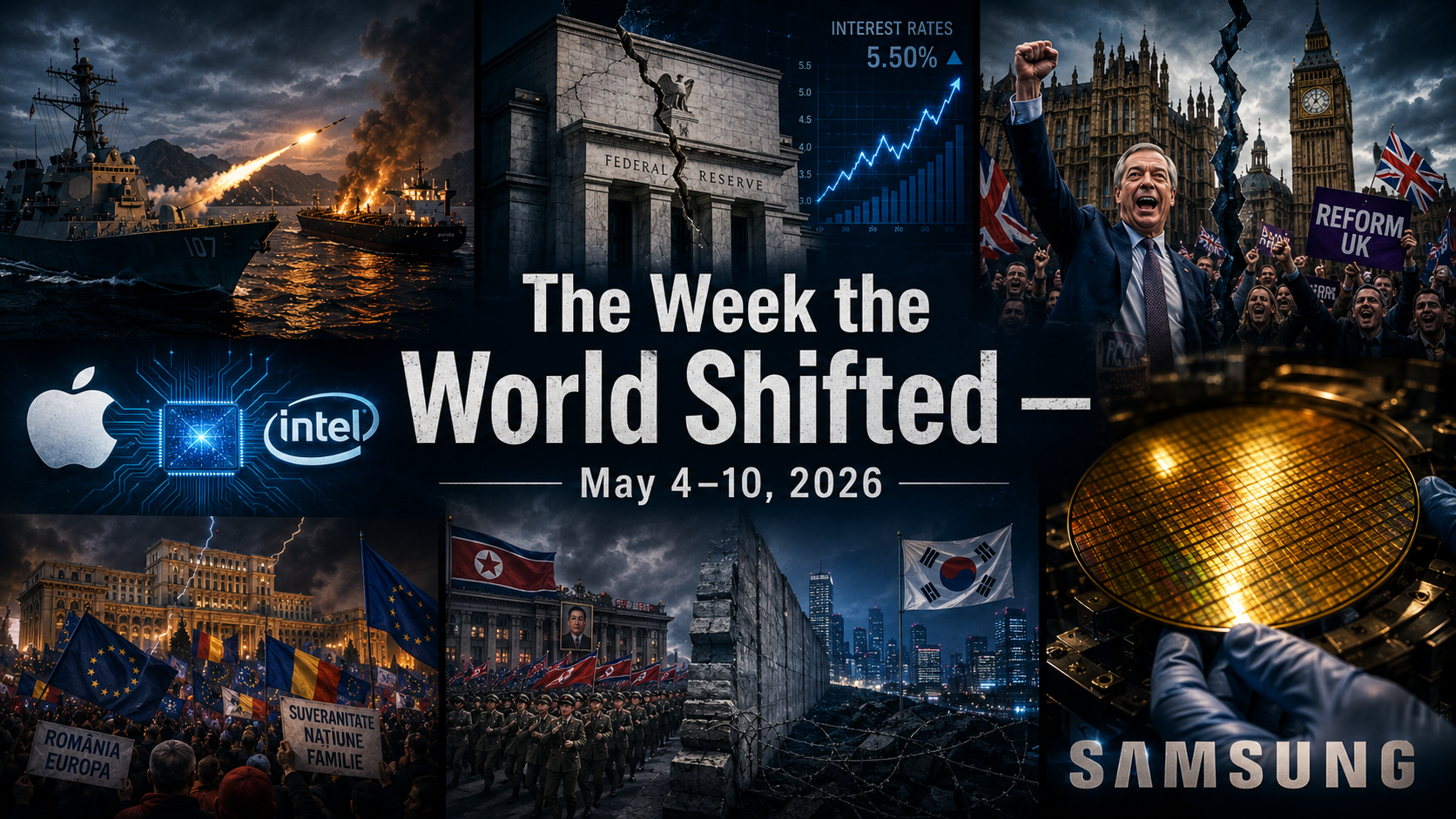
A ceasefire tested by tanker strikes and a bond market already pricing in war inflation. A political earthquake in Britain. A chip deal that reshapes an industry. A government toppled by an unlikely alliance. A peninsula legally redrawn without a single shot. And a semiconductor giant joining the most exclusive club in global finance. This is the week that was.
US Strikes Iranian Tankers as Ceasefire Hangs by a Thread
The already fragile ceasefire between the United States and Iran was pushed to its limits this week as US forces struck two Iranian-flagged oil tankers attempting to break the American blockade in the Gulf of Oman. US Central Command confirmed the strikes, adding that a third vessel had been disabled earlier in the week. Iran called the actions a flagrant ceasefire violation, while an adviser to Iran's Supreme Leader compared control over the Strait of Hormuz to an atomic bomb and vowed it would not be surrendered. President Trump insisted the ceasefire remained in effect while warning of far greater force if Tehran rejected a peace deal. Secretary of State Rubio said Washington expected a formal Iranian response on a peace proposal within hours. Over 22,500 mariners and 1,550 commercial vessels remain stranded in the Arabian Gulf. Oil fell more than 3% on peace hopes, but diplomacy and military escalation are now moving in parallel, at dangerous speed.
Iran War Could Force the Fed to Raise Rates, Pimco Warns
Pimco's Chief Investment Officer Dan Ivascyn issued one of the week's most consequential warnings: the Iran war may force the Federal Reserve to raise interest rates rather than cut them, reversing the trajectory markets had spent two years pricing in. The logic is direct. The closure of the Strait of Hormuz has driven energy costs sharply higher, and because oil cascades through the entire economy, from transportation to food production to manufacturing, the inflationary impact cannot be easily dismissed. The Federal Reserve held rates steady at 3.50%-3.75% at its April 29 meeting, but the vote came in at 8-4, with four FOMC members openly advocating for language signalling potential future hikes — a level of internal dissent not seen in over 30 years. Treasury markets are already reacting: two-year yields rose 10 basis points and 10-year yields climbed to 4.03%. Prediction markets now price a 43% probability of a rate hike before mid-2027. Before the Iran conflict, the dominant bet was on multiple cuts. The war has rewritten the script entirely.
Reform Storms England's Local Elections as Labour Suffers Historic Losses
Nigel Farage's Reform UK delivered what he called a historic shift in British politics, gaining over 600 council seats in England while Labour lost more than 450 and the Conservatives shed nearly 300. Reform took control of at least five councils, including Essex, where Tories had held power for 25 years, and made inroads into Labour's northern heartlands that pollsters compared to the party's worst local results since 1995. In Wigan, a Labour stronghold for over 50 years, the party lost every single one of the 20 seats it was defending to Reform. Prime Minister Starmer accepted responsibility but refused to resign, even as Labour MPs publicly called for a leadership timetable. The results confirmed what polls had been signalling for months: British politics has permanently fractured. Reform is now competitive in every region of England, the Liberal Democrats are on an eighth consecutive winning streak, and in Wales and Scotland, Labour faces further losses. Farage was unambiguous: politics, he said, is no longer about left and right.
Apple and Intel Reach Preliminary Chip-Making Deal, Sending Intel Shares Up 14%
Apple and Intel reached a preliminary agreement this week for Intel to manufacture chips used in Apple devices, the Wall Street Journal reported, confirming more than a year of intensive behind-the-scenes negotiations. Earlier analysis from Ming-Chi Kuo suggested the deal could initially cover lower-end M-series processors, with production on Intel's advanced 18A manufacturing node beginning as early as mid-2027. Intel shares surged more than 14% on the news, reaching a new all-time high; Apple rose approximately 2%. The deal is strategically significant on multiple levels: it gives Intel a marquee anchor customer for its revived foundry business, reduces Apple's dependence on TSMC at a time of sustained geopolitical pressure over Taiwan, and aligns with Washington's push to diversify chip manufacturing onto American soil. For Intel, landing Apple, the world's most strategically valuable chip buyer, is a credibility signal that no other contract could match.
Romanian PM Loses Confidence Vote as Socialists Team Up with Far Right
Romania's pro-European government collapsed this week after parliament passed a motion of no confidence against Prime Minister Ilie Bolojan with 281 votes, well above the 233 required. The motion was filed jointly by the Social Democratic Party and the far-right Alliance for the Unity of Romanians, a partnership that drew immediate condemnation from across Europe. The PSD's defection followed months of tensions over Bolojan's austerity agenda, aimed at reducing Romania's budget deficit, the largest in the EU at nearly 8% of GDP. As reform-driven pain eroded the PSD's voter base and support drifted toward the far right, the Socialists chose political survival over coalition loyalty. The Romanian leu fell to a historic low against the euro before the vote was even cast. Romania must now unlock roughly 10 billion euros in EU recovery funds before an August deadline, a task handed to an interim government with limited powers. The Atlantic Council warned that a mainstream left-wing party aligning with the far right carries implications far beyond Romania's borders.
North Korea Formally Drops Reunification Goal, Redrawing the Korean Peninsula
Pyongyang made it official this week: reunification is no longer a national objective. A revised North Korean constitution, shared by South Korea's Unification Ministry, removes all language calling for the peaceful reunification of the Korean Peninsula, language present in every version of the document since 1992. In its place, the document defines North Korea as a sovereign state that borders China, Russia, and the Republic of Korea, effectively recognising South Korea's existence in international law for the first time. The revision also places nuclear command authority directly under Kim Jong Un and removes the legislature's power to recall him. Analysts described the change as historically significant: for the first time, North Korea's legal framework treats the two Koreas as permanently separate states, with deep implications for denuclearisation talks, regional security, and the diplomatic framework in place since the 1953 armistice.
Samsung Crosses $1 Trillion Market Cap, Joining the World's Most Exclusive Club
Samsung Electronics crossed the trillion-dollar threshold this week, with shares surging nearly 15% on the Seoul Stock Exchange after a first-quarter earnings report showed operating profit rising more than eightfold year-on-year, driven by explosive demand for AI memory chips. The milestone makes Samsung only the second Asian company, after TSMC, to reach a $1 trillion market capitalisation, and pushed the South Korean benchmark Kospi index above 7,000 points for the first time in its history. The result places Samsung above Berkshire Hathaway in market value and reflects a broader structural shift: semiconductor companies are no longer cyclical suppliers but foundational infrastructure for the AI era. Bloomberg analysts project a further 30% upside over the next 12 months, as NAND and DRAM memory prices are expected to continue rising through 2027.
