
War, Virus, and a World on Edge: Monday, May 11, 2026
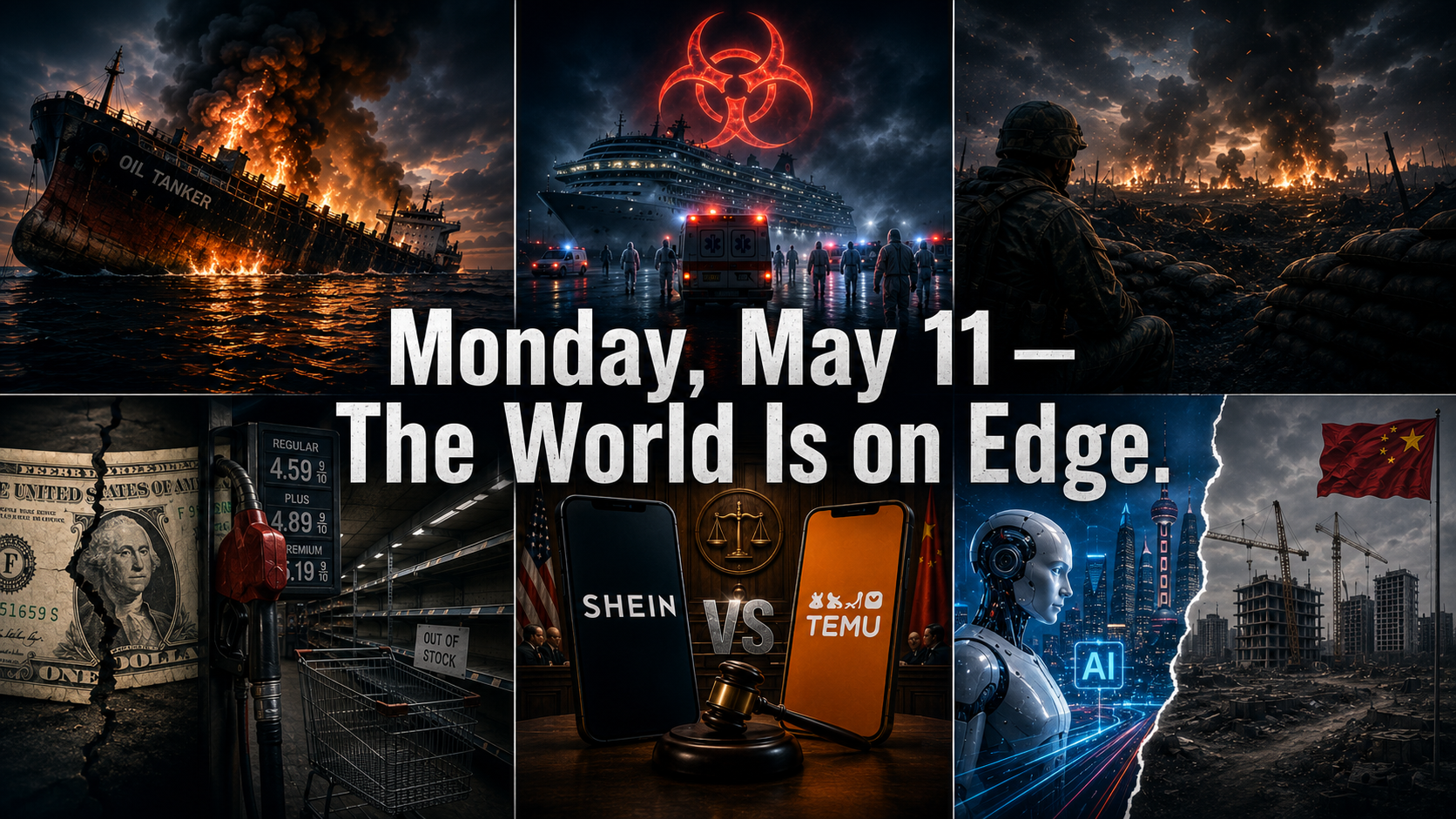
A week after the ceasefire, the world is still paying for the Iran war in ways that go far beyond the Strait of Hormuz. A hantavirus is now on American soil. The global oil market is heading toward a crisis that may not resolve until 2027. Ukraine is quietly preparing for a conflict without end. And two Chinese fast-fashion giants are fighting each other in a London court while their country's economy tells a story that no government press release can fully conceal. Here is what Monday brought.
Saudi Aramco Warns Fuel Stocks Are Heading for 'Critically Low Levels'
Saudi Aramco CEO Amin Nasser issued one of the starkest energy warnings of the Iran conflict on Monday, telling investors that global fuel inventories are drawing down at an accelerating pace and may reach critically low levels ahead of the summer driving and travel season. The oil market, he said, will not normalize until 2027 if the disruption in the Strait of Hormuz persists beyond mid-June. Every week the strait remains closed, the world loses approximately 100 million barrels of oil supply. The total net loss since the conflict began now stands at roughly 880 million barrels. The challenge, Nasser explained, is not only supply volume but logistics: the global tanker fleet is, in his words, completely mixed up, with vessels stranded in the wrong locations and unable to reposition quickly. Aramco itself has maximized alternative pipeline routes and ramped up production where possible, but Nasser was direct: even if the strait reopens today, it will take months to rebalance a market that has been deprived of close to one billion barrels of crude.
Fuel, Munitions and Food: Trump's Iran War Is Ripping Across the US Economy
Two months into the conflict, the economic toll of the Iran war on the United States is becoming impossible to dismiss. Gasoline has risen to a national average of $4.55 per gallon, an increase of more than a dollar since strikes on Iran began in late February, and diesel is averaging above $5 per gallon, driving up the cost of shipping everything from groceries to Amazon packages. Jet fuel has surged more than 85%, prompting airlines to raise ticket prices, cut routes, and introduce additional fees. Goldman Sachs estimates the US may run out of jet fuel as early as July if the conflict persists at its current intensity. The broader inflationary picture is deteriorating: the Consumer Price Index hit 3.3% in April on an annual basis, its highest level since 2024, and the Personal Consumption Expenditures index could reach 4% by year-end, double the Fed's target. Moody's Analytics chief economist Mark Zandi warned that the energy shock from the war threatens to do more economic damage than the tariffs that roiled 2025, further undermining growth and pushing inflation higher at the same time. Goldman Sachs puts recession risk at 30%, EY-Parthenon at 40%. The White House has called the disruptions temporary. Most economists are no longer sure.
Ukraine Is Preparing for a Long War With Russia as Peace Talks Stall
Behind the diplomatic activity of recent weeks, a starker reality is taking shape: Ukraine is preparing for a conflict that may have no foreseeable end. The New York Times reported Monday, citing sources familiar with Ukrainian military planning, that Kyiv has shifted its strategic posture toward long-term resilience rather than short-term negotiation, with officials privately concluding that peace talks, however dressed up in diplomatic language, are effectively dead for now. A three-day ceasefire brokered by President Trump covering May 9 to 11 has already seen accusations of violations from both sides, and the fundamental obstacles to a settlement remain unchanged: Russia demands recognition of all occupied territory and a permanent bar on NATO membership, while Ukraine and its European backers have made clear that territorial concessions remain off the table. Putin, according to Western assessments, sees little incentive to negotiate from a position he believes will only strengthen as time passes. Ukraine's energy infrastructure remains severely degraded after months of Russian strikes, with an energy expert estimating in March that only 30 to 40% of electrical capacity can be restored before next winter even in the best-case scenario. Europe's coalition of the willing is pressing ahead with security planning, but the political path to a durable settlement remains as opaque as at any point since 2022.
American Hantavirus Passengers Arrive in Nebraska After Positive Test on Return Flight
Eighteen American passengers evacuated from the hantavirus-stricken cruise ship MV Hondius landed at Omaha's Eppley Airfield early Monday morning after a State Department flight from Tenerife in Spain's Canary Islands. Sixteen were taken to the National Quarantine Unit at the University of Nebraska Medical Center, the only federally funded quarantine facility in the United States, which previously handled patients from the Diamond Princess cruise ship during the first wave of COVID-19 in 2020. One passenger, who tested positive for the Andes strain of hantavirus during the return flight but remains asymptomatic, was placed directly in a biocontainment unit. Two others, including one showing mild symptoms, were transferred to Emory University's Serious Communicable Diseases Unit in Atlanta for further assessment. The total case count from the outbreak has now risen to at least 10, including three deaths, since the MV Hondius departed Ushuaia, Argentina, on April 1. Health officials were careful to calibrate public messaging: the CDC has classified the response at Level 3, its lowest emergency tier, and both the agency and HHS stressed that the risk to the general public remains very, very low. The Andes virus is the only known strain of hantavirus capable of human-to-human transmission, but experts noted that in 30 years of studying the strain, no large outbreak has ever been recorded.
Shein Accuses Temu of 'Industrial-Scale' Copyright Violations at London High Court
A two-week trial opened at London's High Court on Monday in what has become one of the most consequential legal battles in global e-commerce: Shein versus Temu. Shein alleges that Temu used thousands of its proprietary product photographs to advertise copies of Shein's own-brand clothing, effectively piggybacking on a more established competitor to steal market share at scale. Shein's lawyer Benet Brandreth described the conduct as industrial-scale copyright infringement, noting that Temu has already dropped its defence to claims covering nearly 2,300 photos taken by Shein employees, a concession Brandreth compared to a defendant waiting to see if the witnesses turn up before pleading guilty. Temu denies the wider allegations and has counter-claimed, arguing that Shein is using litigation as a competitive weapon rather than a legitimate attempt to defend intellectual property, and that Shein has broken competition law by tying fast-fashion suppliers to exclusive agreements. The case is part of a broader global legal war between the two rivals, who have also filed suits against each other in the United States. Both companies have expanded rapidly in international markets on the back of ultra-low prices, but both now face a tougher regulatory environment: the US customs exemption on low-value parcels has already been removed, and the European Union is set to follow in July.
Xi's China: Dazzling Technology, Military Muscle — and an Economic Mess
A sweeping portrait of China published by the Wall Street Journal on Monday captured the central paradox of Xi Jinping's rule: a country that is simultaneously more technologically impressive and more economically troubled than at almost any point in its recent history. On one side of the ledger, China's AI sector is advancing at a pace that has alarmed Western policymakers, its electric vehicle industry has achieved global scale, and its military modernisation programme is progressing rapidly, with new aircraft carriers, hypersonic weapons, and advanced surveillance systems. On the other, consumer confidence has remained deeply depressed, the property sector has seen sales fall 65% from the 2020 peak, and youth unemployment among 18 to 24 year olds stood at 16.9% in 2025, a figure not expected to ease in 2026. Retail sales growth slowed to 0.9% year-on-year in December 2025, the slowest pace since the depths of the COVID lockdowns. The IMF projects Chinese growth at 4.5% for 2026, revised upward from earlier estimates, but economists note that headline GDP figures mask an economy characterised by persistent deflation, weak domestic demand, and a household sector that is saving rather than spending. Goldman Sachs estimates that as many as 20 million Chinese workers could lose their jobs as a result of declining exports to the United States. Xi's answer has been to pour investment into technology, AI, and manufacturing, building external strength while the internal economy remains fragile. Whether that bet pays off, or whether the contradictions eventually become unmanageable, is the defining question of his third term.
