
Fractures and Flashpoints: Politics, War, Markets and Technology in One Day
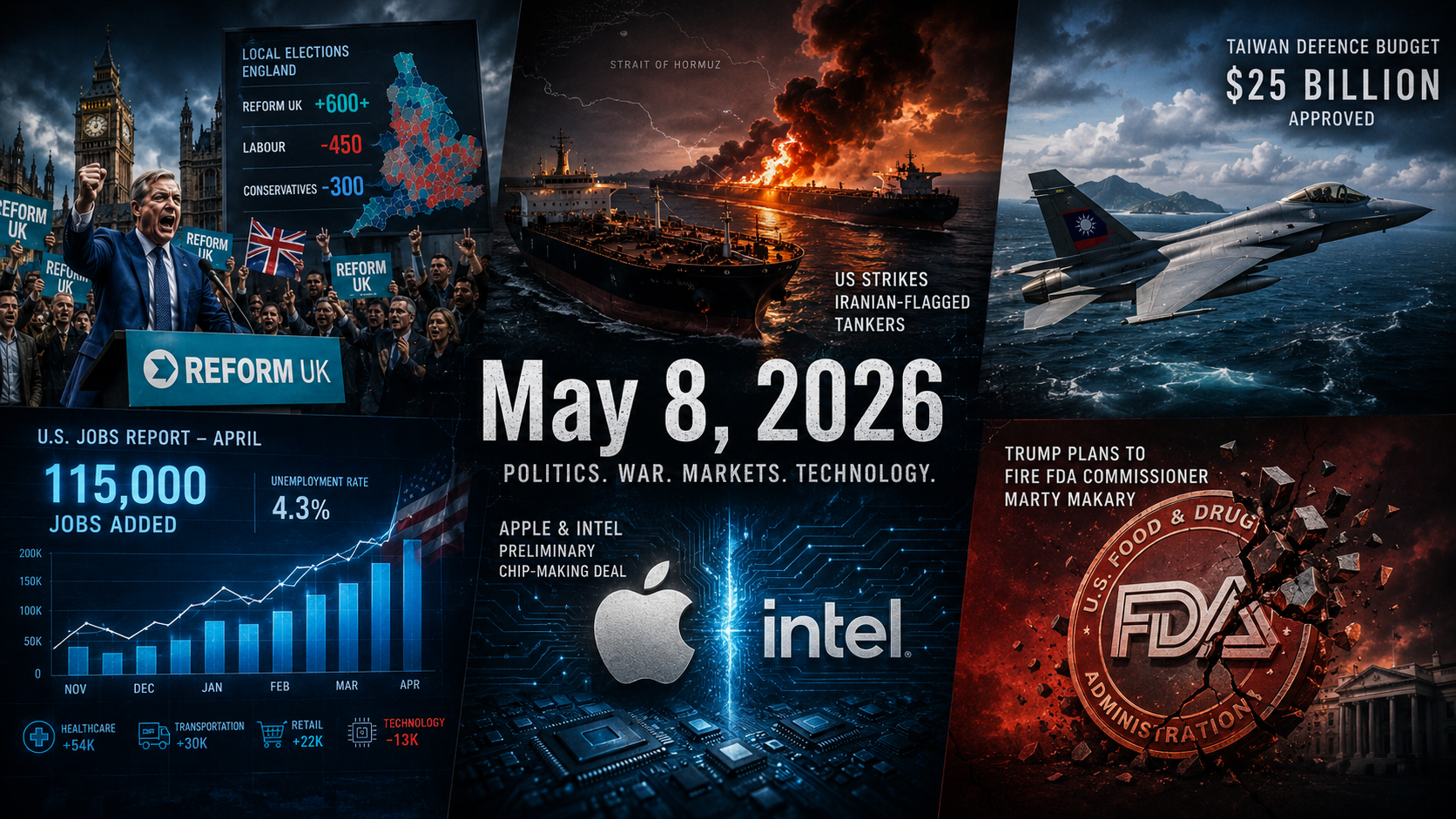
From a political earthquake in Britain to tanker strikes in the Strait of Hormuz, a Silicon Valley partnership decades in the making and a jobs report that defied the odds — Friday, May 8 arrived with no shortage of news. Here is what you need to know.
Reform Storms England's Local Elections as Labour Suffers Historic Losses
Nigel Farage's Reform UK delivered what he called a historic shift in British politics on Friday, gaining over 600 council seats across England while Labour lost more than 450 and the Conservatives shed nearly 300. Reform took control of at least five councils, including Essex, where Tories had held power for 25 years, and Havering in outer London. In Labour's northern heartlands, the losses were devastating: in Wigan, a seat held for over 50 years, Labour lost every one of the 20 seats it was defending to Reform. Prime Minister Starmer accepted responsibility but said he would not step down, even as several MPs publicly called for his resignation. British politics has fractured: Reform is now competitive across every region, the Lib Dems are on a winning streak, and in Wales and Scotland, Labour faces further losses. Farage was unambiguous: politics, he said, is no longer about left and right.
US Strikes Two Iranian-Flagged Tankers as Ceasefire Comes Under New Strains
The fragile ceasefire between the US and Iran was tested to its limits on Friday after US forces struck two Iranian-flagged oil tankers attempting to break the American blockade in the Gulf of Oman. US Central Command confirmed the strikes; a third Iranian vessel had already been disabled Wednesday. Iran called the actions a flagrant ceasefire violation and a breach of international law, while an adviser to Iran's Supreme Leader compared control over the Strait of Hormuz to an atomic bomb and vowed it would not be surrendered. Despite the escalation, Trump insisted the ceasefire remained in effect, warning Iran of far greater force if it rejects a peace deal. Secretary of State Rubio said Washington expected a formal response from Tehran by end of day. Oil prices fell more than 3% on peace hopes. The next 72 hours may determine whether this conflict de-escalates or enters a far more dangerous phase.
Taiwan Passes $25 Billion Defence Budget, Falling Short of President's Demands
Taiwan's opposition-controlled parliament approved a supplementary defence spending package of $25 billion on Friday, roughly two-thirds of the $39.8 billion requested by President Lai Ching-te. The ruling DPP had sought a larger package covering US arms and domestically produced weapons including drones. The opposition KMT and TPP passed their own scaled-back version covering US arms only, citing transparency concerns. The DPP warned that the reduced budget creates security gaps at precisely the moment China's military modernisation is accelerating. For Washington, which has pushed Taiwan to significantly increase defence spending, the $25 billion represents progress, even if it falls short of what Taipei's government deemed necessary.
U.S. Adds 115,000 Jobs in April, Nearly Double Forecasts Despite Iran War Uncertainty
The US economy added 115,000 jobs in April, nearly double the 62,000 economists had forecast and the second consecutive month of stronger-than-expected payroll growth. The unemployment rate held at 4.3%. Healthcare led with 54,000 additions, followed by transportation with 30,000 and retail with 22,000. Technology shed 13,000 positions, extending a contraction that has eliminated roughly 11% of the sector's workforce since 2022. Analysts cautioned against over-optimism: the three-month average is running at just 48,000 per month, and the hiring diffusion index fell compared to March, signalling that job creation is becoming increasingly concentrated. Gas remains at a national average of $4.55 per gallon, a direct consequence of the Iran conflict.
Apple and Intel Reach Preliminary Chip-Making Deal, Sending Intel Shares Up 14%
Apple and Intel have reached a preliminary agreement for Intel to manufacture chips used in Apple devices, the Wall Street Journal reported Friday. Talks had been underway for more than a year. Earlier reporting from analyst Ming-Chi Kuo suggested the deal could initially cover lower-end M-series processors, with production beginning as early as mid-2027 on Intel's 18A node. Intel shares surged more than 14% on the news; Apple rose approximately 2%. The deal is strategically significant on multiple levels: it gives Intel an anchor customer for its revived foundry business, reduces Apple's dependence on TSMC, and aligns with both the Trump and Biden administrations' push to diversify chip manufacturing away from Taiwan and onto US soil.
Trump Plans to Fire FDA Commissioner Marty Makary
President Trump has signed off on a plan to fire FDA Commissioner Marty Makary, the Wall Street Journal reported Friday, though the decision is not yet final. Makary, a Johns Hopkins surgical oncologist confirmed in March 2025, has faced sustained pressure from multiple directions: pro-life groups frustrated with his handling of abortion medications, industry leaders citing regulatory unpredictability, and the White House angered by his resistance to fast-tracking flavored e-cigarette approvals, a campaign promise Trump made in 2024. Top officials have departed his agency citing leadership failures. The combination of pressures from all flanks has left Makary with few defenders inside the administration heading into the 2026 midterms.
