
Diplomacy, Markets and War: When Allies Draw the Line
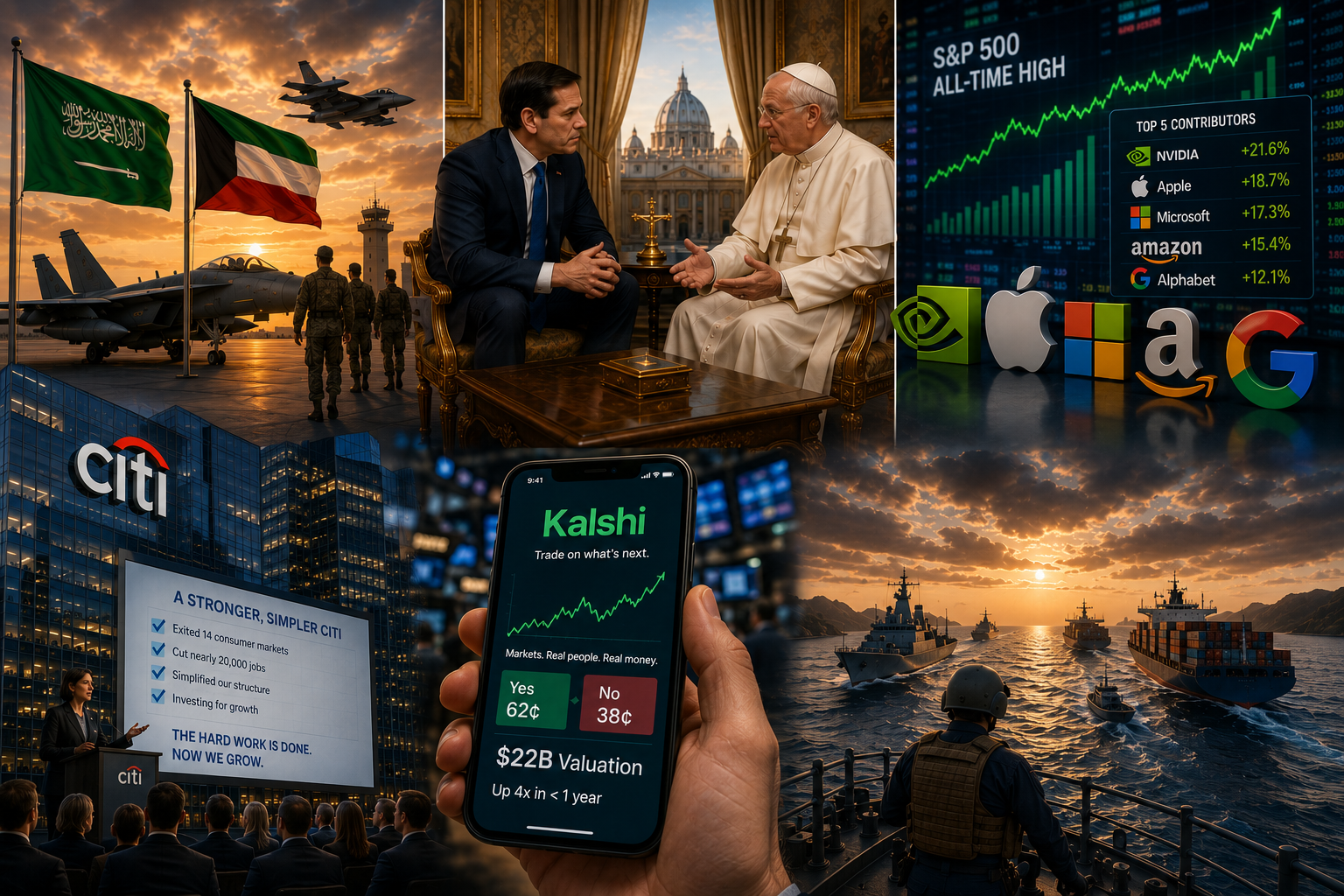
Allies push back, markets rally on the thinnest of foundations, a bank tries to close a decade-long credibility gap, and a prediction platform becomes one of Wall Street's hottest bets. Here is what moved the world today.
Saudi Arabia and Kuwait Restore US Military Access, Reviving Project Freedom
After a diplomatic standoff that briefly paralyzed one of Washington's most consequential military operations, Saudi Arabia and Kuwait have lifted their restrictions on U.S. military access to their bases and airspace, clearing the path for a potential restart of Project Freedom, the operation designed to escort commercial shipping through the Strait of Hormuz. The reversal follows an extraordinary breakdown that unfolded earlier this week, when both Gulf states suspended access after President Trump announced the operation on social media without adequate coordination with regional partners. Saudi Arabia withdrew permission for U.S. aircraft to operate from Prince Sultan Airbase and through Saudi airspace, while Kuwait cut off overflight rights, leaving the operation without the defensive umbrella it needed to function.
The episode laid bare the operational dependencies at the heart of American military power projection in the Gulf. Fighter jets, refueling tankers, and support aircraft all require access, basing, and overflight rights from regional allies, without which the U.S. cannot provide the air cover necessary to protect ships transiting the strait. A call between Trump and Saudi Crown Prince Mohammed bin Salman failed to resolve the issue at the time, and the operation was paused. Now, with access restored and the Wall Street Journal reporting that Washington is actively looking to restart Project Freedom, the pressure returns to the diplomatic track: over 22,500 mariners and 1,550 commercial vessels remain stranded in the Arabian Gulf, and the Strait of Hormuz, which normally carries roughly 20% of the world's oil supply, remains effectively blocked.
In Rome, Rubio Tries to Calm Waters After Weeks of Trump-Pope Tensions
Secretary of State Marco Rubio met with Pope Leo XIV at the Vatican on Thursday in a visit widely interpreted as Washington's attempt to de-escalate one of the most unusual diplomatic rifts in recent memory: a sustained public feud between a U.S. president and the first American-born pope in the history of the Catholic Church. The meeting, which lasted roughly two and a half hours and also included Vatican Secretary of State Cardinal Pietro Parolin, came after weeks of increasingly pointed exchanges. Trump accused Leo of being weak on crime, sympathetic to Iran's nuclear ambitions, and of catering to the radical left. Leo responded without naming Trump directly, insisting that the mission of the Church is to preach the Gospel and peace, and that he had no fear of the administration.
The rift has its roots in Leo's consistent criticism of the U.S. military operation against Iran, which he has called deeply troubling, as well as his defense of migrants and refugees at a time of maximum tension with the White House on immigration. Rubio, a devout Catholic and the most prominent Catholic in the Trump cabinet, was seen as the natural choice to attempt to lower the temperature. Vatican observers described the visit as an effort to return the confrontation to a quieter, more institutional register. The two sides found common ground on religious freedom, humanitarian efforts in the Western Hemisphere, and Cuba policy. But the underlying disagreements, on war, migration, and the use of religious language to justify military action, remain unresolved. The Vatican has confirmed there will be no papal visit to the United States in 2026.
Wall Street's Rebound Is Being Driven by the Fewest Stocks on Record
The S&P 500, Nasdaq, and Dow Jones Industrial Average all closed at record highs on Wednesday, fueled largely by hopes of a U.S.-Iran peace deal and strong earnings from a handful of mega-cap technology companies. But the Financial Times has flagged a striking detail beneath the headline numbers: more than half of the S&P 500's gains came from just five stocks, Alphabet, Broadcom, Amazon, Nvidia, and Apple, representing the narrowest market rally on record by that measure. The five companies posted gains ranging from approximately 12% to 24%, and their outsized weighting in the index meant their performance dominated the aggregate figures even as most of the market's 500 components contributed little.
Analysts are divided on what to make of the concentration. The bullish case is straightforward: these companies reported strong earnings despite geopolitical chaos, and their fundamentals justify the premium. The bearish concern is structural. A rally built on five stocks, all of them AI-adjacent and all of them exposed to any deterioration in the geopolitical situation, is a fragile foundation for record highs. If peace negotiations falter, or if any of these companies disappoint in the next earnings cycle, the index has limited cushion from the rest of its components. Markets are also now pricing in a U.S.-Iran framework deal, with oil prices falling sharply on those expectations. The gap between that expectation and reality is one the market may not be prepared to absorb.
Citi Holds Investor Day, Argues the Hard Work of Turnaround Is Done
Citigroup CEO Jane Fraser hosted an investor day on Thursday aimed at persuading Wall Street that the most painful phase of the bank's multi-year restructuring is now complete and that the institution is ready to grow. The message was carefully framed: after exiting 14 international consumer markets, cutting nearly 20,000 jobs, eliminating dozens of internal committees, and simplifying a famously complex organizational structure, Citi is presenting itself as a leaner, more focused, and meaningfully more profitable bank. Its stock hit a 20-year high after first-quarter earnings in April showed operating profits surge, and the bank's return on tangible common equity, long the metric most cited by critics of Citi's chronic underperformance, is now approaching the targets Fraser set when she took over in 2021.
The market's reaction on Thursday was more cautious. Citi unveiled new medium-term financial targets that, while positive, remain well below those of peers like JPMorgan Chase, which posted a 20% return on tangible equity last year. Investors had hoped for more aggressive guidance. The tension at the heart of Thursday's presentation is the same one that has defined Citi's story for years: the bank has demonstrably improved, but the gap to its closest rivals remains substantial, and Fraser's argument is that the hard, restructuring-driven phase of the work is over, while the growth phase is just beginning. Whether the market believes that story, or whether it assigns Citi the same skeptical discount it has for two decades, will determine the stock's trajectory through the rest of 2026.
Kalshi's Valuation Quadruples to $22 Billion as Prediction Markets Enter the Mainstream
Kalshi, the New York-based prediction market platform, confirmed Thursday that it has raised $1 billion in a Series F round led by Coatue Management and including Sequoia Capital, Andreessen Horowitz, Paradigm, IVP, Morgan Stanley, and ARK Invest, at a valuation of $22 billion. The figure represents a quadrupling of its valuation in less than a year, and a doubling from its $11 billion valuation established just five months ago in December 2025. The growth story behind the number is compelling: institutional trading volume on the platform surged 800% over the past six months, and annualized trading activity more than tripled, from $52 billion to $178 billion. Kalshi now claims over 90% of U.S. prediction market activity and more than $1.5 billion in annualized revenue.
The fundraise reflects a broader and rapid mainstreaming of prediction markets as financial instruments. What began as platforms for retail traders to bet on political and sports outcomes has evolved into a serious hedging and price-discovery tool for institutional investors. Kalshi CEO Tarek Mansour compared the category's growth trajectory to AI, describing event contracts as a potential trillion-dollar market still in its early stages. The company faces real headwinds: Arizona filed criminal charges against Kalshi for allegedly operating an unlicensed wagering business, and more than 20 lawsuits are pending across multiple states over the platform's legal status. Kalshi's position, supported by a favorable regulatory interpretation from the CFTC, is that it operates a federally regulated commodities exchange, not a gambling operation. That legal question will shape the future of the entire industry.
