
Tech, Space, Crypto, Politics and War: The Forces Rewriting the World
Not all news days are equal. Today, the lines between rivals blur, old certainties disappear, and markets rewrite the rules faster than anyone can keep up. Here is what you need to know.
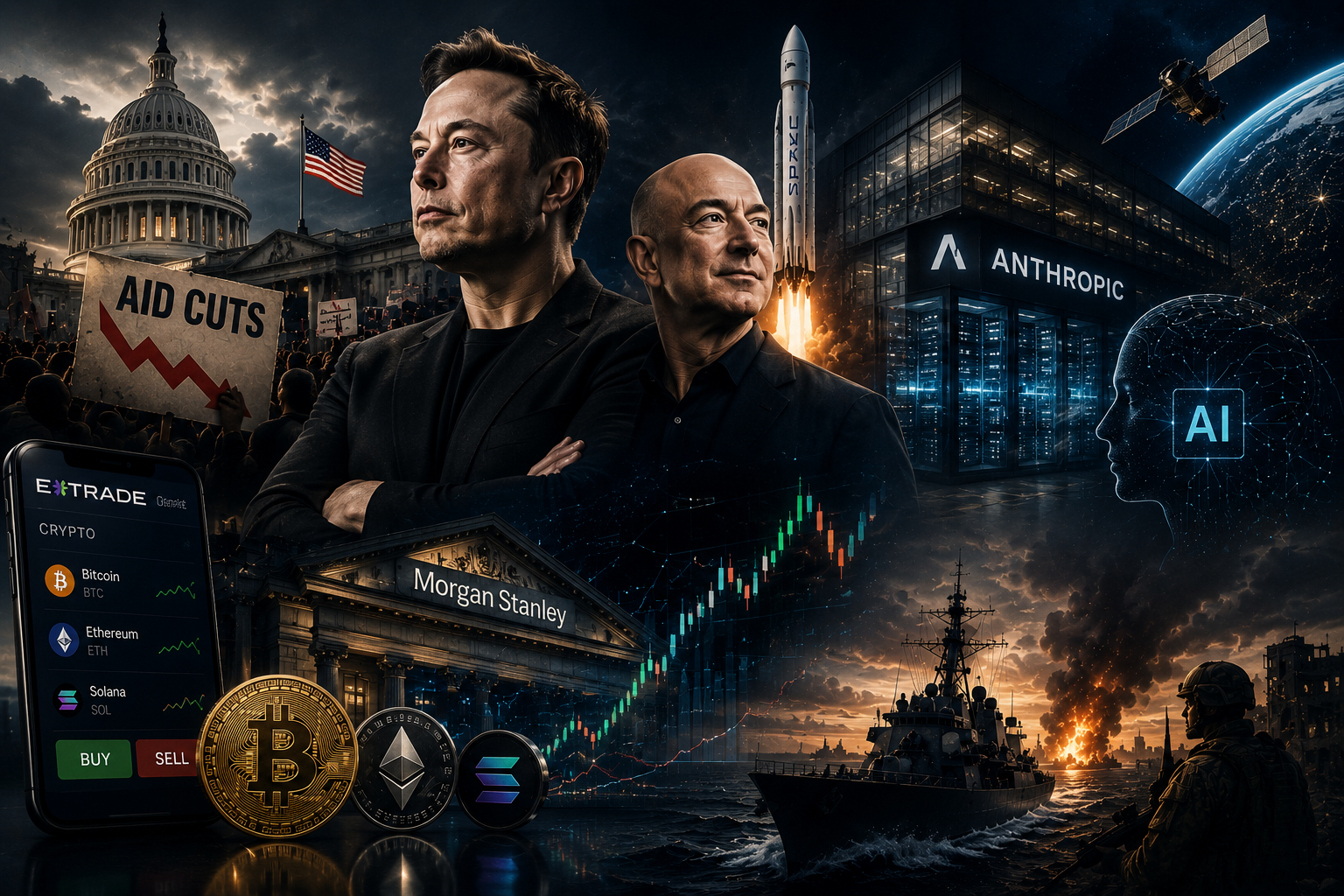
Republicans Mount $8M Midterms Push to Roll Back Musk's Aid Cuts
A coalition of Republican-aligned groups has assembled an $8 million campaign fund targeting the 2026 midterm elections, with the explicit goal of reversing some of the most controversial aid cuts carried out under Elon Musk's Department of Government Efficiency. The initiative reflects a growing fracture within the GOP between those who championed DOGE's aggressive cost-cutting agenda and those now facing the electoral consequences of it. Foreign aid reductions, cuts to public broadcasting, and the slashing of overseas development programs have become liabilities in competitive districts, particularly among moderate Republican voters and suburbanites who supported Trump in 2024 but grew wary of DOGE's reach.
The campaign comes as Musk himself has returned to active Republican fundraising, having contributed over $20 million to House and Senate GOP super PACs by the end of 2025 and a further $10 million to the Kentucky Senate race. The irony is not lost on political analysts: Republican candidates are simultaneously accepting Musk's money and running against the policy legacy of the organization he led. The dynamic underscores just how complicated Musk's role has become within the party, and how the 2026 midterms are shaping up to be, in part, a referendum on DOGE itself.
SpaceX and Anthropic Sign Landmark Compute Deal, Including Space-Based AI Plans
In a partnership that would have seemed implausible a year ago, Anthropic has struck a deal with Elon Musk's SpaceX to access the full compute capacity of Colossus 1, SpaceX's flagship AI data center in Memphis, Tennessee. The agreement gives Anthropic access to more than 300 megawatts of capacity across over 220,000 Nvidia GPUs, encompassing H100, H200, and GB200 accelerators. Anthropic said the deal will substantially expand its infrastructure and immediately lift rate limits for Claude Pro, Max, Team, and Enterprise subscribers. The announcement was made at Anthropic's developer conference in San Francisco by head of product Ami Vora.
The partnership is striking given the competitive tension between the two companies. Musk, who merged SpaceX with his AI startup xAI earlier this year, has been a vocal critic of Anthropic. Yet commercial necessity appears to have overridden rivalry: Anthropic has been struggling with infrastructure strain as demand for Claude surges, while Colossus 1 has significant spare capacity following xAI's decline in model usage and market share. In an additional forward-looking element, Anthropic also expressed interest in partnering with SpaceX to develop multiple gigawatts of orbital AI compute capacity, as the companies explore the possibility of space-based data centers. The deal adds to Anthropic's existing compute agreements with Amazon, Google, Microsoft, and Fluidstack, collectively representing one of the largest infrastructure buildouts in AI history.
Morgan Stanley Launches Spot Crypto Trading on E*Trade, Undercutting Rivals
Wall Street's entry into retail cryptocurrency is accelerating. Morgan Stanley has begun rolling out spot crypto trading on its E*Trade platform, currently in a pilot phase for a select group of users, with a full rollout to all 8.6 million E*Trade clients expected before the end of 2026. The bank is charging 50 basis points per transaction, a fee structure that undercuts Coinbase, Schwab, which charges 75 basis points on its newly launched crypto product, and Fidelity, which charges roughly 1% per trade. Liquidity, custody, and settlement are handled by Zerohash, a crypto infrastructure provider in which Morgan Stanley has also made a direct equity investment. At launch, the offering covers Bitcoin, Ether, and Solana.
The move is more than a product launch. Morgan Stanley's head of wealth management Jed Finn framed it as an effort to disintermediate the disintermediators, signaling that the bank sees this as a structural repositioning rather than a niche offering. The bank oversees roughly $9.3 trillion in client assets through some 16,000 advisers, giving it distribution reach that dedicated crypto exchanges cannot match. Morgan Stanley is also applying for a national trust bank charter that would enable it to directly custody digital assets, exploring crypto-to-ETF conversion services, and preparing for potential tokenized equity trading later this year. The aggressive pricing and infrastructure ambition suggest the bank is willing to compress margins now to capture retail crypto market share before peer institutions respond.
Bezos Overhauls Blue Origin Incentives as SpaceX Targets $1.75 Trillion IPO
The space race is also a talent race. Jeff Bezos has moved to overhaul Blue Origin's employee stock incentive program following widespread internal frustration over a compensation structure that had left many workers watching their options expire without any payout. The previous plan limited stock payouts exclusively to IPO or sale events, a structure that grew increasingly untenable as SpaceX, Blue Origin's primary competitor, allowed employees to cash out shares via secondary sales during funding rounds, providing real financial returns well before any public listing. Blue Origin briefed staff last week on a revamped plan that significantly expands the range of liquidity events that can trigger stock payouts, bringing its compensation model closer in line with SpaceX's more generous approach.
The timing is no accident. SpaceX has recently filed for a U.S. initial public offering targeting a valuation of approximately $1.75 trillion, a move that has intensified competition for aerospace engineering talent across the industry. For Blue Origin, the stakes extend beyond retention: the company is competing with SpaceX for NASA contracts, launch market share, and the long-term credibility needed to attract the capital its ambitions require. Bezos, who has invested over $10 billion of his personal fortune into Blue Origin, appears to have concluded that world-class rockets require world-class incentives, and that the gap between the two companies on compensation had become a structural liability.
North Korea Formally Abandons Reunification, Redefines South Korea as a Separate State
North Korea has formally erased reunification from its national ambition. A revised constitution, shared at a press conference by South Korea's Unification Ministry on Wednesday, removes all language calling for the peaceful reunification of the Korean Peninsula, language that had appeared in every version of North Korea's constitution since a 1992 revision. In its place, the document defines North Korea's territory as a distinct, sovereign state bordering China and Russia to the north and the Republic of Korea to the south. The revision also elevates Kim Jong Un's position to head of state and formally places command of North Korea's nuclear forces under his direct authority, while removing the legislature's power to recall him from office.
The constitutional change formalizes a policy shift Kim first announced in 2024, when he designated South Korea as an adversary and abandoned Pyongyang's long-standing goal of unification. Analysts describe the revision as historically significant: for the first time, North Korea's legal framework recognizes South Korea's existence as a separate state in international law, even as it stops short of formally labeling Seoul as an enemy. The omission of the disputed maritime Northern Limit Line from the territorial clause is seen as deliberate, preserving strategic ambiguity. Oxford University lecturer Edward Howell told Newsweek that in North Korea's eyes, the two Koreas are no longer part of the same country, and that perception is now permanent. The revision has deep implications for regional security, for the prospects of denuclearization, and for the diplomatic framework that has governed the peninsula since the 1953 armistice.
Samsung Crosses $1 Trillion Market Cap, Becomes Second Asian Company to Reach the Milestone
Samsung Electronics has joined the trillion-dollar club. Shares in the South Korean tech giant surged nearly 15% on the Seoul Stock Exchange on Wednesday, pushing its market capitalization past $1.04 trillion and making it only the second Asian company, after Taiwan Semiconductor Manufacturing Company (TSMC), to reach that threshold. The milestone also pushed the South Korean benchmark Kospi index above 7,000 points for the first time in its history. The surge follows Samsung's first-quarter 2026 earnings report, which showed operating profit rising more than eightfold compared to the same period last year, driven almost entirely by explosive demand for AI memory chips used in data center infrastructure. Analysts now expect further price increases for NAND and DRAM memory through 2027 as supply constraints persist.
Samsung's ascent reflects a broader structural shift in the global economy, one in which semiconductor companies are no longer cyclical hardware suppliers but foundational infrastructure providers for the AI era. Together with TSMC and SK Hynix, Samsung sits at the center of a supply chain that every major AI lab, cloud provider, and hyperscaler depends on. The trillion-dollar valuation places Samsung above Berkshire Hathaway in market capitalization and just below Walmart. Bloomberg analysts project the stock could rise a further 30% over the next 12 months. In a striking parallel to the AI deal-making reshaping Silicon Valley, Apple has also reportedly held preliminary discussions with Samsung about potentially manufacturing processors for Apple devices in the United States, offering a strategic alternative to its longtime partner TSMC.
