
The Camera That Scared the Kremlin: Monday, June 8, 2026
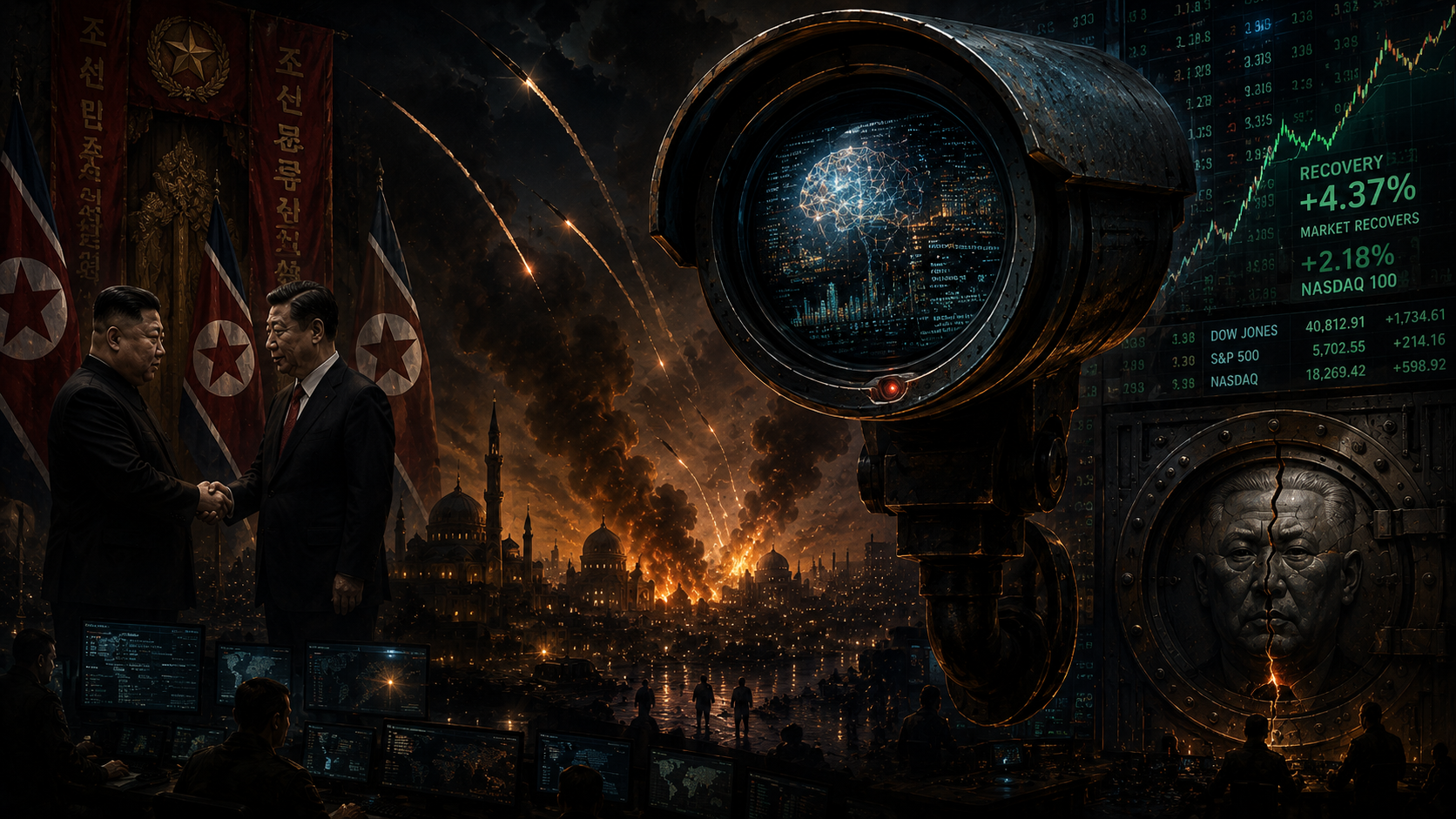
The guns fell silent — for now. After a night of missiles over Tehran and Israeli warplanes carving through Iranian airspace, both sides stepped back from the edge on Monday afternoon: Iran declared its military operation finished, and Netanyahu, at Trump's personal request, stood down. Markets exhaled. The Nasdaq, which had endured its worst session in over a year on Friday following a collapse in AI chip sentiment, clawed back more than a percent as Micron and Marvell led a sharp semiconductor rebound. Across the Pacific, Xi Jinping's motorcade moved through the streets of Pyongyang, the Chinese president touching North Korean soil for the first time in seven years, arriving to greet a Kim Jong Un freshly emboldened by the disclosure of a new nuclear enrichment facility. In a federal penitentiary, Sam Bankman-Fried filed a formal pardon application with the Justice Department, making his long-rumored bid official. And quietly, in a story that may carry the greatest long-term weight of all, the Financial Times reported that Russia's security services shut down parts of their own surveillance apparatus — afraid, for the first time, of what their cameras could see in the wrong hands. Monday, June 8, 2026.
The Ceasefire Holds — Barely
It took a direct call from Donald Trump to pull both Israel and Iran back from what was shaping up to be a serious escalation. After Iran launched roughly thirty ballistic missiles at Israel on Sunday — retaliation for Israeli strikes on Lebanon that Tehran accused of violating ceasefire terms — Israel responded overnight with a multi-wave aerial campaign targeting Iranian air defense installations in Tehran, Tabriz, Isfahan, and the Mahshahr petrochemical complex in the south. By Monday morning, the 100th day of the war that began on February 28, both sides had demonstrated they were still capable of significant damage. By Monday afternoon, both sides chose not to press further.
Iran's announcement was careful in its framing: it had "ended its military operation," but would respond with "harsher attacks" if Israel committed further acts of aggression — particularly in southern Lebanon. Netanyahu accepted Trump's request to stand down, according to Israeli media, though his public statement left room for future strikes, declaring Iranian territory and Hezbollah targets would be hit again "if attacked." Trump's social media post — "Israel and Iran must immediately stop 'shooting'" — was blunter than his diplomatic messaging, and apparently more effective.
The structural fragility here has not changed. The ceasefire brokered in April was always built on mutual exhaustion rather than any underlying resolution. Lebanon remains the tripwire: both sides have competing red lines there, and neither has retreated from the positions that ignited Sunday's exchange. Energy markets reflected this unease — Brent crude, which had spiked toward $95 overnight, retreated but remained elevated, signaling that traders are not pricing in a durable peace. The guns are down. The hands are still on the triggers.
Wall Street Bounces, but the AI Trade Is Now Being Questioned
The rebound on Monday was real but measured. The S&P 500 gained 0.7%, the Nasdaq Composite climbed 1.1%, and the Dow added around 200 points — a partial recovery from Friday's rout, which had been the index's worst single session since October. The leading movers told the story: Micron Technology jumped 8.3% after plunging 13.3% on Friday, and Marvell Technology surged 8.8% following the announcement that it would join the S&P 500 index. Both are semiconductor companies whose fortunes are deeply tied to AI infrastructure investment.
The question the bounce doesn't answer is whether Friday's selloff was a correction or a reckoning. The AI trade — the bet that insatiable demand for compute would drive indefinite earnings growth in chipmakers — has powered an enormous portion of equity market gains since 2023. Broadcom's guidance miss, which triggered Friday's collapse, cracked the assumption at the center of that trade: that the gap between AI investment and AI monetization was a problem that would resolve itself in time. For now, it has not.
The partial recovery on Monday was aided by a de-escalation in the Middle East that eased energy price pressure, and by a degree of technical buying in oversold semiconductor names. Whether that constitutes a genuine reappraisal of AI valuations or simply a reflexive bounce will become clear as the week progresses. Earnings season is approaching, and the questions Broadcom raised will need answers from Nvidia, Microsoft, and others before investor confidence in the sector's trajectory can be properly restored.
SBF Makes the Pardon Bid Official
Sam Bankman-Fried, serving a 25-year sentence for fraud and conspiracy following the collapse of FTX, has formally submitted a clemency petition to the Justice Department's Office of the Pardon Attorney. The application, which had been rumored for months, makes official what has long been a low-grade lobbying campaign: Bankman-Fried and his parents have sought allies, echoed Trump-adjacent positions, and cultivated media attention toward the goal of a presidential intervention.
The odds appear long. Trump has been explicit on multiple occasions that Bankman-Fried should not expect clemency, and the White House reiterated that position this week. The contrast with the president's other crypto-related pardons is instructive: Ross Ulbricht, whose Silk Road sentence carried libertarian symbolism; Changpeng Zhao, whose Binance empire remains a force in the industry; the BitMEX founders, whose cases carried technical legal ambiguity. Bankman-Fried's situation is different — his crimes were intimate, his victims numerous, his public image defined by a spectacular collapse that wiped out billions in customer funds. He does not fit the mold of the crypto martyr, and Trump has shown little appetite for a pardon that would generate more political cost than it delivers.
Still, the formal filing matters. It keeps the possibility alive, activates a legal process, and gives Bankman-Fried's team a procedural mechanism through which to apply continued pressure. Given Trump's history of surprising clemency decisions, nothing is fully foreclosed. But the White House's signal is clear, and the petition faces steep terrain.
The Camera That Scared the Kremlin
Of all the stories to emerge from the expanding Israel-Iran war, this one may prove the most consequential beyond the conflict itself. According to a Financial Times investigation, Russian security services quietly shut down significant portions of their own national surveillance infrastructure after learning how Israeli intelligence exploited Iran's traffic and security camera network to locate Ayatollah Khamenei and plan his assassination on February 28. The FSB director, Alexander Bortnikov, warned regional security chiefs directly: the vast camera grids that authoritarian states have built to monitor their own populations have become a vulnerability — a back door through which adversaries can walk.
The details of the Israeli operation are remarkable. AI systems parsed millions of hours of video from thousands of Iranian surveillance cameras, cross-referencing footage to identify patterns, locations, and ultimately the precise timing and route of Khamenei's movements. The assassination that resulted was not primarily a feat of human intelligence — it was a feat of machine learning applied to a surveillance network that its operators believed was theirs alone. Israel had found a way in. And Russia, reviewing the architecture of its own system, concluded that it might not be immune to the same approach.
The implications extend far beyond the Kremlin's immediate fear. Authoritarian regimes have spent the past two decades building surveillance states premised on asymmetric visibility — they can see their citizens; their adversaries cannot see them. The Khamenei assassination has inverted that assumption. The cameras go up in the name of control; the AI now decides who is watching whom. Putin's apparatus has been forced to confront a truth that democratic societies have long argued: the tools of surveillance, once built, do not remain in the hands of those who built them forever. The security services that switched off their cameras did so not out of principle, but out of fear. That, in its own way, is a form of accountability.
Xi in Pyongyang: A Visit Framed by Uranium
The optics of Xi Jinping's arrival in Pyongyang were, by design, traditional — a state welcome, a motorcade, the choreography of socialist brotherhood. The context was anything but. One day before Xi landed, North Korea chose to publicly reveal a new facility for producing nuclear bomb material, a disclosure timed with unmistakable deliberateness. Kim Jong Un arrived at this meeting not as a supplicant seeking China's blessing, but as the leader of a declared nuclear state, signaling that Beijing's patronage, however valuable, does not define Pyongyang's strategic ceiling.
For Xi, the visit serves multiple purposes simultaneously. It is an attempt to reassert Chinese primacy in a relationship that Russia has been steadily encroaching upon — North Korea has supplied Moscow with artillery shells and ballistic missiles throughout the Ukraine war, receiving military technology and economic sustenance in return. It falls on the 65th anniversary of the Sino-North Korean mutual defense treaty, lending diplomatic gravity. And it allows Beijing to position itself, at least symbolically, as a stabilizing force on the peninsula at a moment when the nuclear disclosure will alarm Washington, Seoul, and Tokyo in equal measure.
Whether Xi extracts meaningful concessions — a slowdown in North Korea's nuclear program, limits on its Russia relationship, a return to even nominal engagement with denuclearization — remains to be seen. Kim has become adept at accepting China's attention while yielding little in return. The two days of talks will be closely read for any communiqué language that suggests movement. More likely, the summit will end with warm words and a relationship that is publicly reinforced but privately strained — a dynamic that has defined Sino-North Korean relations for much of the past decade.
