
Red Screens, Open Water, and Europe Without a Jet: Tuesday, June 9, 2026
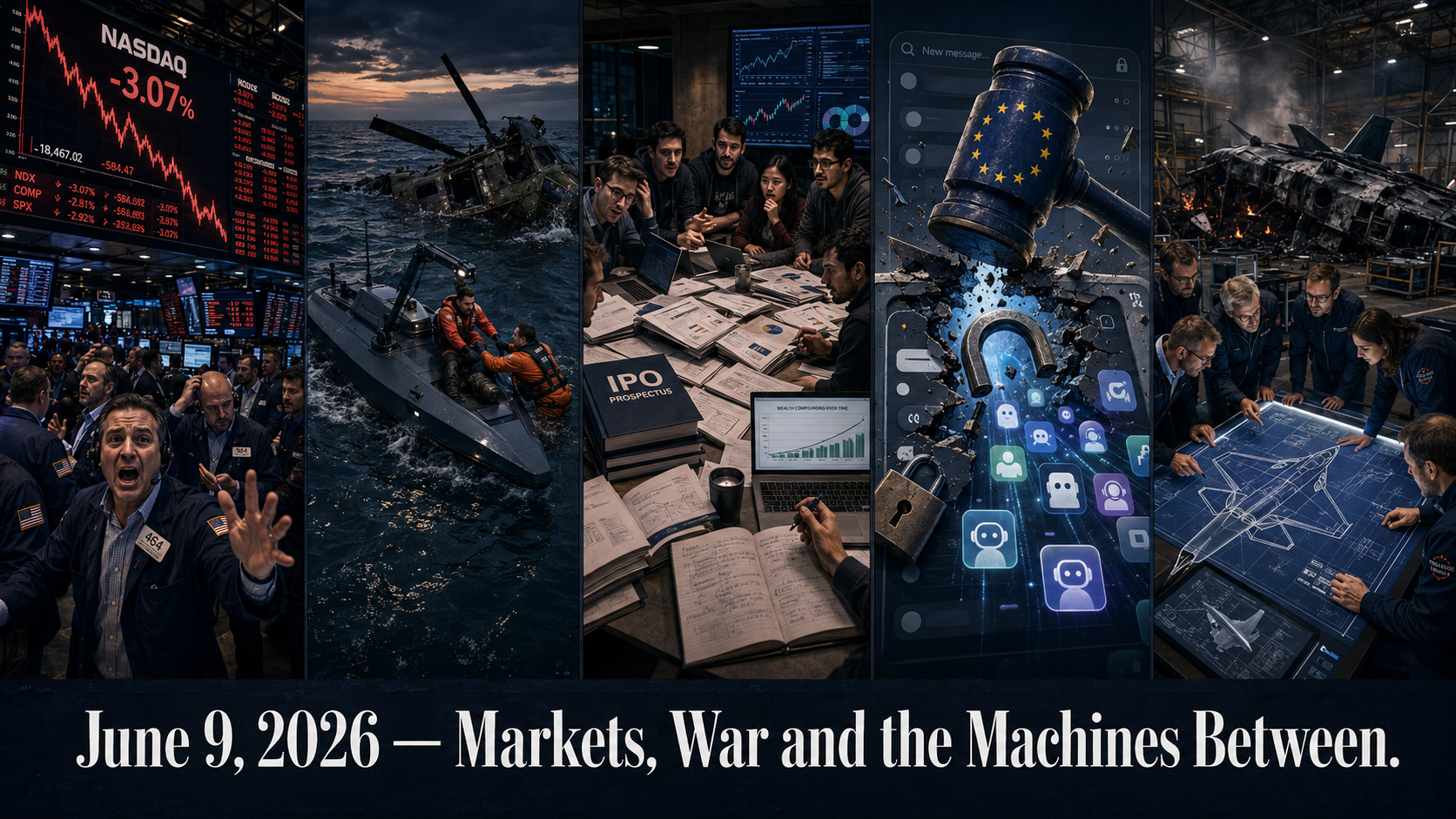
The week arrived with a correction. What began as a cautious rebound on Tuesday turned into a 3% slide for the Nasdaq by afternoon, as early optimism gave way to the same structural doubt that has haunted tech markets since Friday's AI chip rout — the question of whether demand is real or merely assumed. Far from the trading floors, in the gray waters off the coast of Oman, something unprecedented was unfolding: a drone boat was navigating toward two U.S. Army soldiers floating in the Strait of Hormuz after their Apache helicopter went down, completing the first autonomous sea rescue in military history. In Brussels, the European Commission issued its first emergency antitrust order in seventeen years, demanding that Meta open WhatsApp's infrastructure to rival AI agents within five working days, with Meta's appeal already filed before the ink was dry. In California, SpaceX employees were sitting through an unusual company seminar — not about rockets, but about how to manage sudden wealth. And in the corridors of European defense, Airbus quietly submitted a position paper that amounts to an admission: the €116 billion FCAS fighter jet program between France and Germany is finished, and someone needs to build what comes next. Tuesday, June 9, 2026.
The Nasdaq's Second Bad Day in a Row
Tuesday was supposed to be the bounce-back. Futures pointed higher in the pre-market, and the Nasdaq opened with a climb that briefly recovered some of the previous week's losses. Then the sellers returned. By afternoon, the index had surrendered all of its gains and more, closing down 3% in what analysts described as a continuation of the repricing that Broadcom's earnings miss had triggered. The S&P 500 declined in tandem, and the Russell 2000 fell harder still — a signal that the selloff was broadening beyond large-cap tech into the wider market.
The pattern is becoming familiar and unsettling: morning optimism, afternoon reversal. What it reflects is a market that has not yet found a clearing price for the AI trade. Investors know that the infrastructure build-out is real — the data centers, the chips, the energy contracts. What they are less certain about is whether the returns on that investment are coming, and when. Broadcom's guidance miss planted a seed of doubt; two days of selling have watered it. The question now is whether earnings season, which begins in earnest in the coming weeks, will offer the evidence needed to stabilize sentiment or accelerate the reckoning.
Oil added pressure. With Brent crude still trading above $90 on residual Iran-Israel tension, energy costs continue to act as a tax on margin across the economy. The Fed's next meeting is weeks away, and the combination of a hot labor market, elevated energy prices, and a wobbling equity market gives policymakers little room to move in any direction comfortably. The word of the week in trading rooms is "repricing." The question is of what, and by how much.
The Drone Boat That Rewrote the Rescue Manual
Two U.S. Army soldiers were floating in the waters off the coast of Oman at approximately 5:30 p.m. local time on Tuesday when the Navy's unmanned surface vessel — a drone boat operated by Task Force 59, the 5th Fleet's autonomous systems unit — reached them. The Apache helicopter they had been flying had gone down under circumstances still under investigation. The drone stabilized their position, kept them afloat, and transported them to a safe extraction point where a manned helicopter hoisted them to safety. Both soldiers are in stable condition.
The operational significance cannot be overstated. This was the first known instance of an autonomous naval vessel executing a personnel recovery mission in a live operational environment. Task Force 59 was established precisely to test and expand the role of unmanned systems in contested maritime theaters — and the Strait of Hormuz, one of the most strategically charged bodies of water on earth, is as live an environment as any. That a drone boat performed a rescue there is not merely a military footnote; it is a proof of concept that will reshape how the Navy thinks about search and rescue, force protection, and the division of risk between humans and machines.
The Apache's loss — the first since the Iran conflict began — is also notable in its own right. The helicopter went down during routine patrol operations in regional waters, and the cause remains under investigation. Whether mechanical failure or something more serious, the incident underscores how persistently dangerous the Hormuz corridor has become. The drone saved two lives on Tuesday. The broader question — how many more assets are operating in those waters, manned and unmanned, and under what rules of engagement — will not be answered in a press release.
SpaceX Teaches Its Engineers to Be Rich
Inside SpaceX's facilities in Hawthorne and Boca Chica, a quiet but telling initiative has been unfolding. According to reporting in The Wall Street Journal, SpaceX has begun offering employees — many of whom hold significant equity stakes accumulated over years at a company whose private valuation has soared past $200 billion — structured financial education sessions focused on wealth management. The program brings in advisors to explain tax optimization, diversified investing, estate planning, and the mechanics of turning illiquid equity into a long-term financial plan.
On one level, this is an HR story. A company with a lot of paper-wealthy employees recognizing that financial illiteracy is a liability — for the employees themselves and, by extension, for retention. But on another level it reflects something more culturally significant: the normalization of extreme private wealth concentration within a generation of workers who entered the industry as engineers, not as financiers. The SpaceX employee who joined in 2018 with a modest salary and stock options is, in several cases, now sitting on eight-figure holdings. That is a level of wealth most people encounter only through inheritance or exit events, not through a salaried career.
What SpaceX is doing is essentially building a private financial services program for its workforce — a perk that until recently was the exclusive domain of investment banks and management consulting firms, where outsized compensation was always the expectation. The signal this sends to the rest of the tech industry is clear: equity-heavy compensation is no longer sufficient; you also have to help people handle what that equity becomes. It is, in its own way, a measure of how far the private space economy has traveled.
Brussels Cracks Open WhatsApp — and Sets a Precedent
The European Commission's decision to issue an emergency interim order against Meta on Tuesday is the most consequential regulatory action in the AI era so far. The Commission, invoking the Digital Markets Act, gave Meta five working days to restore free access to WhatsApp's business infrastructure for rival AI agents — specifically those developed by The Interaction Company (makers of Poke.com), the French startup Agentik, and a Spanish competitor. Meta had first offered access for a fee in March, then briefly for free in May, before reverting to terms the Commission characterized as equivalent to a ban. Meta has vowed to appeal.
The stakes extend well beyond WhatsApp. What Brussels is effectively ruling is that a dominant platform cannot use its messaging infrastructure as a moat around its own AI products. WhatsApp, with two billion users and deep integration into business communication across Europe and the developing world, is an unparalleled distribution channel. If Meta can lock competing AI agents out of that channel — charging fees that make competition economically unviable — then the AI agent market becomes structurally tilted before it has even properly begun. The Commission's argument is that this is precisely the kind of leveraging behavior the DMA was designed to prevent.
This is only the second time in seventeen years that the Commission has issued an interim measure of this kind — the first was against Microsoft in 2009. The rarity of the instrument reflects both the urgency the Commission attached to the case and the difficulty of meeting the legal threshold for emergency relief. That they did so here signals Brussels' intention to fight this fight in real time rather than waiting for years of conventional antitrust proceedings. For Meta, the cost of noncompliance could be fines of up to 10% of global annual revenue. For the AI industry, the outcome will determine whether the next layer of the internet is truly open — or owned.
Europe's Fighter Jet Breaks Apart, and Airbus Picks Up the Pieces
The FCAS — the Future Combat Air System — was supposed to be Europe's most ambitious defense project: a sixth-generation fighter jet developed jointly by France, Germany, and Spain, at an estimated cost of €116 billion, scheduled for operational deployment around 2040. It was also supposed to be proof that European defense cooperation could function at the highest level of technological complexity. On Monday, France and Germany confirmed that the project is being terminated. The primary cause of death: Dassault Aviation and Airbus could not agree on who would be in charge.
Into the wreckage, Airbus has moved quickly. A consortium calling itself "Team Gen 6" — comprising Airbus Defence and Space alongside Autoflug, Diehl Defence, Hensoldt, Liebherr, MBDA, MTU Aero Engines, and Rohde & Schwarz — has submitted a formal position paper to the German government, proposing a German-led alternative to fill the gap FCAS leaves behind. The paper is a lobbying document and a market claim simultaneously: we exist, we are capable, and if Germany is going to lead Europe's next fighter program, here is the team to do it.
The collapse of FCAS is a serious blow to the idea of Franco-German defense integration that has underpinned European security cooperation for decades. The Rafale and the Eurofighter will now age without an agreed-upon successor. The German air force, committed to replacing its Eurofighters before mid-century, faces a planning vacuum. What the Airbus consortium is offering is not a replacement for FCAS but a German-first alternative to it — which is, in the current political climate, perhaps the more honest approach. European defense cooperation has rarely survived contact with industrial national interests. The question now is whether Germany will lead alone, or whether a new Franco-German alignment is still possible under different terms. The answer will shape European air power for the next thirty years.
