
Strikes, Shelves, and Streets on Fire: Wednesday, June 10, 2026
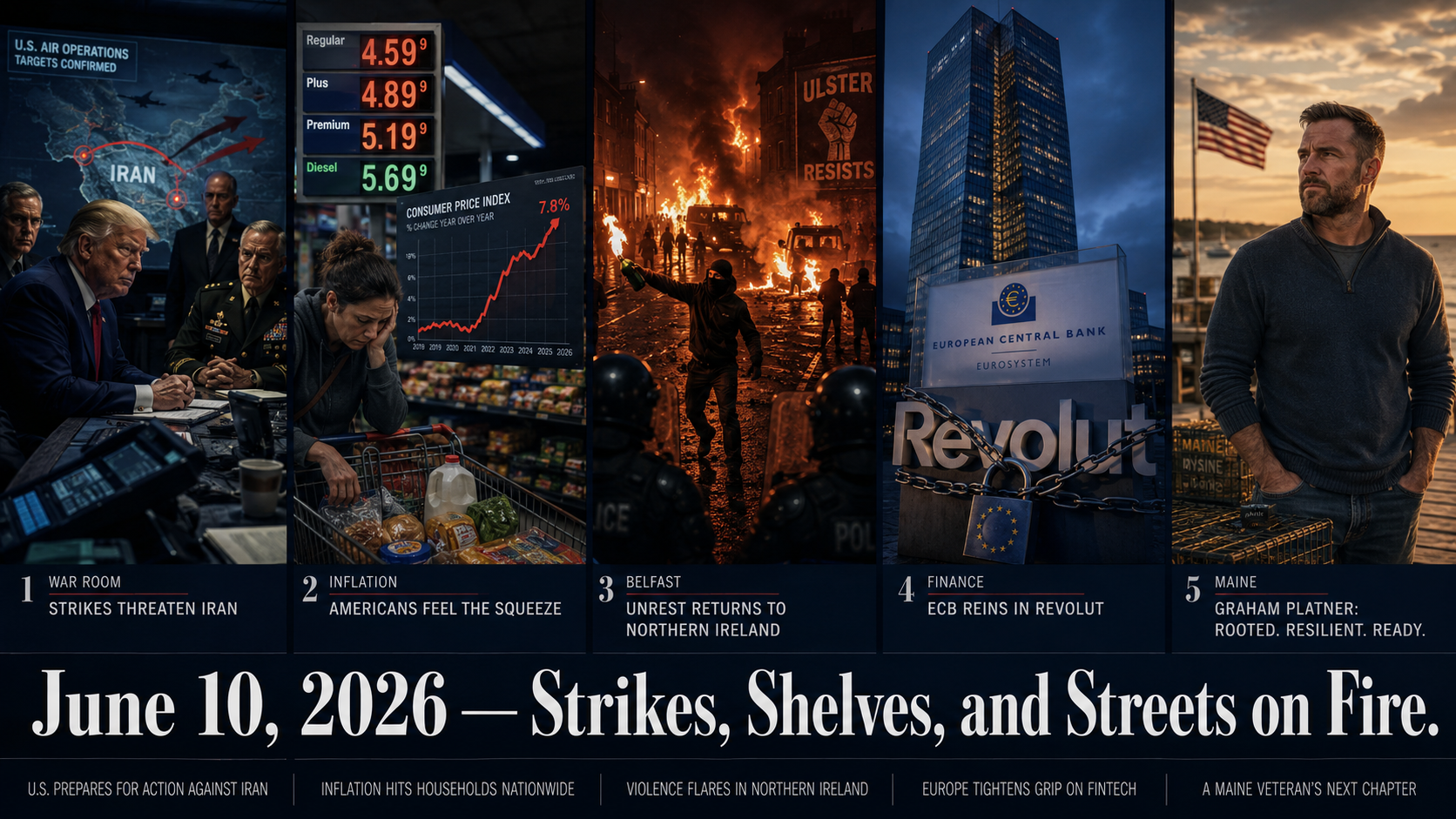
There are days when the news arrives not as a sequence of events but as a single, accelerating pressure — a world pressing harder on every front at once. On Wednesday, June 10, 2026, Donald Trump stood before cameras and announced that new American attacks on Iran would come before nightfall, the second act of a military confrontation that had already drawn blood across the Gulf. Simultaneously, fresh inflation data confirmed that American households were still paying the price of an energy market that refuses to calm, with prices climbing 4.2% in May alone. In Belfast, masked men burned families out of their homes in a second wave of anti-immigrant violence, the kind of fury that feeds on viral footage and political silence. Across the Channel, the European Central Bank put its foot down on Revolut — the fintech darling that had built an empire on moving fast and asking questions later. And in Maine, a soft-spoken oyster farmer and Marine veteran named Graham Platner walked out of a Democratic primary and into a November collision with Susan Collins, one of the most durable politicians in American life.
The Gulf on the Edge of a Second Strike
When the United States struck Iranian air defense installations near the Strait of Hormuz on June 9, it did so in retaliation for the downing of an American Apache helicopter — an act Iran has not denied. The strikes were surgical, targeted, and framed by the White House as measured. But measured rarely stays measured. Iran responded by hitting American military assets in Bahrain, Kuwait, and Jordan. No mass casualties were announced. That restraint, on both sides, has begun to feel less like diplomacy and more like the calm before a larger decision.
On Wednesday morning, Donald Trump confirmed what analysts had feared: new strikes against Iran were coming, larger in scope, later that day. The announcement carries the logic of escalatory deterrence — a belief that the only credible signal is a bigger one — but in a corridor as narrow as the Hormuz Strait, where a third of the world's seaborne oil passes through waters now patrolled by adversarial navies, the margin for miscalculation is nearly zero.
What makes this moment distinct from prior U.S.-Iran standoffs is the absence of a diplomatic back-channel visible to the public. Previous crises — 2019's tanker war, the Soleimani killing — came with back-room conversations that eventually cooled the temperature. Today, there is no visible interlocutor, no European framework still standing, no Omani back-channel confirmed active. The Gulf is watching a script that has no agreed ending.
The Inflation That Won't Let Go
The Bureau of Labor Statistics confirmed on Wednesday that U.S. consumer prices rose 4.2% in May year-over-year — the highest reading in over a year and a figure that lands directly in the White House's most politically sensitive inbox. The culprit is familiar: energy. Gasoline prices climbed sharply through May as conflict in the Gulf premium-priced every barrel of oil that passed through Hormuz, and as domestic refinery margins widened alongside geopolitical risk.
The Federal Reserve, which had been cautiously signaling a possible summer rate pause after months of hold, now faces a corridor that has narrowed further. Cutting into 4.2% inflation invites a political firestorm; holding while the economy softens risks a recession narrative that Democrats and Republicans alike will weaponize in campaign season. Chair Powell has said the Fed follows the data. The data, on Wednesday, said something uncomfortable.
For ordinary Americans, the May reading is less an abstraction than a grocery receipt. Food-at-home prices, housing costs, and transportation remain elevated. The brief window of disinflation that had given consumers a moment of relief in late 2025 has closed. What replaces it is a second chapter of cost-of-living pressure wearing a different headline but the same weight.
Belfast Burns Again
The first wave had come the week before, in Southampton, when the sentencing of a knife attacker triggered violent clashes with police. On Tuesday night, the second wave arrived in Belfast — and it was worse. A Sudanese man appeared in court charged with attempted murder after a knife attack in north Belfast left his victim, a man in his 40s, with severe injuries including the permanent loss of an eye. A video of the attack circulated rapidly across social media. By nightfall, hundreds of masked men were in the streets. Vehicles burned. Families were driven from their homes. Police were attacked.
British Prime Minister Keir Starmer moved quickly to the cameras, calling the violence "targeted" at ethnic minorities and promising the full force of the law. But the Prime Minister's language, however precise, runs up against a political dynamic that has been building for years: the gap between the official narrative on immigration and the lived reality in communities that feel unheard, unseen, and ungoverned. Anti-immigrant and anti-Islam activists have been explicit in their calls for street action. They are not operating in a vacuum.
What Belfast reveals, again, is that violence of this kind does not require an organized political movement to metastasize. It requires a spark, a video, and an infrastructure of grievance that platform algorithms are extraordinarily good at amplifying. The U.K. government faces not just a law enforcement challenge but a deeper question: what does it offer, concretely, to the communities where these fires keep starting?
The ECB Puts a Leash on Revolut
Revolut has long operated on a philosophy its own executives have described as launching "self-guided missiles" — products developed and deployed at speed, with compliance and regulatory approval treated as something to negotiate afterward rather than engineer in advance. It is a philosophy that made Revolut the most valuable fintech in Europe. The European Central Bank has now decided it is also a philosophy that cannot continue.
The ECB this week ordered Revolut's European banking arm to halt new product releases until it submits to a third-party review of its risk management, compliance, and legal functions. The phrase "self-guided missiles" — reportedly drawn from internal Revolut communications — has become the defining metaphor of the ECB's concern: a financial institution moving faster than its own safety systems. The ECB's intervention does not threaten Revolut's existing product base, but it draws a hard line around the company's ability to grow.
The stakes are significant beyond Revolut itself. Europe has spent years debating whether its regulatory architecture is too slow, too conservative, and too structurally disadvantaged relative to the U.S. and China to compete in financial technology. The Revolut case will now become a reference point in that debate — an argument that speed without governance is not innovation but liability, offered by the institution responsible for the Eurozone's financial stability.
The Oyster Farmer Takes Maine
Graham Platner grew oysters on the coast of Maine. He served three combat tours in Iraq as a Marine and one in Afghanistan with the National Guard. He was not the Democratic establishment's candidate for U.S. Senate — that mantle had briefly belonged to outgoing Governor Janet Mills, who ended her campaign when it became clear that Platner's grassroots support had outgrown the institutional lane. On Tuesday night, June 9, he won the Democratic primary.
He will face Susan Collins in November. Collins is one of the most carefully constructed political identities in the Senate — a Republican moderate from a blue-trending state who has survived wave elections by maintaining a reputation for independence while almost never casting a vote that costs her party. She has beaten back challengers before. But the political environment of 2026 is not 2020 or 2014. Polls taken before the primary showed Platner ahead.
Platner's candidacy distills something that Democratic strategists have been trying to articulate for a cycle and a half: the party's strongest candidates in contested terrain are not those who speak fluently in Washington's language, but those who carry a biography that precedes the political identity. A Marine. An oyster farmer. A local official. A man who, by every metric, looks more like the state he is asking to represent than the party that nominates him. Whether that is enough to move Maine in November remains an open question. It is, at minimum, the most interesting answer the Democrats have given it in years.
