
Take the Island, Ring the Bell: Thursday, June 11, 2026
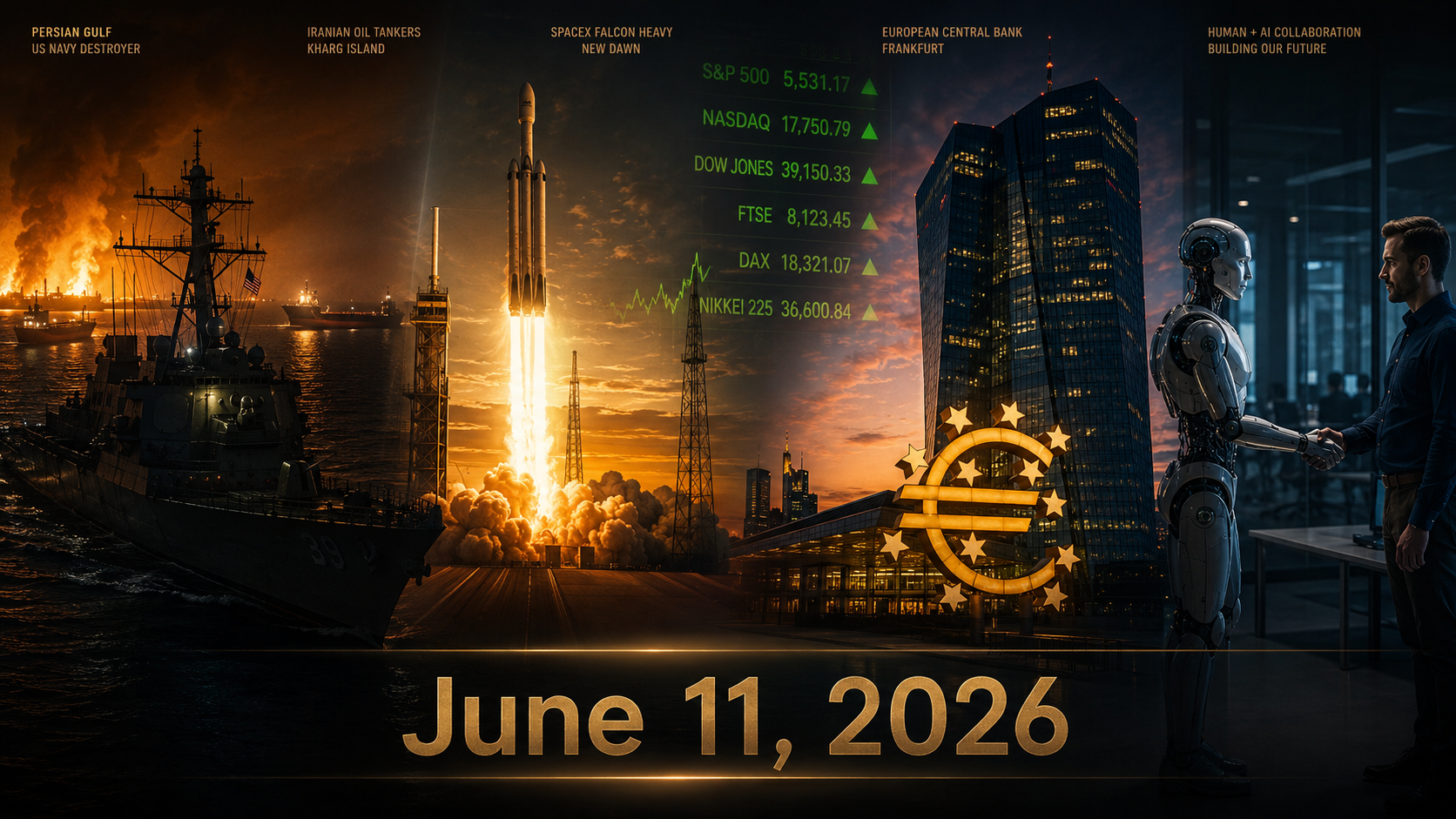
The same president who spent months trying to broker a ceasefire threatened on Thursday to seize Iran's most valuable piece of real estate: Kharg Island, the loading terminal through which nearly ninety percent of Iranian crude passes. Donald Trump declared the United States would strike Iran "very hard tonight" and raised the prospect of assuming "total control" of Iran's oil and gas sector in what he called "the not too distant future." Tehran responded by closing the Strait of Hormuz to all shipping. The day began with the world's most consequential oil chokepoint sealed and the Middle East in its deepest crisis since April. It ended, improbably, with Wall Street throwing a party: SpaceX rang in what may prove to be the largest initial public offering in history, drawing more than two hundred and fifty billion dollars in orders for a listing valued at seventy-five billion. On any ordinary Thursday, either story would consume the news cycle. This is not an ordinary Thursday.
"Very Hard Tonight": Trump Threatens to Take Kharg Island
The sequence of events that produced Thursday's escalation reads like a pressure gauge approaching its limit. US and Iranian forces traded strikes for a second consecutive day, with Iran attacking Bahrain, Kuwait, and Jordan after new waves of American bombardment. Trump, accusing Tehran of "stalling" on peace negotiations, took to social media to announce that the US would hit Iran "very hard tonight" and that Washington was actively considering the seizure of Kharg Island — the narrow strip of land off Iran's southwestern coast that functions as the physical spine of the country's petroleum economy. Without Kharg, Iran's ability to export oil collapses almost entirely.
The threat is not purely rhetorical, but it is also not an announcement of imminent military action in the conventional sense. Seizing and holding Kharg Island would require a sustained amphibious and air campaign of a scale the United States has not mounted since the Gulf War, and would almost certainly trigger a full Iranian military response across the region. What Trump appears to be doing is using the threat as maximum-pressure leverage — the same playbook he has used throughout the Iran crisis — to force a settlement. The message to Tehran is explicit: accept a deal, or risk losing the economic infrastructure on which the Islamic Republic's survival depends.
Iran read the message and responded by closing the Strait of Hormuz entirely, halting all shipping in waters through which roughly twenty percent of global oil passes on an average day. The closure is both a countermeasure and a signal: Tehran is demonstrating that the pain of disruption runs in both directions. Global oil markets reacted sharply, and the human arithmetic of what follows — higher energy prices, accelerating inflation in importing economies, pressure on central banks that had only just reached stability — is now the central economic variable in every government in the developed world.
The Biggest Listing in History: SpaceX Goes Public
Against the backdrop of geopolitical fire, Elon Musk's SpaceX completed what may be the defining financial event of the decade. The company priced its initial public offering at $135 per share, implying a valuation of approximately $1.8 trillion and raising $75 billion in fresh capital — figures that would break every record in IPO history. Investor demand was extraordinary: orders exceeded $250 billion, leaving the book nearly four times oversubscribed. BlackRock alone is reported to have discussed committing between $5 billion and $10 billion as an anchor investor, a figure that reflects not just confidence in Musk's aerospace enterprise but the broader institutional conviction that space infrastructure is becoming a core asset class.
The timing of the SpaceX listing is layered with irony. The company that built its franchise on humanity's expansion beyond Earth is going public on a day when the earthly order seems most fragile. But the market logic is straightforward: Starlink's satellite internet network is already profitable and expanding rapidly, Starship has completed multiple successful orbital missions, and the company holds long-term contracts with NASA, the US Department of Defense, and a growing roster of commercial customers. For institutional investors navigating a world of elevated geopolitical risk, SpaceX represents something rare — an asset whose revenue base is partly sovereign and whose long-term growth trajectory is largely decoupled from the crises currently convulsing the Middle East.
The IPO also marks a moment of public reckoning for Musk's broader relationship with markets and government. Since his acquisition of X and his increasing involvement in US politics, questions about governance, regulatory exposure, and reputational risk have circled Musk's ventures. That BlackRock — historically careful about headline risk — is reportedly prepared to anchor the deal at this scale suggests those concerns have not materially dented SpaceX's institutional standing. What happens to the stock when it opens to retail trading will be one of the more closely watched moments of the financial year.
The ECB Blinks First — and China Quietly Saves the Rest
The European Central Bank raised its deposit rate by a quarter point to 2.25% on Thursday, the first increase since 2023 and the clearest acknowledgment yet that the Iran war's inflationary consequences are not transitory. Euro area inflation reached 3.2% in May, well above the ECB's 2% target and driven overwhelmingly by energy costs inflated by Hormuz disruption. ECB President Christine Lagarde warned that price pressures were "widening beyond energy," a phrase that signals the bank sees second-round effects — higher wages, higher industrial input costs — beginning to embed themselves in the European economy. The bank revised its 2026 growth forecast modestly downward to 0.8%, a number that captures an economy doing considerably better than feared while simultaneously failing to reach its potential.
The rate hike puts the ECB back on a tightening path it abandoned two years ago, and it does so at precisely the moment when the geopolitical outlook is most uncertain. If the Iran ceasefire talks succeed in the coming days, as Trump continues to insist they will, energy prices could fall sharply and today's hike will look premature. If talks collapse and hostilities intensify, the ECB faces the prospect of raising rates into a recession — the stagflationary scenario it has been trying hardest to avoid.
An underappreciated variable in this equation is China. A detailed analysis published Thursday revealed that Chinese oil imports have fallen by nearly five million barrels per day since the start of the Iran war — roughly five percent of global daily supply. The reduction is structural as well as cyclical: Chinese consumers are switching from gasoline cars to electric vehicles at record pace, industrial activity is contracting, and Beijing has been drawing down its enormous strategic reserves rather than purchasing at elevated prices. The effect on global oil markets has been stabilising; without China's demand destruction, the price effects of Hormuz disruption would have been dramatically worse. The crucial question is how long China's reserves can sustain that buffer, and what happens to global prices when Beijing returns to the market at scale.
Bezos Bets on Abundance: AI and the Labor Question
Jeff Bezos published a characteristically counterintuitive argument this week, predicting that artificial intelligence will not produce mass unemployment but rather a labor shortage. His logic: AI will drive such large productivity gains that costs will fall across the economy — cheaper groceries, more affordable housing, lower prices for the goods that constitute ordinary life — while simultaneously elevating the roles of human workers rather than replacing them. He compared equipping workers with AI tools to handing a manual labourer a bulldozer: "You should be so happy." The implication is that fears of AI-driven displacement are not just wrong but analytically backwards.
Bezos's argument has the advantage of historical analogy. Past waves of automation — mechanised agriculture, electrification, computerisation — did not permanently reduce aggregate employment. They shifted labor toward higher-value activities and raised real wages over the medium term. If AI follows a similar arc, the pessimistic forecasts circulating in policy and academic circles would be overstated.
The counter-evidence, however, is harder to dismiss than Bezos's optimism allows. More than 49,000 AI-related layoffs have been recorded in early 2026 alone, concentrated in finance and technology — the sectors that generate the highest-quality data on structural economic change. The displacement is happening now, in industries with no obvious reabsorption path for mid-career workers. Whether the Bezosian golden age arrives, and how long the transition costs last for those displaced in the interim, may prove to be the defining social policy question of the next decade.
"We Are Not Looking for Conflict": Russia Recalibrates Its Messaging
As Western attention remains consumed by the Middle East, NATO's posture toward Russia has undergone a quiet recalibration that deserves more notice than it has received. NATO's top US commander acknowledged this week that Russian military leadership has been signalling, through multiple channels, that Moscow is "not looking for conflict" with the alliance — a formulation carefully distinct from either conciliation or retreat. Russian President Vladimir Putin, responding to Western claims that Russia is preparing for war, called such suggestions "a lie, a gross, brazen lie."
The statements reflect a Russian calculus shaped by Ukraine exhaustion, economic strain, and the acute awareness that Western military attention and material are partly redirected toward the Middle East. Russia is neither advancing its stated ambitions nor retreating from them. It is, in the language of its military doctrine, preserving operational space while the geopolitical landscape shifts. Whether that translates into a genuine reduction in threat or a temporary pause should be the subject of serious analytical attention at a moment when it is receiving almost none.
Agora The Framework covers global politics, geopolitics, finance, science, and technology. All reporting is based on publicly available sources and does not represent the editorial endorsement of any political position.
