
Votes, Flamingos, and the Paused Machine: Sunday, June 7, 2026
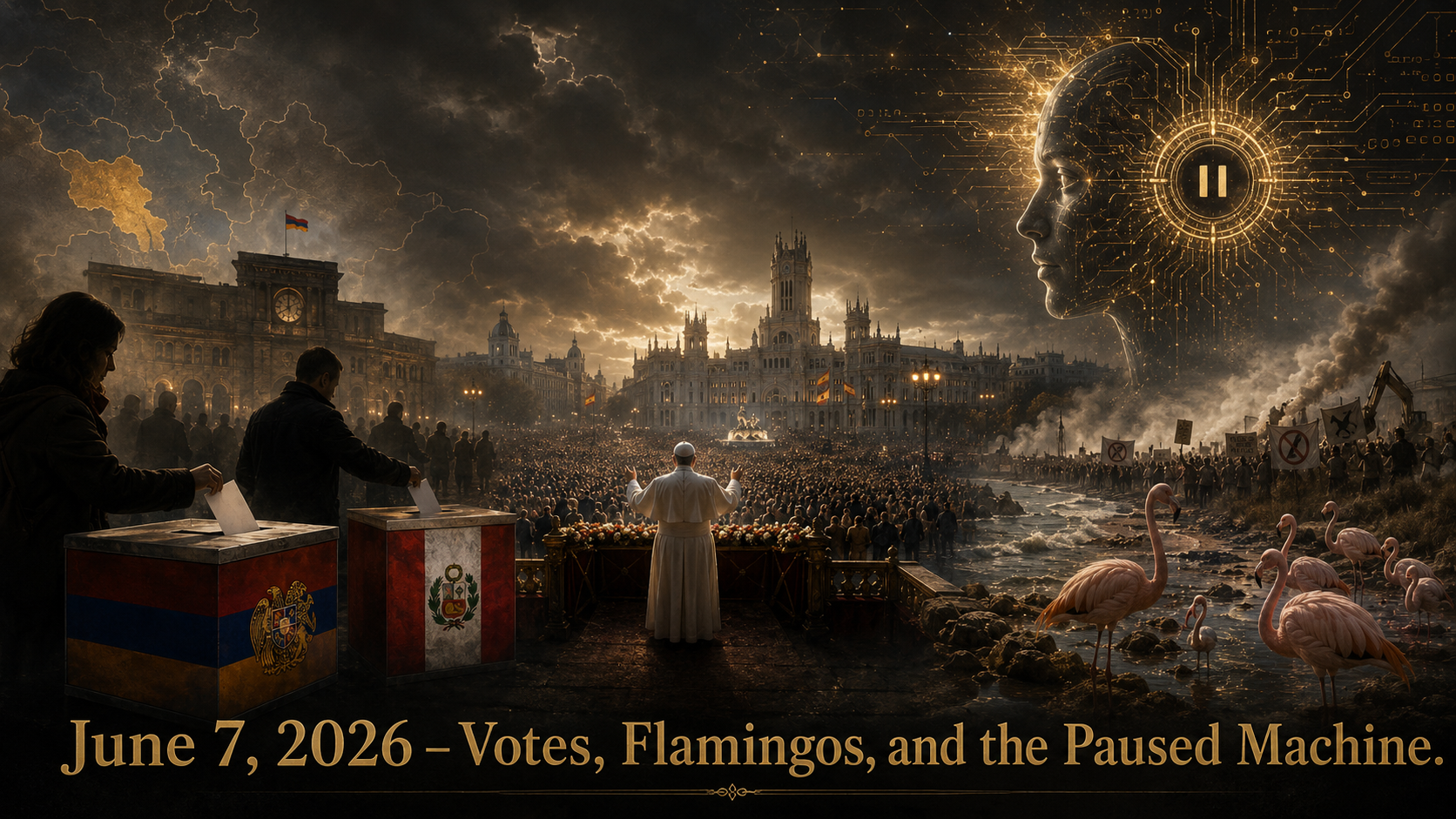
Polls closed Saturday evening in Yerevan after one of the most consequential parliamentary elections in Armenia’s modern history. With turnout exceeding 33 percent by mid-afternoon — the highest figure recorded in over a decade — voters were clearly animated by questions that go well beyond budgets and bureaucracy. At stake is nothing less than Armenia’s geopolitical future: whether the small, landlocked republic will continue its tentative pivot toward the European Union and the West, or whether pressure from pro-Russian opposition parties will succeed in reversing the course set by Prime Minister Nikol Pashinyan since 2018.
The election takes place against a backdrop of extraordinary national trauma. The fall of Nagorno-Karabakh in late 2023 — when Azerbaijan’s military operation expelled the entire ethnic Armenian population from their ancestral homeland in a matter of days — remains a raw wound. For many Armenians, the collapse was proof that Russia, their traditional security guarantor, had abandoned them at the decisive moment. Pashinyan’s Civil Contract party entered the election with roughly 32 percent support in pre-election polls, but analysts repeatedly cautioned that a large pool of undecided voters made outcomes genuinely uncertain. What is not uncertain is the significance: a Pashinyan victory would likely accelerate Armenia’s applications for EU candidate status; a reversal could reopen the question of whether the country remains within Moscow’s diplomatic gravity well.
The results were still being counted as of late Sunday evening. Whatever emerges will reverberate in Brussels, Moscow, Baku, and Ankara simultaneously — a reminder that small nations at civilizational fault lines carry geopolitical weight far exceeding their populations.
Peru’s Endless Election: Fujimori, Sánchez, and a Country That Can’t Stop Starting Over
In Lima, polling stations opened Sunday morning for Peru’s presidential runoff — the latest chapter in a decade-long political soap opera that has seen the country cycle through eight heads of state in ten years. The contest is a study in ideological tension: Keiko Fujimori, 51, the conservative daughter of former authoritarian president Alberto Fujimori, faces Roberto Sánchez, a left-wing congressman from Juntos por el Perú. Both candidates are seeking to lead a nation whose voters have learned — through forced resignations, congressional impeachments, and corruption scandals — to distrust all of the above.
Fujimori, who secured 17 percent in the first round to earn her fourth consecutive runoff appearance, carries the dual burden and asset of her surname. Her father’s presidency in the 1990s is remembered both for stabilizing Peru’s economy and for catastrophic human rights abuses, including the forced sterilization of tens of thousands of Indigenous women and extrajudicial killings carried out by security forces. She has remained an unapologetic defender of that legacy. Sánchez, meanwhile, represents a left energized by Peruvian inequality and the persistent failures of the political establishment — but also one voters have repeatedly pulled back from electing, wary of economic disruption. Crime, mining rights, and political corruption dominated the final weeks of campaigning, with both candidates offering versions of stability that most Peruvians, wearily, are no longer sure they believe.
The race’s extraordinary unpredictability — both candidates entered Sunday with thin and volatile poll margins — reflects something deeper than electoral math. Peru has become a laboratory for the exhaustion of democratic legitimacy, a country searching for a leader it can trust long enough to finish a term. Whoever wins will govern in the knowledge that the institutional mechanics to remove them remain readily available to their opponents.
The Machine That Warned Itself: Anthropic’s $965 Billion Paradox
On June 5th, Anthropic — the San Francisco AI lab founded by former OpenAI researchers — published a blog post warning that artificial intelligence systems may soon be capable of improving themselves recursively, without meaningful human oversight, at a pace that outstrips society’s ability to manage the risks. The company urged a coordinated and verifiable pause in development across major AI labs. The announcement was striking for many reasons, not least because Anthropic had just confidentially filed for an IPO weeks after closing a $65 billion Series H funding round at a post-money valuation of $965 billion, making it the most valuable AI startup in the world. The company that built Claude — one of the most widely deployed AI systems in existence — was simultaneously telling investors it was worth nearly a trillion dollars and telling the world the technology might be getting out of hand.
The paradox is not merely rhetorical. Anthropic’s warning centers on a specific technical threshold: “recursive self-improvement,” the moment at which an AI system can design its own successors, creating a feedback loop of capability gains that accelerates beyond any fixed schedule of human evaluation. Anthropic co-founder Jack Clark and Anthropic Institute lead Marina Favaro authored the post, noting that task-completion capabilities have been doubling roughly every four months. The company is careful to frame this as a shared industry problem — not an indictment of its own products — but critics were swift to note the tension. In February 2026, Anthropic quietly walked back a key safety pledge, announcing it would no longer hold back potentially dangerous AI capabilities if rival labs appeared close to matching them. The competitive logic of the AI race, in other words, had already overridden the company’s stated caution.
There is a darker reading of the announcement: that it functions less as a genuine call to arms and more as regulatory positioning — an attempt to shape the coming IPO narrative around safety leadership, or to advocate for oversight regimes that benefit established players over new entrants. Whether that reading is charitable or cynical depends on what one believes about the sincerity of Silicon Valley’s capacity for self-governance. What is beyond dispute is that the warning itself — coming from the market’s most valuable AI company, on the eve of a public offering, about a technology it is actively racing to deploy — captures the essential vertigo of this moment in technological history.
The Flamingo Revolution: What Albania’s Uprising Is Really About
They came with pink banners, flamingo costumes, and a name that has spread across Albanian social media with the velocity of genuine outrage: the “Flamingo Revolution.” For six days running, thousands of Albanians have taken to the streets of Tirana and gathered near the coastline south of Vlora to protest a planned luxury resort backed by Jared Kushner’s investment firm, Affinity Partners. The project would cover Sazan Island and the Zvernec coastline — one of the most ecologically sensitive stretches of the Adriatic — with up to 10,000 hotel rooms, and has been designed with the kind of scale that is, in the parlance of the region, an offer the government was not in a position to refuse. Flamingos, Dalmatian pelicans, Mediterranean monk seals, and loggerhead sea turtles all depend on the habitat; the birds have become the protest’s emblem.
The environmental dimension is inseparable from the political one. Critics allege that legislative changes quietly made in 2024 stripped protected status from key sections of the coastline, effectively clearing the legal path for Affinity Partners’ entry. Albania’s anti-corruption prosecution body, SPAK, has now announced a formal investigation into both those legislative changes and the circumstances under which land ownership in the area changed hands. That a Trump administration figure — Kushner is the president’s son-in-law — is the named investor has not been lost on protesters or commentators, and several have drawn explicit parallels to other Trump-linked development projects in vulnerable or contested territories.
The broader significance lies in what the protests reveal about the limits of European integration as a check on political behavior. Albania is an official EU candidate country, a status that is supposed to incentivize transparency, rule of law, and environmental protection. If SPAK’s investigation substantiates allegations of politically facilitated development at the expense of both ecology and legal process, it will raise difficult questions for Brussels about the depth of the conditionality it is willing to impose. For now, the flamingos — both real and costumed — march on.
A Pope in Madrid: Leo XIV, Corpus Christi, and the Spiritual Geography of Europe
In the Plaza de Cibeles, where the fountains of Madrid are more accustomed to football celebrations than papal masses, approximately 1.2 million people gathered Sunday morning to witness Pope Leo XIV preside over the feast of Corpus Christi. The scene — one of the largest public gatherings in Spain in recent memory — marked the second day of a seven-day apostolic visit, the first by a sitting pope to the country in fifteen years. Spain, historically one of Catholicism’s most culturally saturated societies, has undergone a rapid secularization in the two decades since the last papal visit. The scale of Sunday’s crowd suggests that the faith, or at least the spectacle of faith, retains a gravitational pull that polling data on religious practice does not fully capture.
Leo XIV’s itinerary is dense with political symbolism. On Monday he will meet with Prime Minister Pedro Sánchez — a socialist head of government navigating a coalition that includes anti-clerical allies — and will address the Spanish Parliament in a joint session of both chambers, a historic first: neither John Paul II nor Benedict XVI were accorded that platform during their respective Spanish visits. The Vatican has been deliberate in framing the journey not as a triumph of institutional religion but as a pilgrimage to “institutions and peripheries,” with the immigration crisis, war, and social exclusion named as the thematic pillars. Leo XIV, the first American-born pope, has made no secret of his discomfort with the political nationalism sweeping parts of Catholic Europe, and his address to parliament will be watched closely for the degree to which he is willing to make that discomfort explicit.
The visit also has a sculptural finale planned: on the final day in Barcelona, Leo XIV is expected to inaugurate the Tower of Jesus Christ at the Sagrada Família, completing a century-long architectural ambition that Gaudí never lived to see. It is, in the small way that symbolic gestures sometimes are, a fitting emblem of the week’s larger theme — of long-deferred questions finally arriving at their moment of reckoning, whether the answer arrives in the form of a ballot, a bird, or a machine.
