
Seven Stories from May 15, 2026: A Detailed Briefing
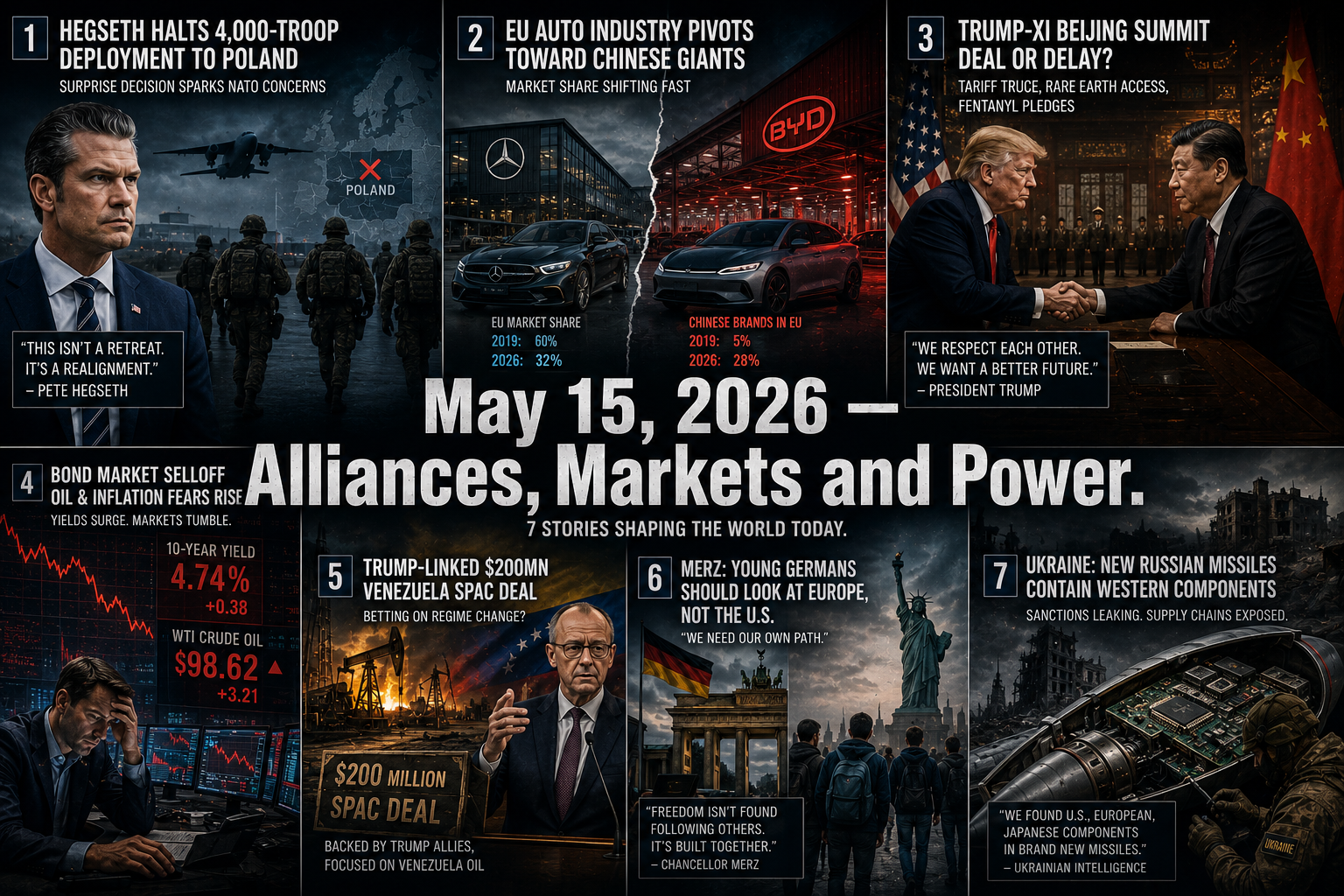
The news cycle of May 15, 2026 was dominated by an unusually dense set of stories cutting across the trans-Atlantic alliance, the U.S.–China relationship, energy and bond markets, the post-Maduro Venezuelan oil deal, the European auto industry's pivot toward China, and the still-running Russo-Ukrainian war. The following briefing assembles the most material facts, quotes, figures and context for each of the seven stories specified.
1. Hegseth Halts Brigade Deployment to Poland
U.S. Defense Secretary Pete Hegseth abruptly canceled the planned rotation of an armored brigade of roughly 4,000 troops to Poland, despite the unit already being in the final stages of preparation and some personnel and equipment having already arrived in Europe. The decision comes amid the gradual reduction of the U.S. military presence in Europe — a net decrease of around 5,000 troops — even though approximately 7,400 American soldiers remain stationed in Poland and around 80,000 across the continent overall. The cancellation surprised military leadership, which had not informed Congress, and was criticized by Democratic senators as the wrong signal to Russia, China, and Iran, especially in the context of the war in Ukraine. In the background, Donald Trump has grown increasingly frustrated with Europe’s limited military involvement in the war with Iran and is using troop deployments as a tool of political and economic pressure within NATO. The move fits into his doctrine of “flexible realism,” which abandons large “tripwire”-style deployments in favor of defending U.S. territory and focusing on the Indo-Pacific, while simultaneously turning troop presence into a transactional lever in disputes with allies.
2. European Auto Industry Hands Factories to Chinese Carmakers
Chinese automakers, virtually unknown in Europe just a few years ago, now account for nearly 9% of total car sales and 14% of electric vehicle sales on the continent, and are strengthening their position by acquiring or building factories inside the EU. To bypass tariffs and benefit from subsidies reserved for locally produced vehicles, companies such as BYD, MG, Chery, and Leapmotor are entering partnerships with European groups or taking over underutilized plants. Stellantis is currently the clearest example, transforming its Madrid factory into a production base for Leapmotor models while preparing an Opel SUV based on a Chinese platform and discussing additional similar partnerships. Other groups, including Ford, are considering broad cooperation agreements with Geely, while BYD prefers outright acquisitions of European factories to maintain full control over production. Overcapacity and missed production targets — such as Volkswagen’s roughly 500,000-unit shortfall — are pushing European manufacturers toward these alliances. In the short term, factories and jobs are being preserved, but there is growing concern that once Chinese brands gain trust and recognition, Europe’s automotive value chain could ultimately be absorbed into China’s electric vehicle ecosystem.
3. Trump–Xi Summit in Beijing: Stability Without Major Solutions
The May 14–15 summit in Beijing between Donald Trump and Xi Jinping was presented by both sides as a step toward “strategic stability” in U.S.-China relations, although it produced neither a joint communiqué nor a major package of agreements. Beijing is attempting to transform Trump’s transactional willingness to ease tensions into a more durable framework for the coming years, including for any eventual successor to Trump. Economically, Trump announced Chinese orders for 200 Boeing aircraft and a relaxation of export controls on certain advanced Nvidia chips for Chinese companies, while several major American CEOs participated in the visit. The two sides also discussed expanding U.S. agricultural exports and continuing cooperation on fentanyl precursor substances, though no clarification was offered regarding the general 10% tariff regime or critical issues tied to strategic minerals and AI safety frameworks. On Iran and the Strait of Hormuz, both parties agreed that oil flows must resume, with China expressing interest in importing more American crude while refusing any militarization of the waterway. The most sensitive issue remained Taiwan: Xi warned that mishandling the matter could place the relationship “in grave danger,” while Trump’s lack of firm guarantees fueled fears in Taipei that the island’s status could become a bargaining chip.
4. Financial Markets: Bond Yields Climb to One-Year Highs
On May 15, U.S. and European stock markets pulled back from record highs amid another sharp increase in government bond yields and rising oil prices linked to the war with Iran. The S&P 500 fell nearly 1%, the Dow Jones Industrial Average lost more than 300 points, and the Nasdaq — heavily exposed to technology and AI stocks — dropped around 1.4%, while Britain’s FTSE 100 also opened in negative territory. The yield on the U.S. 10-year Treasury rose to around 4.6%, its highest level in roughly a year, after the biggest weekly increase since Trump’s 2025 tariff shock, as investors reassessed the likelihood of another Federal Reserve rate hike in December. Recent inflation data — both consumer and producer prices — suggest that the energy shock driven by the Strait of Hormuz disruption and Brent crude above $108 per barrel is reigniting price pressures. At the same time, long-term yields also reached historic highs in Japan, the UK, and the eurozone, signaling a regime shift after years of extremely low financing costs. Central bankers and analysts warn that renewed fears of persistent inflation could place additional pressure on risk assets, even as the U.S. economy continues to show signs of resilience through retail sales.
5. Trump-Linked Financial Group Prepares $200 Million Venezuela SPAC
A small financial group connected to the Trump family is preparing a SPAC vehicle worth around $200 million to capitalize on the “new economic beginning” in post-Maduro Venezuela, at a time when the Washington administration directly controls major Venezuelan oil flows. At the center of this network is Dominari Holdings, an investment bank headquartered in Trump Tower in which Donald Trump Jr. and Eric Trump have invested and together hold more than 20% of shares, while management has received compensation packages disproportionate to the firm’s size. Dominari and Trump family associates are already involved in a separate $300 million SPAC, New America Acquisition I, officially aimed at companies with “American values” but flexible enough to overlap with energy opportunities. After Nicolás Maduro’s capture and the U.S. takeover of up to 50 million barrels of Venezuelan oil, the White House organized an initial $500 million sale, blocked creditors, routed part of the funds through a bank account in Qatar, and called for $100 billion in American investment into Venezuela. This blending of political decisions and financial vehicles tied to the president has raised major conflict-of-interest concerns, with Democratic lawmakers accusing the administration of creating a politically and legally gray “offshore account” to manage assets seized by the U.S. military. The Venezuela case is becoming a test of the legal and ethical boundaries of political capitalism in the Trump era.
6. Merz Says He Would Not Send His Children to the U.S.
During a speech at the Catholic Congress in Würzburg, German Chancellor Friedrich Merz surprised the audience by stating that although he remains an admirer of America, he would not recommend that his children — or young Germans more broadly — study and work in the United States under the current social climate. He argued that, in his view, the social environment has deteriorated sharply over the past year and that even highly educated Americans are struggling to find jobs, referring to the combination of automation, artificial intelligence, and stricter immigration policies. The remarks come amid increasingly tense personal relations with Donald Trump, after Merz accused the United States of being “humiliated” by Iran during negotiations, provoking furious responses from the American president and later announcements of partial troop withdrawals from Germany. The fact that a traditionally pro-American German chancellor is publicly criticizing the transatlantic partner and discouraging academic and professional mobility toward the U.S. marks an important symbolic shift in Europe’s perception of America. At the same time, these comments fit into a broader cooling of transatlantic relations, with France, Italy, and Spain increasingly challenging Washington’s political and military initiatives despite continuing to depend on the American security umbrella.
7. Russian Missiles With Western Components Strike Kyiv Again
After a brief unilateral “Victory Day ceasefire,” Russia resumed massive drone and missile attacks on Kyiv, killing at least one person, injuring dozens more, and partially collapsing a residential building while air raid sirens sounded for hours. Ukrainian investigations found that the Iskander and Kh-101 missiles used in the attack wave were manufactured in 2026 — some only weeks before launch — and still contained numerous Western electronic components, including chips, microcontrollers, and other critical parts that reached Russia through intermediaries in third countries. These findings are part of a growing body of investigations showing how Moscow has managed to triple production of Iskander ballistic missiles over the past two years by expanding the Votkinsk plant and feeding it with machinery and components indirectly imported from China, Taiwan, Belarus, and Western countries. Organizations such as Conflict Armament Research and Ukrainian intelligence services have repeatedly identified supply routes originating in the United States, Germany, the Netherlands, Japan, and Switzerland that ultimately end up in the Russian arsenal through distributors, often without serious penalties for manufacturers. At the same time, Ukraine relies heavily on Western air defense systems such as Patriot and SAMP/T, but technical adaptations made to Russian missiles have eroded interception rates and forced Kyiv to request even more advanced weapons. While Russian military losses are estimated at over one million personnel, Moscow’s continued ability to produce new missiles using Western technology demonstrates the current limitations of the sanctions regime and prolongs the threat facing Ukrainian cities.
