
Missiles, Markets and Music: The Week of May 11–17, 2026
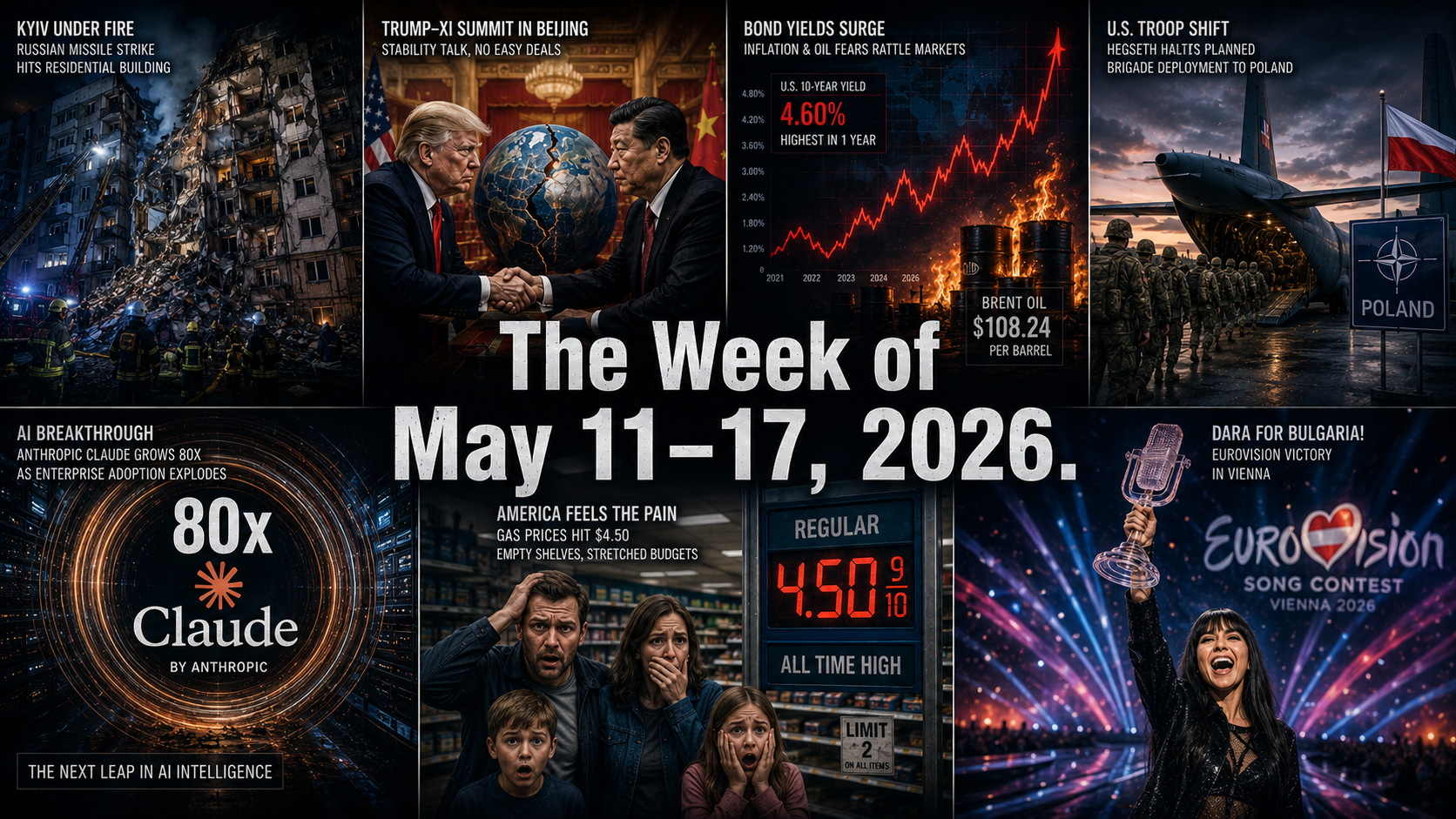
A week in which Ukraine buried its dead and found Western microchips in the missiles that killed them. In which the two most powerful leaders on earth sat across a table in Beijing and agreed on almost nothing that mattered. In which bond markets around the world sent a signal that no government wanted to hear. In which the United States quietly began withdrawing from its own alliance. In which an AI company that nobody thought would win is now worth nearly a trillion dollars. In which the Iran war arrived in the grocery store and at the gas pump for every American family. And in which, on a Saturday night in Vienna, a Bulgarian singer nobody had picked to win took the stage and changed the story entirely. This is the week of May 11 to 17, 2026.
Russian Missiles That Killed Ukrainians This Week Were Built in 2026 With Western Parts
The ceasefire that Russia had declared for Victory Day, May 9, collapsed almost immediately, and what followed was one of the most devastating weeks of Russian aerial bombardment since the full-scale invasion began in February 2022. A combined drone and missile assault on Kyiv killed at least one person and injured more than 31 others, with a multistory residential apartment building partially collapsing after a direct strike. Rescue teams worked through the night pulling survivors from the rubble. Separate cumulative tallies from the Kyiv Independent counted 24 killed, including three children, and 47 injured across the broader wave of attacks during the week. President Zelensky called the strikes deliberate targeting of civilians and ordered military preparations for a response.
What made the week's strikes particularly damning in political terms was the finding published by Ukrainian forensic investigators: the Iskander ballistic missiles and Kh-101 cruise missiles recovered from the latest attack were manufactured within 2026, in some cases only weeks before being fired, and continued to carry Western-designed electronics smuggled through sanctions cordons via third-country intermediaries. Ukraine's Scientific Research Institute of Forensic Expertise documented that components from manufacturers based in the United States, the Netherlands, Germany, Switzerland, Japan and the United Kingdom have appeared repeatedly in Russian missile guidance systems. Vladyslav Vlasiuk, the Ukrainian president's commissioner for sanctions policy, renewed calls for Western governments to hold manufacturers legally responsible. The U.S. Senate Permanent Subcommittee on Investigations had already concluded that American firms had the resources and knowledge to vet buyers more rigorously. None has been prosecuted.
Trump and Xi Stabilize the Relationship. The Hard Part Hasn't Started Yet.
The two-day summit at the Great Hall of the People in Beijing produced no joint statement, no breakthrough on Taiwan, no binding commitment on Iran, and no resolution of the tariff and semiconductor disputes that have defined the bilateral relationship for the better part of a decade. What it produced, instead, was an agreement to keep talking, a framework Xi described as a constructive China-US relationship of strategic stability, and a Chinese pledge to treat this as the guiding framework for the next three years. Trump called Xi a great leader and a friend, invited him to the White House in September, and told Fox News that China had agreed to order 200 Boeing jets. Nvidia CEO Jensen Huang, who traveled on Air Force One alongside Elon Musk and Apple CEO Tim Cook, reported that Beijing had cleared the way for H200 chip sales to major Chinese companies.
The harder issues were deferred rather than resolved. Xi's opening salvo, delivered in front of cameras on Thursday morning, placed Taiwan at the center of everything, warning that mishandling it would cause clashes and even conflicts and put the entire relationship in great jeopardy. Beijing's readout of the summit led with Taiwan; Washington's did not mention it. On Iran, both sides agreed the Strait of Hormuz must remain open, but no concrete mechanism for Beijing to pressure Tehran was agreed. Tariffs remain in place. Rare earth restrictions remain unresolved. CSIS analysts noted that China would almost certainly continue to provide systematic support for Russia's war machine regardless of what was said in Beijing. The summit stabilized a relationship that had been heading toward a new crisis. Whether stabilization is enough, given what both sides left on the table, is the question that will define the months ahead.
Bond Yields Hit One-Year Highs Globally as the Oil Shock Reprices Everything
The week's most consequential financial signal came not from any stock exchange but from the global bond market, which sent an unambiguous message on Friday, May 15: investors no longer believe inflation is under control, and they are demanding to be paid more to hold government debt. The U.S. 10-year Treasury yield rose roughly 10 basis points to 4.58%, its highest level in a year, capping its largest weekly jump since Trump's tariffs rattled markets in April 2025. Japan's 30-year government bond yield breached 4% for the first time since its 1999 debut, its 20-year rate hit peaks unseen since 1996, and its 40-year yield reached its highest since the instrument debuted in 2007. UK 30-year gilt yields hit 28-year highs, compounded by the political crisis threatening Prime Minister Starmer's fiscal credibility. Yields also surged in Germany, Spain, Australia and across emerging markets.
The driver in every case was the same: the Iran war and its energy shock. Brent crude topped $108 a barrel during the week. April's U.S. Consumer Price Index showed inflation at 3.8% annually, its largest jump in nearly three years, with nearly half the monthly increase driven by energy costs. Producer prices accelerated at the fastest pace since 2022. Fed Governor Michael Barr said inflation is the overwhelming risk facing the economy. Markets are now pricing roughly a two-thirds probability of a Federal Reserve rate hike at the December meeting, a remarkable reversal from the multiple cuts that had been expected just three months ago. Newly confirmed Fed Chair Kevin Warsh, who takes over from Jerome Powell this week, inherits a central bank that is under simultaneous pressure from a president demanding cuts and from an economy that may demand the opposite.
Hegseth Stuns the Pentagon Again, Canceling the Poland Troop Deployment
For the second time in two weeks, Defense Secretary Pete Hegseth made a decision that left the Pentagon's own senior leadership caught off guard. On Wednesday, May 14, Hegseth signed a memo canceling the planned rotational deployment of the 2nd Armored Brigade Combat Team, 1st Cavalry Division, roughly 4,000 soldiers who had been in the final stages of preparation for a nine-month rotation through Poland, the Baltic states and Romania. Some personnel and equipment had already arrived in Europe and had to be sent back. The memo also canceled the future deployment to Germany of a battalion specializing in long-range rocket and missile fire, and ordered the removal of the command overseeing those capabilities from the European continent entirely. The move came two weeks after the Pentagon announced the withdrawal of 5,000 troops from Germany, a decision that had itself not been flagged to Army leadership testifying before the Senate Armed Services Committee days earlier.
The strategic logic, such as it is, was described by Pentagon officials as part of a pivot toward homeland defense and the Indo-Pacific, and as a transactional signal to European allies who did not join the U.S. operation against Iran. The political logic was even clearer: Trump has been in an open feud with German Chancellor Friedrich Merz, who accused Iran of humiliating the United States and received a withering public rebuke from Trump in response. Senator Jeanne Shaheen said the withdrawal sends the wrong message to Putin, to China and to Iran. Gen. Alex Grynkewich, commander of U.S. European Command, had told lawmakers in March that Russia remains an enduring regional challenger capable of threatening the US homeland. The deployment cancellation is the largest single reduction in U.S. rotational presence in Eastern Europe since the full-scale Russian invasion began in 2022.
Anthropic Was Behind. Now It's the AI Boom's Front-Runner.
Twelve months ago, Anthropic was the responsible but slower rival, celebrated for safety research while OpenAI dominated headlines and market share. This week, CEO Dario Amodei disclosed that the company's revenue and usage grew 80-fold in the first quarter of 2026 on an annualized basis, a figure so far beyond internal projections that Amodei described it as just crazy and too hard to handle. The company had built infrastructure for 10-fold growth. The actual demand was eight times larger. That mismatch explains the compute crisis that has defined Anthropic's operations in recent months and drove the landmark deal with SpaceX's Colossus 1 data center in Memphis, giving Anthropic access to over 300 megawatts of capacity and more than 220,000 Nvidia GPUs. The growth is being led by Claude Code, now the dominant AI tool in professional software engineering, and by rapid expansion into enterprise and financial services.
Anthropic announced a $1.5 billion joint venture with Goldman Sachs, Blackstone, Apollo, Hellman & Friedman and General Atlantic to deploy Claude directly inside portfolio companies. At a New York financial services briefing, JPMorgan CEO Jamie Dimon sat alongside Amodei as Anthropic's chief economist projected that AI would add 1.8 percentage points annually to US labor productivity over the next decade. The company is now in discussions to raise capital at a valuation approaching $900 billion, which would make it worth more than OpenAI for the first time. Amodei separately put the probability of an AI model capable of training its own successor by end of 2028 at 60%, a statement that, from a lab known for understatement on risk, carries unusual weight.
Trump's Iran War Is Now in the Grocery Store, at the Gas Pump and on the Pay Stub
The economic toll of the Iran conflict arrived this week not as an abstraction in a government report but as a lived experience for tens of millions of American households. The Bureau of Labor Statistics confirmed what those households had been feeling for months: inflation has now risen faster than wages, erasing real purchasing power gains for the first time since 2023. Gasoline averaged $4.50 per gallon nationally, the highest since July 2022, having surged 5.4% in April alone. Grocery prices posted their biggest monthly jump in nearly four years. Airfares are up 20% year-on-year, driven by a 60% surge in jet fuel costs since the conflict began in late February. Goldman Sachs estimates the US may run out of jet fuel as early as July if the Strait of Hormuz remains blocked at its current rate of disruption.
Moody's Analytics chief economist Mark Zandi warned that the energy shock from the Iran war threatens to do more economic damage than the tariffs that roiled markets in 2025, undermining growth and pushing inflation higher simultaneously. Goldman Sachs put recession risk at 30%, EY-Parthenon at 40%. President Trump announced plans to suspend the federal gas tax as a relief measure, a politically popular but economically limited response to a structural supply problem. Saudi Aramco CEO Amin Nasser warned that global fuel inventories may reach critically low levels ahead of the summer travel season and that the oil market will not normalize until 2027 if the Strait of Hormuz disruption persists beyond mid-June. Every week the strait remains closed, the world loses approximately 100 million barrels of oil supply. Total net losses since the conflict began now stand at roughly 880 million barrels.
Bulgaria Wins Eurovision 2026 for the First Time in History, Romania Finishes Third
On Saturday night in Vienna, in front of an audience of millions across Europe and beyond, Bulgaria's Dara was crowned the winner of the 70th Eurovision Song Contest with her party anthem Bangaranga, accumulating 516 points and winning both the national jury vote and the public televote, the first time a single entry has won both categories simultaneously since Portugal's triumph in 2017. It is Bulgaria's first-ever Eurovision victory. Dara, a well-known pop figure on the Balkan music scene and a mentor on The Voice Bulgaria, had not been among the bookmakers' favorites to win. The staging, handled by Fredrik Rydman, combined explosive choreography with the kind of club-driven energy that played equally well in the arena in Vienna and on television screens across the continent. Israel finished second, provoking audible boos in the arena when its audience points briefly moved it to first place, a flashpoint reflecting the political controversy that has surrounded Israel's participation across the past two editions of the contest.
Romania's Alexandra Căpitănescu finished third with the rock song Choke Me, the country's best Eurovision result in years. Australian star Delta Goodrem came fourth with Eclipse, and Italian singer Sal Da Vinci finished fifth with Per Sempre Si. Finland's Pete Parkkonen and Linda Lampenius, who had been the strong betting favorites throughout the week, ended in sixth place, continuing Eurovision's long tradition of surprising the markets. The contest was held in Vienna because Austria's JJ won the 2025 edition, and took place against a backdrop of political tension: Iceland, Ireland, the Netherlands, Slovenia and Spain all boycotted this year's competition in protest at Israel's inclusion, giving Eurovision 2026 the lowest number of participating countries since the introduction of semi-finals in 2004. The 71st Eurovision Song Contest will be hosted in Bulgaria in 2027.
