
Taiwan, Chips, Money and War: Thursday, May 14, 2026
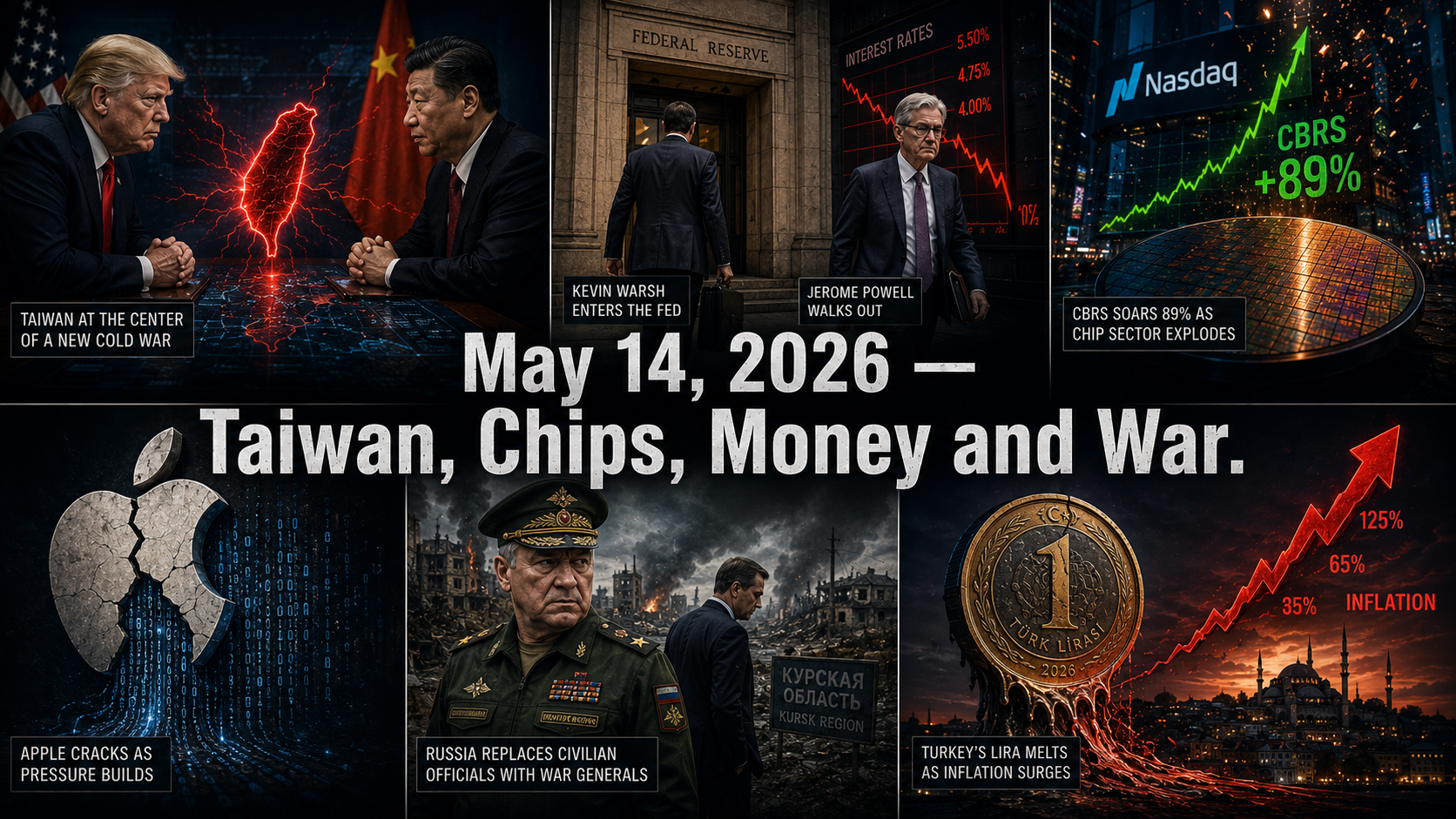
Xi opened the Beijing summit with a warning, not a welcome. The US got a new Fed chair, and the market is not sure he can deliver what Trump wants. An AI chip startup nearly doubled on its first day of trading. An AI model found a way into Apple's most hardened systems. Putin quietly purged the last governor who dared to complain. And Turkey raised its inflation target by 50% and stopped pretending it had a ceiling. Thursday was a day of hard truths.
Xi's Taiwan Warning to Trump Defines the Tone of the Beijing Summit
Chinese President Xi Jinping wasted no time setting the terms of the two-day summit at the Great Hall of the People in Beijing. In his opening remarks to President Trump on Thursday morning local time, Xi placed Taiwan at the center of the agenda, calling it the most important issue in China-US relations and warning that mishandling it would cause clashes and even conflicts, putting the entire relationship in great jeopardy, according to Beijing's foreign ministry. The warning was striking in its directness. Xi also invoked the concept of the Thucydides Trap, the historical tendency for a rising and an established power to end up in armed conflict, raising the stakes of his words well above diplomatic rhetoric.
Trump, for his part, struck a warmer tone, calling Xi a great leader and a friend, inviting him to the White House in September, and expressing optimism that the relationship was going to be better than ever. The contrast between the two leaders' registers was noted by every observer in the room: Trump came with trade deals to tout; Xi came with a red line to draw. The White House readout of the first session focused on economic cooperation and the Iran war, with no mention of Taiwan. Beijing's readout led with it. Musk, Cook and Jensen Huang, who all traveled with Trump on Air Force One, told reporters after meeting Xi separately that the talks had gone well. Taiwan's government said there was no surprising message so far, while confirming it was preparing for possible surprises.
Senate Confirms Kevin Warsh as Federal Reserve Chair, Replacing Jerome Powell
The US Senate confirmed Kevin Warsh as the 17th chair of the Federal Reserve on Wednesday in a 54-45 vote, the most partisan confirmation of a Fed chair in modern history and a long-sought victory for President Trump, who spent the better part of a year publicly pressuring, criticising and attempting to undermine the institution and its outgoing leader Jerome Powell. Warsh, 56, a former Fed governor from 2006 to 2011 and a lecturer at Stanford's business school, formally takes over Powell's role on Friday when Powell's term as chair expires. Powell will remain at the Fed as a governor, having two years left on his board term, a historically unusual arrangement that reflects both his determination to resist what he described as a series of legal attacks on the Fed and the institution's need for continuity.
The confirmation is a political milestone, but the economic question it opens is more consequential than the political one it closes. Trump has made no secret of his expectation that Warsh will cut interest rates, and Warsh has previously argued that rates can be lower. But the environment he inherits makes swift cuts almost politically impossible: inflation rose 3.8% in the twelve months to April, its largest annual increase in nearly three years, driven in large part by the energy shock from the Iran war. At the Fed's last meeting in April, three FOMC members signalled their next move could as easily be a hike as a cut. Markets are now pricing roughly a one-in-three chance of a rate increase by December. Warsh has said he will use his own judgement and not take orders from the White House. Trump has joked that he would sue Warsh if rates are not cut. His first FOMC meeting as chair is scheduled for June 16 to 17.
Cerebras Shares Nearly Double on Debut in the Year's Biggest IPO
Cerebras Systems began trading on the Nasdaq on Thursday under the ticker CBRS and the market's verdict was unambiguous. The AI chipmaker priced its IPO at $185 per share, raising $5.55 billion in the largest public offering of 2026 so far, and shares surged to as high as $367 in early trading before stabilising around $334, a near-doubling that halted the stock for volatility. The company's fully diluted valuation, which stood at $8.1 billion just eight months ago, now approaches $56 billion. Investor demand for the IPO exceeded available shares by more than 20 times. Cerebras builds what its CEO Andrew Feldman calls a chip the size of a dinner plate: its Wafer-Scale Engine 3 is 58 times larger than a conventional GPU and runs AI inference tasks more than 15 times faster than leading GPU-based systems on certain open-source models. Revenue jumped 76% in 2025 to $510 million. The company has secured a cloud deal with OpenAI worth more than $20 billion and an arrangement with AWS to host its chips in Amazon data centres. Cerebras is seen as a bellwether: if this is a test of investor appetite for AI infrastructure ahead of anticipated listings from SpaceX, OpenAI and Anthropic, the test has been passed emphatically.
Apple's Security Has Been Tough to Crack. Anthropic's Mythos Helped Find a Way In.
Researchers at cybersecurity firm Calif used Anthropic's Claude Mythos Preview in April to uncover a previously unknown vulnerability in macOS, the Wall Street Journal reported Thursday. Operating under Anthropic's Project Glasswing initiative, the researchers used Mythos to write code linking two existing macOS bugs in a way that produced a privilege escalation exploit: an attack path that could allow a hacker, combined with other methods, to seize control of an affected machine and access restricted areas of the operating system. Apple confirmed it is reviewing the report and said security is its top priority. Anthropic has restricted Mythos to a select group of organisations, including Apple, AWS, Google, Microsoft, Nvidia, CrowdStrike and Palo Alto Networks, after concluding that its cybersecurity capabilities, which include autonomously finding thousands of zero-day vulnerabilities across every major operating system and web browser, were too powerful for general release. The Apple disclosure is the first high-profile public result from that effort, and it will not be the last.
Putin Replaces the Governor Who Dared Complain, Installing a War General in His Place
Vladimir Putin signed decrees on Wednesday replacing the governors of both the Belgorod and Bryansk regions, the two Russian territories that border Ukraine and have been most heavily exposed to Ukrainian cross-border strikes. The departure of Belgorod Governor Vyacheslav Gladkov is the more politically significant. Gladkov had built an unusual profile among Russian regional officials, documenting Ukrainian strikes on Belgorod daily via social media and earning genuine popularity for his transparency, while occasionally voicing mild public criticism of central government decisions. His departure was framed by the Kremlin as occurring at his own request, the standard formula that rarely reflects actual circumstances. In his place, Putin appointed General Alexander Shuvaev, a decorated military officer who fought in Ukraine and previously served in campaigns in Syria and Georgia. Bryansk's governor was similarly replaced with Yegor Kovalchuk, an official from Russia's occupational administration in Luhansk. The pattern is clear: civilian administrators with independent voices are being replaced with military loyalists, hardening the character of Russia's border regions as the war enters its fifth year.
Turkey Raises Its Inflation Target by 50% and Stops Pretending It Has a Ceiling
Turkey's central bank delivered a stark admission on Thursday: the inflation target it had been working toward is no longer achievable. Governor Fatih Karahan announced that the bank is raising its year-end inflation target from 16% to 24%, a 50% upward revision, and suspending its forecast range entirely, citing major uncertainty generated by the US-Israeli war on Iran. The move acknowledges that Turkey's multi-year disinflation effort has been derailed by an external shock beyond its control. Turkey imports the vast majority of its energy, and the surge in oil and gas costs since the Strait of Hormuz was effectively closed in February has fed directly into transportation, manufacturing, food production and household budgets. The decision to suspend the forecast range entirely is the more telling signal: a central bank that publishes a range is committing to outcomes it believes it can achieve. Suspending that range is an admission that uncertainty is now too large to be bounded. The lira came under renewed pressure following the announcement. Turkey is one of many economies discovering that the Iran war's aftershocks extend far beyond the countries directly at war.
