
AI, Energy, Space and War: Wednesday, May 13, 2026
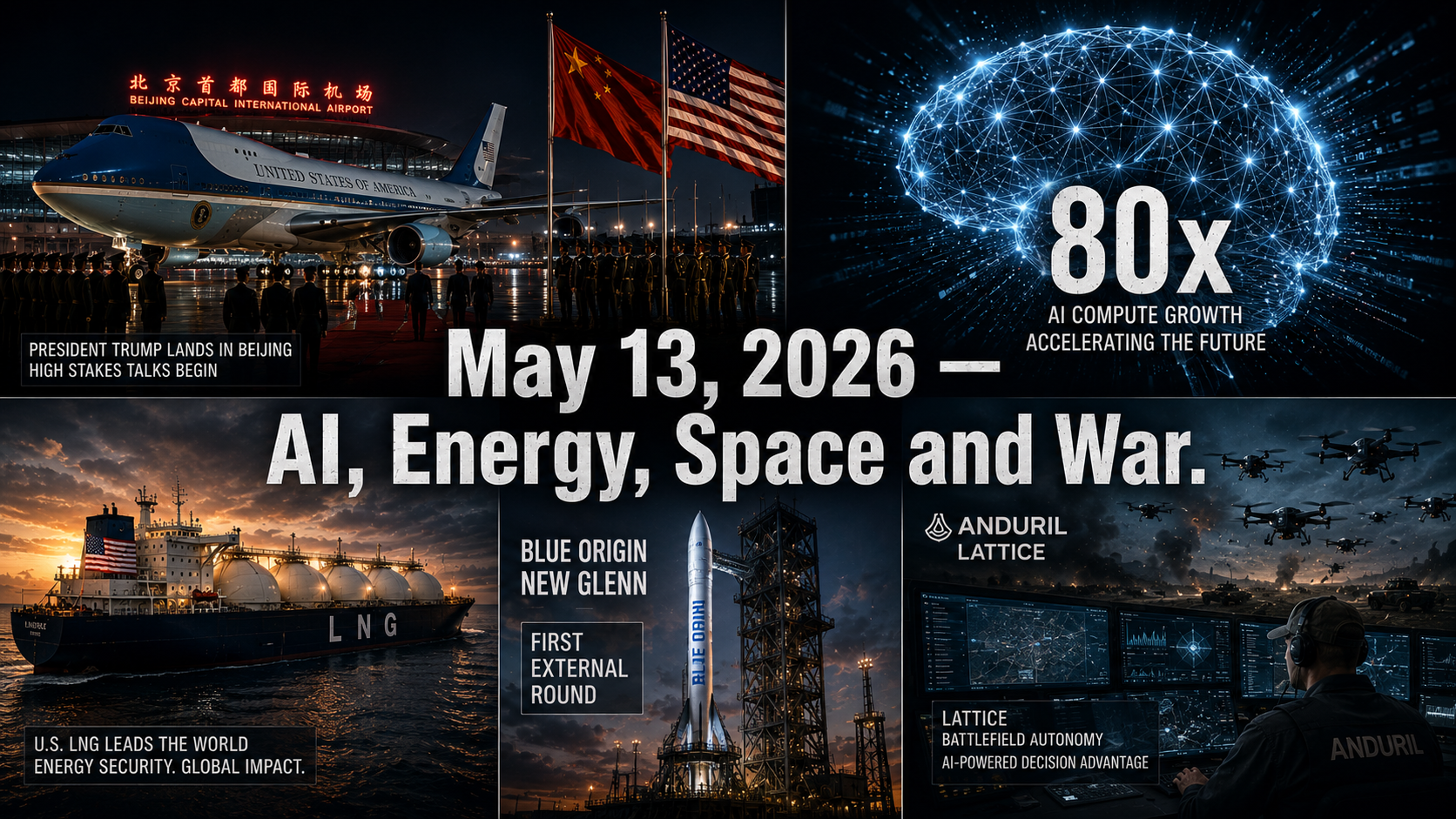
Trump lands in Beijing with an unresolved war in his pocket. Anthropic has gone from playing catch-up to leading the AI race in under a year. America's energy dominance is quietly rewriting the geopolitical map. Blue Origin is finally opening its doors to outside money. And a nine-year-old defence startup just doubled its valuation to $61 billion in a single morning. Wednesday brought five stories that, together, sketch the contours of a world being rebuilt in real time.
Trump Arrives in Beijing With an Unesolved Iran War Hanging Over the Summit
Air Force One touched down at Beijing Capital International Airport on Wednesday evening local time, marking the first visit by an American president to China since Trump's own trip in 2017, and the most consequential bilateral summit in years. Trump was greeted by Chinese Vice President Han Zheng and met by a delegation that included Secretary of State Marco Rubio, Defense Secretary Pete Hegseth, and a striking collection of Silicon Valley CEOs: Elon Musk of Tesla and SpaceX, Tim Cook of Apple, and Nvidia's Jensen Huang. The optics were deliberate, projecting US technological and economic weight alongside military and diplomatic muscle. The two-day talks with President Xi Jinping, beginning Thursday morning Beijing time, are expected to cover trade, Taiwan, artificial intelligence and critical minerals. But one issue dominates everything else: the Iran war.
Trump had originally planned to visit China in March, delaying the trip when he predicted the conflict would be over in a matter of weeks. More than two months later, a peace deal remains elusive, and Trump described the ceasefire on Monday as being on massive life support. The strategic stakes of the Beijing summit are, in part, defined by that failure. China has close ties with both Iran and Pakistan, which hosted earlier failed peace talks, and has quietly emerged as a potential mediator. Iran's foreign minister visited Beijing just days before Trump's arrival, underscoring the depth of that relationship. US officials are hoping Xi will use that leverage to press Tehran toward a deal, while acknowledging that Xi holds significant cards of his own and may use the moment to extract concessions on Taiwan, semiconductor restrictions, or rare earth export controls. As Beijing's residents told CNN correspondents, few in China have any appetite for being pulled into someone else's war.
Anthropic Was Behind. Now It's the AI Boom's Front-Runner.
Twelve months ago, Anthropic was the responsible but slower rival, celebrated for safety research while OpenAI dominated headlines and market share. Today, the picture has inverted. CEO Dario Amodei revealed this month that Anthropic's revenue and usage grew 80-fold in the first quarter of 2026 on an annualized basis, a figure so far beyond internal projections that Amodei described it as just crazy and too hard to handle. The company had planned for 10-fold growth and built infrastructure accordingly. The actual demand was eight times larger than the most aggressive internal scenario. That mismatch explains the compute crisis that has dominated Anthropic's operational life in recent months and drove the landmark deal with SpaceX's Colossus 1 data centre in Memphis, giving Anthropic access to over 300 megawatts of capacity and more than 220,000 Nvidia GPUs.
The growth is being driven by Claude Code, the agentic coding tool launched last year that has become the dominant AI tool in software engineering, and by a rapid expansion into enterprise and financial services. Anthropic announced a $1.5 billion joint venture with Goldman Sachs, Blackstone, Hellman & Friedman, Apollo, and General Atlantic to deploy Claude directly inside portfolio companies. At a financial services briefing in New York, Jamie Dimon of JPMorgan sat alongside Amodei on stage as Anthropic's chief economist projected that AI could add 1.8 percentage points to US labor productivity annually over the next decade, roughly doubling recent run rates. The company is now in discussions to raise capital at a valuation approaching $900 billion, which would make it worth more than OpenAI for the first time. Amodei separately predicted a 60% probability that an AI model will be capable of fully training its own successor by the end of 2028, a statement that, coming from a lab known for understatement on risk, carries unusual weight.
How the United States Became the World's Greatest Energy Exporter
Ten years ago this February, the first cargo of US liquefied natural gas departed from Sabine Pass in Louisiana, marking the beginning of a transformation that has fundamentally altered global energy geopolitics. Today, the United States is the world's largest exporter of LNG, surpassing both Australia and Qatar, with exports averaging more than 16 billion cubic feet per day in 2026 and forecast to exceed 18.1 billion cubic feet per day by 2027. The journey from energy importer to dominant exporter was made possible by the shale revolution, the combination of horizontal drilling and hydraulic fracturing that unlocked vast domestic reserves of oil and natural gas beginning in the 2000s, and accelerated by a decade of infrastructure investment that added liquefaction terminals along the Gulf Coast and created the flexible, free-on-board export model that made US LNG attractive to buyers from Japan to Germany.
The strategic implications of that transformation are playing out in real time. When Russia invaded Ukraine in 2022, the United States was able to redirect LNG exports to Europe, which received 68% of US volumes in the years that followed, effectively replacing Russian pipeline gas and strengthening Washington's hand in European energy diplomacy. The Iran war has added a further dimension: with the Strait of Hormuz effectively closed since early March and Qatar's Ras Laffan LNG facility damaged by Iranian strikes, the United States has emerged as the only major exporter with both the volume and the logistics to partially fill the gap in Asian markets. The IEA projects that between 2025 and 2030, a total of 345 billion cubic feet per year of new US LNG export capacity will come online, the largest wave in the history of LNG markets. Energy independence, once a political slogan, is now a structural geopolitical fact.
Blue Origin Weighs Its First External Fundraising as the Space Race Enters a New Phase
For 25 years, Blue Origin has been Jeff Bezos's private project, funded almost entirely by sales of his Amazon stock, with no outside investors, no public listing, and no external accountability. That is about to change. The Financial Times reported Wednesday that Blue Origin is weighing its first-ever external funding round, a decision that CEO Dave Limp has framed in unusually direct terms at an all-hands meeting with employees: achieving the company's launch ambitions, he said, will require a large amount of funding that cannot be met by a single investor alone. Blue Origin spent approximately $4.8 billion this year, and cumulative expenditure since its founding is approaching $28 billion, figures that reflect an aggressive expansion including a new 800,000 square-foot manufacturing facility, a second launch pad in Florida, and continued investment in its New Glenn rocket and lunar lander programmes.
The timing of the decision is inseparable from SpaceX's impending IPO. With Musk's company targeting a listing at a valuation of $1.75 trillion or more, potentially the largest in financial history, the market for space infrastructure investment is at its most receptive in decades. Limp told employees that Blue Origin is optimistic about strong investor interest, and analysts note that an external funding round would, for the first time, establish a third-party market valuation for the company. Bezos, whose net worth is estimated at $221 to $241 billion in 2026, has not indicated any intention to sell the company, but Limp explicitly did not rule out an IPO as a future possibility. Analysts at Capstone believe a successful external round would lay the foundation for precisely such a listing, following the same strategic logic SpaceX has used to build market credibility ahead of its own float.
Anduril Raises $5 Billion and Doubles Its Valuation to $61 Billion in a Single Round
Anduril Industries, the defence technology startup founded by Palmer Luckey, the creator of the Oculus VR headset, confirmed Wednesday that it has raised $5 billion in a Series H funding round led by Thrive Capital and Andreessen Horowitz, doubling its valuation from $30.5 billion to $61 billion in one of the largest private defence technology financings in history. The round also included participation from Founders Fund and Lux Capital. CEO Brian Schimpf said the company would aggressively invest the capital in manufacturing, research, and infrastructure to scale autonomous defence systems for the United States and its allies. Anduril doubled its revenue in 2025 to $2.2 billion, a trajectory that has made it the clearest winner in a wave of venture capital flooding into defence technology as geopolitical risks multiply. The company was founded in 2017 at a time when, as Schimpf put it, defence was not a category that attracted significant venture investment. That has changed meaningfully.
Anduril's core product is Lattice, an AI-enabled command-and-control platform that integrates drones, radar, sensors, and battlefield intelligence into a single unified interface, a software-first approach that distinguishes it from traditional hardware-focused defence contractors like Lockheed Martin and Northrop Grumman. The company has also expanded aggressively into physical manufacturing: its Arsenal-1 facility in Ohio, a five-million-square-foot autonomous weapons complex, is expected to begin production in July 2026. On Wednesday, the Department of Defense separately announced an agreement with Anduril and three other firms to purchase more than 10,000 low-cost hypersonic missiles over the next three years. Anduril is also part of the consortium working on Trump's $185 billion Golden Dome missile defence shield. The funding round comes ahead of a widely anticipated IPO, though no timeline has been formally announced. At $61 billion, Anduril is now worth more than L3Harris Technologies and rapidly closing on General Dynamics.
