
How Fast Is the Universe Really Expanding? The New Measurement That Deepens the “Hubble Tension”
Introduction: A universe running away from us
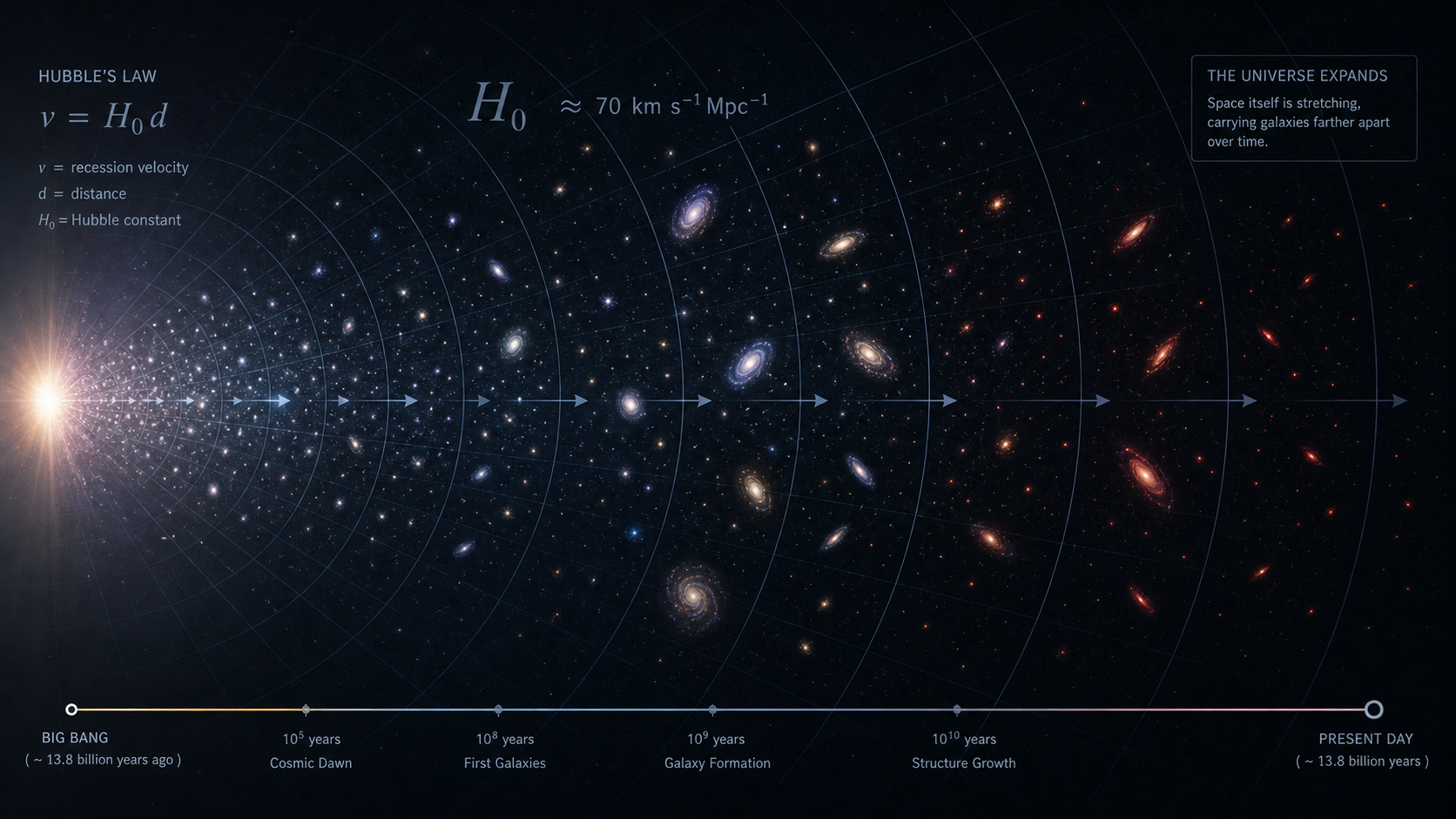
For almost a century we have known that the universe is expanding, with galaxies moving away from each other at a speed that increases with distance.
The rate of this expansion is called the Hubble constant and is usually expressed in kilometers per second per megaparsec (1 megaparsec is approximately 3.26 million light‑years).
At first sight, the question “how fast is the universe expanding?” should have a single answer, if our cosmological model is correct.
In reality, over the last decade two incompatible values have emerged, giving rise to what physicists call the “Hubble tension.”
Two universes in one: Where the Hubble tension comes from
Modern cosmology is built on the Lambda Cold Dark Matter model, written ΛCDM, in which the Greek letter Λ (Lambda) represents dark energy, and Cold Dark Matter represents a form of matter that does not emit light and moves slowly compared to the speed of light.
Based on observations of the cosmic microwave background radiation, taken for example by the Planck satellite, this model predicts a Hubble constant of roughly 67–68 km/s/Mpc.
In parallel, “local” measurements — that is, in the nearby universe — use the so‑called cosmic distance ladder: variable Cepheid stars, type Ia supernovae and other “standard candles” to determine distances.
These methods have consistently produced values around 72–75 km/s/Mpc, significantly higher than the Planck+ΛCDM prediction, meaning that the universe seems to expand by about 8–10% faster than it “should.”
This discrepancy is not a mere technical detail.
If both sets of measurements are correct, it means our standard model of the universe is incomplete.
The news: A 1% precision measurement that leaves little room for excuses
The Wall Street Journal article starts from a recent study by a large international collaboration, known in science reporting as the Local Distance Network or H0 Distance Network.
Their goal was to systematically combine almost all modern methods of measuring cosmic distances and to obtain a single value for the Hubble constant, with a precision of the order of 1%.
The result of the study, published on 10 April 2026 in the journal Astronomy & Astrophysics, is:
H0=73.50±0.81 km/s/MpcH0=73.50±0.81 km/s/Mpc
That is, an expansion rate of about 73.5 kilometers per second for every megaparsec.
This level of precision, better than 1%, significantly reduces the room in which simple “measurement error” could explain the difference from the 67–68 km/s/Mpc obtained from the Lambda Cold Dark Matter model.
In short: the new analysis does not solve the Hubble tension; it confirms and sharpens it.
The more accurately we know how fast the universe expands today, the clearer it becomes that this value does not match what our model says when we start from the universe 13.8 billion years ago and evolve it forward in time.
Why it is unlikely to be just an instrumental error
In recent years, different teams have tried to track down possible sources of systematic error: the calibration of Cepheid star luminosities, the nature of type Ia supernovae, the selection of galaxies and their environments, the effects of cosmic dust or the evolution of stellar populations.
Many of these analyses relied on the Hubble Space Telescope and, more recently, on complementary observations from the James Webb Space Telescope, which sees better in the infrared and reduces the impact of dust.
Combined Hubble + James Webb data already led to the same conclusion: the universe appears to expand about 8% faster than the value predicted by Lambda Cold Dark Matter, with an average Hubble constant of roughly 73 km/s/Mpc.
The new study goes further by integrating more distance techniques and obtaining the value 73.50 ± 0.81 km/s/Mpc, which makes it much harder to argue that the tension is just an artifact of a single instrument or method.
In parallel, other studies have tried to pull the local value of the Hubble constant downward, even suggesting values around 64 km/s/Mpc, but these are not currently consistent with most independent observations.
The new work strengthens the idea that the problem does not lie in one instrument alone, but in how we interpret the cosmos as a whole.
What this could mean for physics
If we assume that measurements of the cosmic microwave background (the early universe) and local measurements (the present‑day universe) are both correct, we are left with an uncomfortable conclusion: the standard Lambda Cold Dark Matter model does not perfectly describe the history of cosmic expansion.
The roughly 8–10% difference in the expansion rate could indicate several possibilities.
One is a “dynamic” form of dark energy, which behaved differently in the early universe than it does today.
Another is an additional ingredient in the universe’s matter or radiation content — for example, new particles, “dark radiation” or sterile neutrinos — that changes the way matter curves spacetime.
A third possibility is that we may need to revise the way gravity works at very large scales, beyond Einstein’s general relativity.
None of these ideas has yet become a new standard, but the new measurement pushes the scientific community to take models beyond Lambda Cold Dark Matter seriously.
What the number 73.5 km/s/Mpc means in practice
A Hubble constant of 73.5 km/s/Mpc means that for every megaparsec (about 3.26 million light‑years) of distance, a galaxy recedes from us at 73.5 kilometers per second on average.
If a galaxy is 100 megaparsecs away, its recession velocity would be, in an idealized sense, about 7,350 km/s, just from the expansion of space itself.
This rate is not the “speed” of the universe as a whole, but the way distances between objects grow over time in a space that is stretching.
As we look farther out, we see not only more distant regions of space but also farther back in time, and the relationship between distance and the redshift of light encodes the history of expansion.
In popular terms, the new result says: today’s universe is “running away” a bit faster than the calculations lead us to expect when we start from the young universe and evolve it with the standard model.
This article summarizes the results of a study published in the scientific journal Astronomy & Astrophysics, as reported for a wider audience by The Wall Street Journal in ‘How Fast Is the Universe Expanding? These Cosmologists Finally Figured It Out.’.
