
Are we living in a new world order?
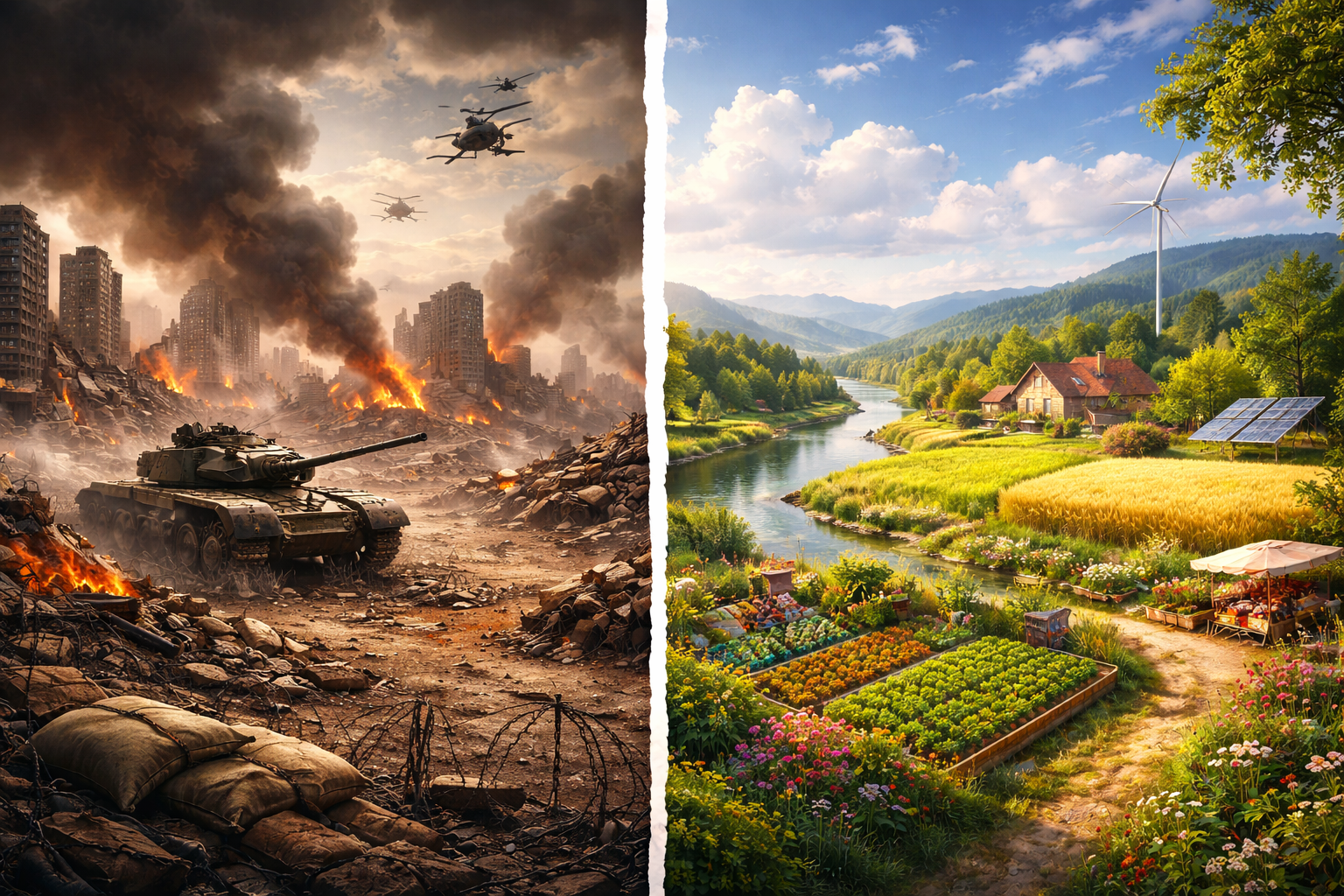
Not yet, but we are no longer in the old world order either. I would say we are in a period of transition. In my view, this period began in 2020 with the pandemic, which exposed the downsides of globalization, and in 2022, with Russia’s invasion of Ukraine, this process accelerated and will probably last for about another decade, until the end of this transition that will shape the new world order.
The old world order
With the end of the Second World War, which concluded brutally with the bombing of Japan by the United States using two nuclear bombs, a technology appeared that was so destructive it changed not only the outcome of the war, but also the pre‑war world order. In that old order, the United Kingdom was the dominant power, “setting the time” for the world in both a literal and a figurative sense.
After the United States demonstrated its military power, it began to build its economic strength and its capacity for global projection. By establishing the dollar as the main reserve and trading currency, managing the gold reserves of many countries and benefiting from the world’s largest oil production, the US managed to impose its currency as the central means of payment in international trade – hence the term “petrodollar,” since oil, one of the most traded commodities, is priced in dollars.
In parallel with the recognition of this new global power, Great Britain and the other colonial empires started the process of decolonization, and the states on the western side of the “Iron Curtain” gradually aligned themselves with the American model. At the same time, in the East, the Soviet Union began to contest the position of the United States and the capitalist economic system, which led to the Cold War – a conflict waged on several fronts: economic, through trade and industrial competition; military, through the arms race in nuclear and conventional weapons; and ideological, through wars and crises in Southeast Asia and other regions.
Throughout this period, as the two superpowers competed, economic globalization developed. Trade increased, prices fell, and interdependence between economies grew stronger. After the collapse of the USSR and the end of the Cold War, the process of globalization accelerated even more. However, the world did not reach the point where the level of interdependence would make major wars impossible, even though many hoped that sufficiently deep globalization would have this effect.
The transitional period
The shortcomings of the global system established after the Second World War have become so evident that almost no one is fully satisfied with the current international order. From middle powers to the largest ones, such as China and the United States, we can see a desire to reshape the world order. China contests US power, while the US itself questions some of the arrangements and institutions it created, arguing that certain rules now disadvantage it, while other states benefit disproportionately.
At the same time, several challengers have emerged who do not want a new world order dominated either by the United States or by China. Among them are Russia, India and the European Union, which favour a multipolar world – a structure in which there are several relatively comparable centers of power, involved in both competition and cooperation.
Russia is no longer an economic superpower, but militarily it remains a major actor and projects its influence by trying to rebuild a sphere of influence in the post‑Soviet space and in Eastern Europe. China is expanding its economic and political power in Asia, Africa and other regions, while the United States is trying to maintain its position but faces more rivals and a more fragmented international environment.
The European Union wants to be heard as an autonomous pole, being one of the largest economic powers in the world and a growing military force. It seeks to expand its influence through trade agreements and partnerships with countries in South America, Southeast Asia and other democratic or emerging regions. India adopts a more moderate attitude and primarily pursues economic development, often playing the role of mediator; it is increasing its influence but generally avoids using rhetoric as aggressive as that of other competitors.
The conclusion for this period is that more and more actors are pushing the world towards a multipolar configuration, in which neither the US nor China has enough power and support to dominate the international system alone.
The new world order and the end of the transition
The new world order will take shape at the end of this transitional period. How will it end? Ideally, not as the first half of the twentieth century ended, with a world war and millions of deaths. Today, in addition to nuclear weapons, a new source of fear is artificial intelligence, seen by some as a “new atomic bomb” if it is used for destructive purposes.
Some claim we are already in a “new world war,” referring to the war in Ukraine and the multiple conflicts in the Middle East and other regions. The tension in the air is indeed very high, but in my opinion, we are not yet in a world war in the strict sense; however, escalation could happen very quickly.
The fear surrounding AI depends on the purposes for which it is developed. If artificial intelligence is used to increase productivity and life expectancy, it can bring a net gain to humanity. If, on the contrary, it is used to maximize destruction and casualties, it becomes a major threat. Just like nuclear energy, AI is a tool: uranium and other radioactive elements can be used both for energy and medical applications, and for weapons.
Once a new order is established, a critical period will follow. Some states will be dissatisfied, feeling that they have lost status and may try to overturn the new order, which could lead to a revisionist conflict comparable to the tensions that preceded the Second World War. At the end of the transition, a difficult economic period is also likely: the costs of adapting to a new system are high, the benefits appear later, and the change implies not only new rules but also the restructuring of the entire economic and political “infrastructure”.
The new world order will be decisive for the future. If the change is managed well and the new system is based on a model of cooperation and relatively balanced economic and scientific competition, the outcome can be a gain for humanity. If, on the other hand, the model is deeply unbalanced and conflict‑driven, there is a risk of a system in which the strongest pole concentrates most resources while the others remain marginalized, which will fuel tensions and crises.
We do not yet know what the new world order will look like, but one thing is clear: the process of change has begun, and we are both witnesses and participants in it, even if not always consciously. The hope is that the direction in which the system evolves will eventually lead to a better outcome than the eras we are trying to leave behind.
