
When Washington Turns on Itself: Thursday, May 21, 2026
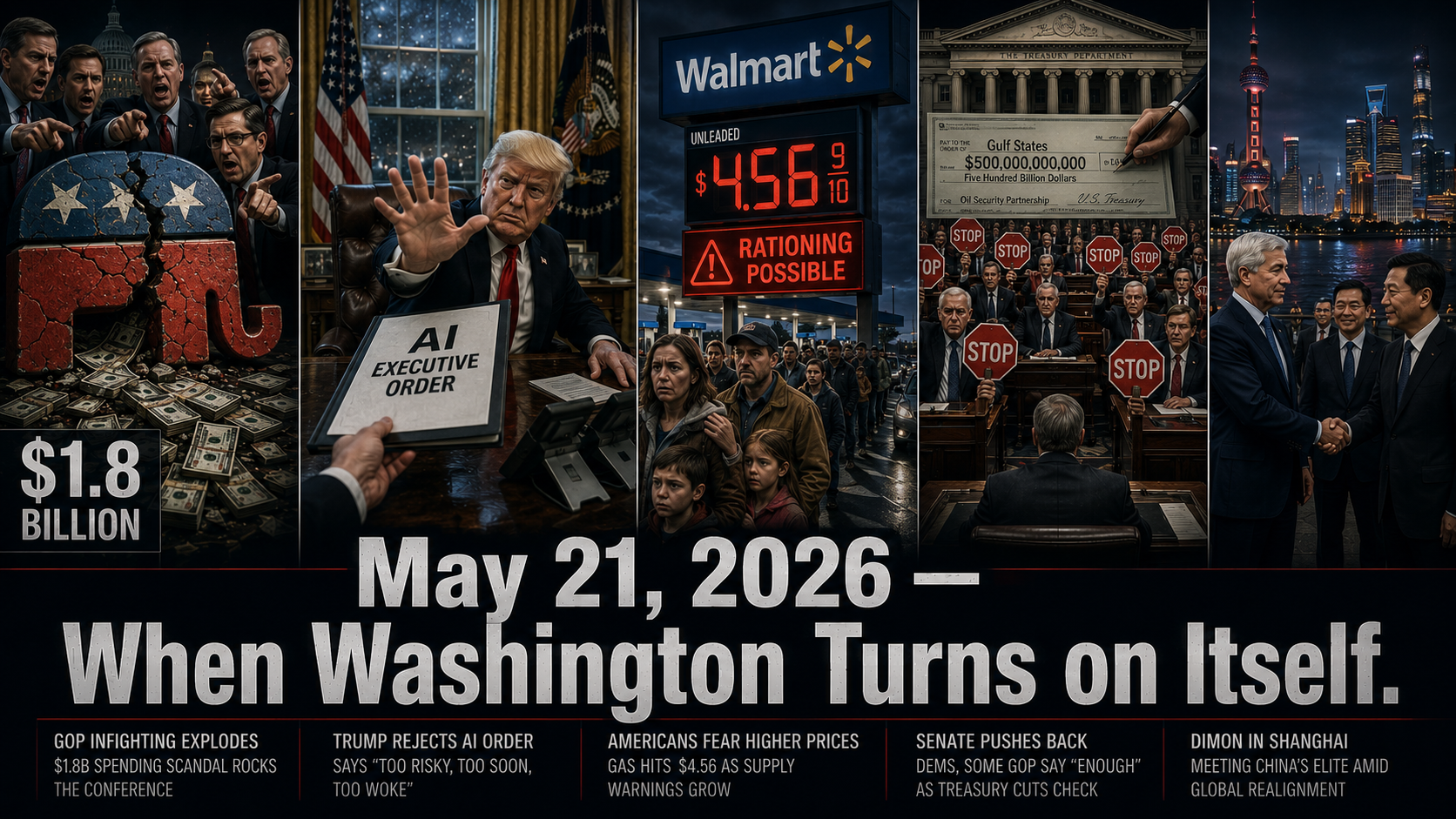
Washington is fighting itself on every front today. Republican congressmen are threatening to kill the president's own fund. Trump pulled back from signing an AI executive order at the last minute. Senators want to limit the Treasury's ability to send money abroad while Americans pay $4.56 for gas. And Walmart, the store that keeps score on how ordinary Americans are actually doing, is talking about fuel rationing. Meanwhile, Jamie Dimon flew to Shanghai and said something Washington does not want to hear: that China is better at this than it used to be. Thursday came loaded.
Trump Is on a Collision Course With His Own Party Over the $1.8 Billion Fund
The $1.776 billion Anti-Weaponization Fund that President Trump's Justice Department created this week is already generating a rebellion inside the Republican Party. Rep. Brian Fitzpatrick of Pennsylvania, a moderate Republican whose district voted for Kamala Harris in 2024, told reporters Wednesday he was going to try to kill the fund, calling it constitutionally dubious and politically indefensible. Fitzpatrick sent a letter to the Justice Department demanding answers and said he was exploring legislative options to shut it down. He was the first Republican to publicly break with the White House on the issue, but he is unlikely to be the last. The fund is the result of an unusual settlement between Trump and the IRS: Trump sued his own administration for $10 billion over the 2019 leak of his tax returns, then settled through Acting Attorney General Todd Blanche, his former personal criminal defense lawyer, creating a fund that will pay out to anyone claiming they were targeted by the government for political reasons.
The constitutional objections are significant. Only Congress has the power to appropriate federal dollars, and no legislation authorised this fund. The money comes from the Treasury's Judgment Fund, a pre-existing mechanism for settling lawsuits against the government, but legal experts are divided on whether using it for a broad programmatic payout of this kind is permissible. Blanche told a Senate Appropriations subcommittee that even people convicted of assaulting Capitol Police officers on January 6, 2021 might be eligible to receive payments. Vice President Vance separately said that Tina Peters, a Colorado county clerk convicted of a state crime, and Hunter Biden could also qualify. Democrats are already mobilising: Rep. Jamie Raskin has introduced legislation to prohibit any federal funds from being spent on the Anti-Weaponization Fund, and is eyeing a discharge petition to force a floor vote if Republican leadership blocks his bill. For Trump, the fund is a political asset for his base. For a growing number of Republicans in competitive districts, it is a liability they did not ask for.
Trump Pulls Back From AI Executive Order at the Last Minute, Citing Overregulation
President Trump postponed signing a highly anticipated artificial intelligence executive order on Thursday afternoon, hours after the White House had already sent out invitations to executives from leading technology companies. Trump told reporters in the Oval Office that he had decided to delay because he did not like certain aspects of the order as drafted. The US is ahead of China and the rest of the world on AI, he said, and he did not want to do anything that could get in the way of that lead. He described AI as causing tremendous good and said he was concerned that the executive order could have been a blocker. The signing had been postponed multiple times already; this marked the latest in a pattern of internal disagreement about how much federal oversight, even voluntary oversight, the administration was willing to impose on AI companies.
The order as drafted would have established a voluntary pre-release review framework under which AI companies agreed to share advanced models with the federal government for national security evaluation before public release, with agencies given up to 90 days for security assessment. Major AI companies including OpenAI and Anthropic had been negotiating with the administration on the terms. The framework would have extended and formalised the agreements already announced by the Department of Commerce's Center for AI Standards and Innovation with Google DeepMind, Microsoft, xAI, OpenAI and Anthropic. The stumbling block, according to reporting from CNN and the Washington Post, appears to have been internal White House resistance to any language that could be read as imposing requirements on AI companies rather than purely inviting voluntary cooperation. Trump's framing of the delay, that he did not want to block American AI dominance, signals that the administration is unlikely to accept any framework that the industry could describe as burdensome.
Walmart Warns of Fuel Rationing as the Iran War Reaches the Checkout Line
Walmart, which reports its quarterly earnings Thursday and serves roughly 90% of the US population within ten miles of one of its stores, has told analysts and investors that the Iran war is fundamentally changing the spending behaviour of its customers. The company warned that gas prices above $4.50 per gallon cause consumers to begin measurably reducing discretionary purchases, and that prices above $5 per gallon produce significant demand destruction across multiple categories. With the national average for regular gasoline sitting at $4.56 per gallon on Thursday, up $1.38 from a year ago, Walmart executives said they are seeing those effects in real time. The company separately warned of the possibility of fuel rationing at its gas stations if supply disruptions from the Iran war worsen, a scenario that would represent an unprecedented operational step for the retail giant.
The Walmart warning crystallises what has until now been an abstract macroeconomic argument into a retail reality. Oxford Economics has forecast that 2026 will bring the slowest annual consumption growth since 2013, excluding the pandemic years, driven primarily by the energy shock from the closure of the Strait of Hormuz. The Iran war has not just raised gas prices: it has disrupted the supply of fertilisers needed to grow food, pushed transportation costs higher across every supply chain, and contributed to the April CPI reading of 3.8%, its highest in three years. Walmart noted that it is absorbing some of those transportation and shipping cost increases rather than passing them fully to customers, but that absorption has a limit. The company reported a notable hit to its income from higher fuel expenses in its first-quarter filing. For the Federal Reserve and the White House, the Walmart data is one more data point confirming what bond markets have been pricing for weeks: the Iran war is not a headline story. It is an economic condition.
Senators Move to Curb the Treasury's Ability to Fund Foreign Allies — With Americans Paying $4.56 for Gas
A bipartisan group of senators is advancing legislation that would restrict the Treasury Department's ability to extend currency swap lines and other financial backstops to foreign governments without explicit Congressional approval, the Wall Street Journal reported Thursday. The push is a direct response to Treasury Secretary Scott Bessent's disclosure last month that many Gulf allies, including the UAE, Saudi Arabia and others, have requested dollar swap lines as the Iran war disrupts their oil revenues and strains their financial systems. While Bessent has defended the potential swaps as mechanisms to protect dollar dominance and prevent disorderly sales of US assets, the political optics are, for many senators, impossible to manage at a moment when American households are paying record fuel prices. Senator Chris Van Hollen of Maryland crystallised the objection at a Senate hearing: the war in Iran has already cost American families dearly, he said, and the idea of providing financial backstops to wealthy Gulf states with some of the highest per capita incomes in the world is a difficult case to make to constituents spending $4.56 at the pump.
The legislative push reflects a broader tension that has been building since the Iran war began in February: the conflict is imposing real costs on American consumers while simultaneously creating financial pressures on Gulf allies whose economic stability matters to the US. The UAE's implicit threat, reported by the Wall Street Journal, that it might shift oil transactions to the Chinese yuan if it runs short of dollars adds a geopolitical dimension that is hard to dismiss. Dollar dominance in oil markets is one of the foundations of US financial power, and any shift toward yuan-denominated oil sales would be a structural setback regardless of the short-term politics. The senators pushing for Congressional oversight of swap line decisions are not arguing against helping allies per se, but against a Treasury that can commit hundreds of billions in financial support without a vote. Whether that argument prevails will depend on how quickly the Iran war ends and whether a deal that reopens the Strait of Hormuz removes the immediate pressure.
Jamie Dimon Flies to Shanghai and Praises China for Being 'More Consistent'
Jamie Dimon, the chairman and CEO of JPMorgan Chase and one of the most closely watched voices on the global economy, traveled to Shanghai on Wednesday for the bank's annual Global China Summit, and used the occasion to deliver a characteristically direct assessment of what he sees when he looks at China. Speaking to Bloomberg TV in Shanghai, Dimon said that China has been more consistent than the United States in how it opens its financial services sector to foreign firms, and that this consistency should be acknowledged rather than dismissed. We are long-term investors in China, he said. We are not pulling back. The remarks carry weight because they come from the CEO of the world's most valuable bank by market capitalisation, a man who has always been careful to describe himself as a full-throated, red-blooded American patriot capitalist, and who is therefore not easily dismissed as naive or Beijing-friendly.
Dimon was in Shanghai for a conference that brought together business and economic leaders under the theme New Vision, New Growth, where he also warned about global fiscal deficits and said investors risk being complacent about where long-term interest rates are heading. On China equities, he observed that earnings had recovered strongly from the 2021 to 2024 down cycle. JPMorgan has maintained and expanded its operations in China even as US-China relations have deteriorated, and Dimon has consistently argued that decoupling is neither inevitable nor desirable. His current Shanghai visit lands in a specific context: the Trump-Xi Beijing summit last week stabilised the relationship without resolving any of its core tensions, and the AI chip dispute, the Strait of Hormuz crisis, and Taiwan remain live fault lines. Against that backdrop, Dimon's praise of China's consistency is a data point in its own right. The world's most influential banker is in Shanghai, telling the market to take China seriously.
