
The Day the Oil Moved and Everything Else Followed
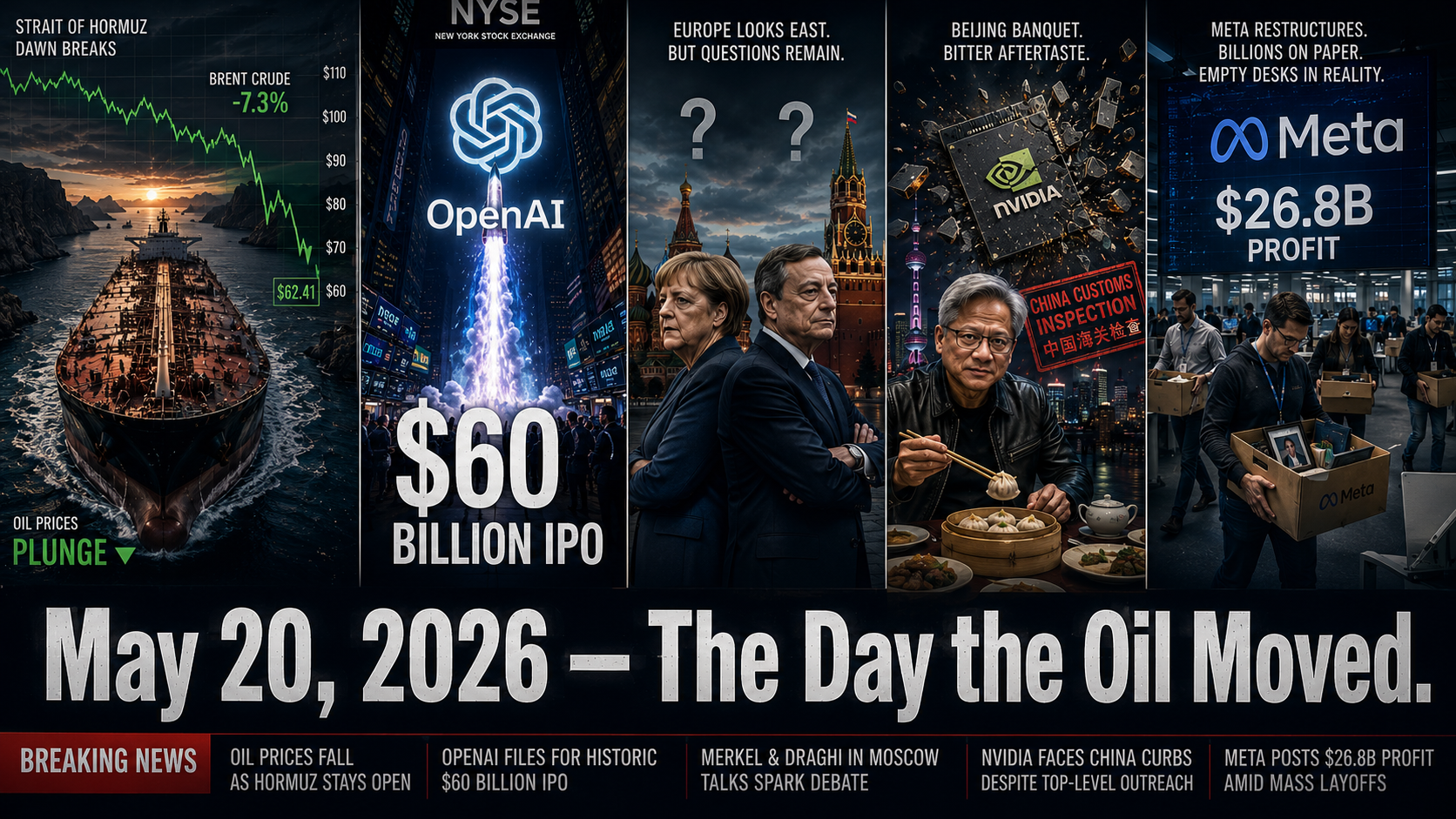
Three supertankers pushed through the Strait of Hormuz on Wednesday, and the world held its breath. Oil fell 5%. Stock markets rallied. Peace suddenly felt possible. Everything that happens in global markets and geopolitics today flows, sometimes literally, through that narrow corridor. The rest of Wednesday confirmed it: OpenAI filed for an IPO that could be the largest in history. Europe went looking for someone who can talk to Putin. China banned a Nvidia chip while its CEO was eating dim sum in Beijing. And Meta told 8,000 people they no longer have jobs — the same week it posted $26.8 billion in profit. This is what the AI era looks like from the inside.
Oil Falls 5% as Three Supertankers Attempt the Strait of Hormuz Crossing
Three supertankers carrying 6 million barrels of Middle East crude oil began transiting the Strait of Hormuz on Wednesday, the most significant movement of commercial shipping through the waterway since the US-Israeli war on Iran began on February 28. Oil prices fell sharply on the news, with Brent crude dropping more than 5% to approach the $100 per barrel threshold, having traded as high as $138 in early April when the strait's effective closure sent shockwaves through global energy markets. The ships, including a South Korean-flagged Very Large Crude Carrier carrying 2 million barrels of Kuwaiti crude loaded on March 4, were exiting the Gulf via a transit route Iran had ordered vessels to use. The VLCC Universal Winner is headed for Ulsan, South Korea, where the country's largest refiner is expected to receive the cargo on June 9.
The movement coincided with signals from both the White House and Tehran that a deal is closer than it has been at any point in the conflict. President Trump told US lawmakers the war will end very quickly and hopefully in a very nice manner. Vice President JD Vance said negotiations are in a pretty good spot. The diplomatic and shipping developments together produced a market reaction that underscored just how much of the world's economic anxiety has been priced into oil: every point of progress toward reopening the strait sends commodity prices lower and equity markets higher simultaneously. Analysts at Citi had this week warned that Brent could hit $120 in the near term if disruptions persist, while Wood Mackenzie projected it could approach $200 if the strait remains largely shut through year-end. Wednesday's tanker movement does not constitute a formal reopening, but the market read it as the most credible signal yet that one may be coming.
OpenAI Is Filing for an IPO That Could Be the Largest in History
OpenAI is preparing to file a confidential IPO prospectus with the SEC within days, potentially as early as this Friday, the Wall Street Journal reported Wednesday, citing sources familiar with the matter. The company is working with Goldman Sachs and Morgan Stanley on the filing and is targeting a public debut as early as September 2026. The move comes days after a US jury unanimously rejected Elon Musk's lawsuit against OpenAI in less than two hours of deliberation, dismissing his claims that the company had strayed from its original nonprofit mission and clearing one of the most significant legal obstacles to the listing. OpenAI closed a $122 billion funding round in March at an $852 billion post-money valuation, generating $2 billion in monthly revenue and serving 900 million weekly active ChatGPT users. The IPO, when it comes, is expected to raise at least $60 billion, which would make it the largest public offering in financial history.
The filing places OpenAI in a direct race with Anthropic, which is also preparing a late-2026 listing, and with SpaceX, whose S-1 prospectus is expected in June. The potential simultaneous listing of three of the most consequential private companies in the world within months of each other represents an event in capital markets with few precedents. JPMorgan analysts estimate the combined listings could draw between $100 and $240 billion in institutional capital toward AI equities, a rotation that could compress valuations in other sectors and produce short-term volatility in crypto and fixed income. OpenAI's listing will also be the first major test of public market appetite for a frontier AI company whose valuation rests not on current profitability, which remains deeply negative, but on projected dominance in a technology category that does not yet have a settled revenue model.
Europe Goes Looking for a Putin Whisperer — and the Shortlist Is Telling
European Union governments are in active discussions about appointing a special envoy to negotiate with Vladimir Putin, the Financial Times reported Wednesday, with the shortlist narrowed to three names: former German Chancellor Angela Merkel, former Italian Prime Minister and European Central Bank president Mario Draghi, and Finnish President Alexander Stubb. The effort reflects a fear that has been building in Brussels for months: that if a peace deal for Ukraine is eventually struck between Washington and Moscow, the EU could find itself excluded from a settlement that directly determines the security architecture on its own continent. The urgency has been sharpened by the May 9 ceasefire's rapid collapse, Russia's continued missile strikes on Ukrainian cities, and the perception in several European capitals that Trump may be willing to accept a deal that falls far short of what Kyiv and Europe consider acceptable.
All three candidates come with significant complications. Merkel, who served as Germany's chancellor for 16 years and had more direct contact with Putin than any other Western leader, is also closely associated with the energy dependency on Russia that critics argue funded the war. Her relationship with Putin, once seen as a diplomatic asset, has been reassessed sharply since the full-scale invasion began. Draghi brings economic credibility and his 2022 report on European competitiveness remains highly regarded in Brussels, but he has no established relationship with the Kremlin. Stubb is more hawkish on Russia than the other two and would likely be unacceptable to Moscow as a meaningful intermediary. EU foreign policy chief Kaja Kallas, who would normally be the natural candidate for such a role, was described by diplomats as having effectively ruled herself out through her open hostility to Russia and her stated support for its territorial dissolution.
China Banned Nvidia's Gaming Chip While Jensen Huang Was Eating Dim Sum in Beijing
In one of the more pointed pieces of diplomatic theatre to emerge from last week's US-China summit, Beijing added Nvidia's RTX 5090D V2 gaming chip to a list of banned goods at Chinese customs checkpoints on Friday, May 15, the same day Jensen Huang was in the Chinese capital as part of President Trump's delegation, touring sites and meeting officials. The timing was not accidental. The RTX 5090D V2 is a version of Nvidia's top-of-the-line gaming GPU specifically engineered to comply with US export controls, a design intended to let the company maintain some presence in the Chinese market without running afoul of American restrictions on advanced AI hardware. Beijing's message by banning it while Huang was physically in the country was precise: even compliant, downgraded products are not welcome when they can be repurposed for AI development, and market access is a lever China will pull when it sees fit.
The move extends the chip war beyond its original boundaries. Previous restrictions had focused on high-end AI accelerators like the H100 and H200. Gaming chips had not been targeted. By crossing into that category, Beijing is demonstrating that its response to US export controls is not limited in scope and will expand as Washington's restrictions evolve. Huawei is expected to capture the largest share of China's AI chip market this year, with sales projected to jump at least 60% as Chinese companies seek domestic alternatives to Nvidia. The Trump administration had approved H200 exports to Chinese companies like Alibaba and Tencent months ago, but Beijing has blocked those chips at the border regardless. Huang told Bloomberg TV on Monday that he believes China's market will eventually open. Based on what happened while he was in Beijing, the timeline for that reopening is not obvious to anyone outside the company.
Meta Cuts 8,000 Jobs and Reports $26.8 Billion in Profit in the Same Week
Meta began notifying approximately 8,000 employees on Wednesday that their positions were being eliminated, sending layoff emails to Singapore staff at 4 a.m. local time before rolling out notifications across Europe and North America through the morning. The cuts represent 10% of Meta's global workforce of just under 80,000 employees. An additional 6,000 open positions are being cancelled simultaneously, bringing the effective headcount reduction to approximately 14,000. More cuts are expected in August and the fall. The layoffs come the same week Meta reported record first-quarter 2026 revenue of $56.31 billion and net income of $26.8 billion — a juxtaposition that has become the defining paradox of the AI era in Big Tech: record profits coexisting with mass job losses, with the money redirected from human salaries into GPU purchases, data centers and AI infrastructure at a scale without precedent in corporate history.
The restructuring is not purely about cuts. Meta's Chief People Officer Janelle Gale confirmed that roughly 7,000 employees are being transferred into newly created AI-focused teams, including Applied AI Engineering, Agent Transformation Accelerator and Central Analytics, all oriented toward building and deploying AI agents capable of handling tasks that previously required large human teams. Zuckerberg has been explicit about the logic since January: projects that used to require big teams can now be accomplished by a single very talented person. The company has raised its full-year capital expenditure forecast to between $125 and $145 billion, virtually all of it directed toward AI infrastructure. Internal morale, by every available measure, has been collapsing for months: employee ratings on professional forums dropped 25% from their 2024 peak, culture scores fell 39%, and at least three countdown websites tracking the layoff date were built internally by Meta staff. One carried the header Big Beautiful Layoff.
