
The Cost of Everything: Thursday, May 28, 2026
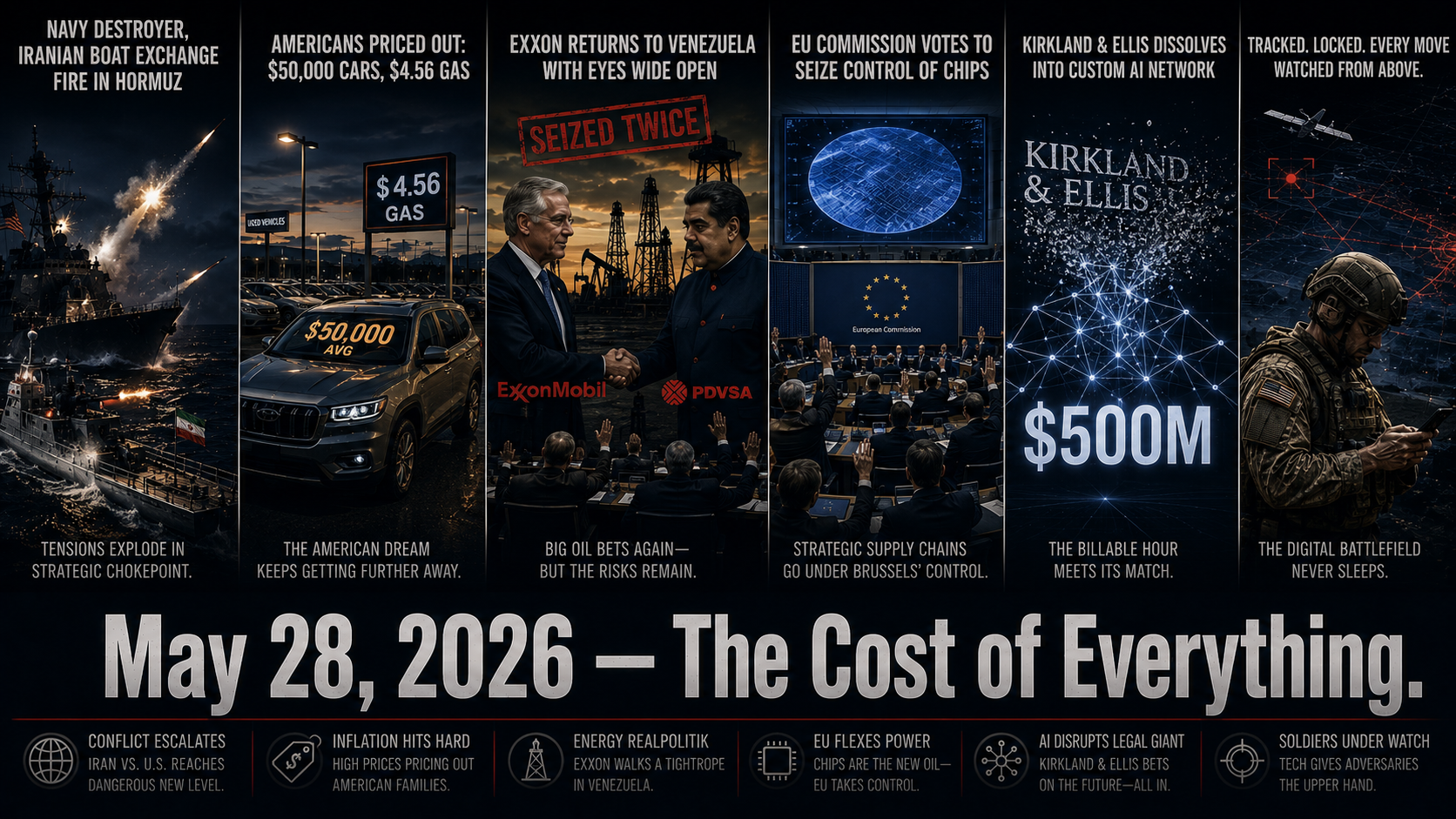
A million Americans have stopped buying cars. The US and Iran exchanged fire for the second time in days. ExxonMobil is weighing a return to a country that seized its assets twice. Europe is writing emergency powers to grab control of chip factories in a crisis. The world's most profitable law firm just bet $500 million on its own AI. And the Pentagon confirmed what nobody wanted to admit: adversaries are tracking US troops in war zones through the same apps that serve them ads. Thursday, May 28.
US and Iran Exchange Fire for the Second Time in Days as Ceasefire Frays
The ceasefire between the United States and Iran is fraying in real time. US forces carried out new strikes overnight targeting Iranian sites around the Strait of Hormuz that posed threats to American personnel and commercial shipping, and shot down four Iranian attack drones in the process. The strikes came two days after a previous US military action against Iranian missile launch sites and mine-laying boats in the same corridor. Iran's foreign ministry called the earlier attacks a grave violation of the ceasefire, and the IRGC warned it would retaliate against any violation. On Thursday, a US official confirmed that American forces in Kuwait had been the suspected target of an Iranian missile strike, with Tehran saying it had hit the base responsible for the Bandar Abbas strikes. Both sides accused the other of violating the truce. US Central Command described both sets of strikes as self-defense within the bounds of the ceasefire agreement.
The diplomatic picture deteriorated further on Wednesday when Trump signaled that a deal was not close, walking back the optimism he had expressed earlier in the week. The US is not satisfied with where the talks are, Trump told reporters, and he would not be rushed by either economic or political concerns. The Doha talks, which had raised hopes on Monday when Iran's top negotiating team traveled to Qatar, appear to have produced no breakthrough. Iran's internet connectivity has been completely shut down for 88 days, since the conflict began on February 28. Oil markets, which had priced in increasing peace probabilities, reversed course. Brent crude rose back toward $100 a barrel on Thursday after falling sharply earlier in the week. The second exchange of fire in two days, with both sides accusing the other of provocation, suggests the ceasefire is holding only in the narrowest technical sense.
One Million New-Car Buyers Have Left the Market — and Nobody Expects Them Back Soon
The US auto industry is confronting a structural shift that is more damaging than a typical cyclical downturn: approximately one million Americans who were expected to return to the new-car market after pandemic-era disruptions have instead dropped out of it entirely, and are not expected back before the end of the decade. The Wall Street Journal reported Thursday that General Motors, Ford, Toyota and other major automakers have adjusted their planning assumptions to account for a market that will shrink or stagnate in 2026, after years of projecting a recovery to pre-pandemic volumes of roughly 17 million vehicles per year. The average transaction price for a new vehicle is now approximately $50,000, a figure that has risen sharply since 2020. The average American holding an auto loan is spending 15% of their income on car-related expenses, a threshold the US Department of Transportation classifies as transportation cost burdened. When that ratio is reached, buyers stop buying.
Three forces are working simultaneously against the market. Interest rates remain elevated under new Fed chair Kevin Warsh, who inherited an inflation problem driven partly by energy costs and has limited room to cut. Gas prices have risen to a national average of $4.56 per gallon, their highest since July 2022, as a direct consequence of the Iran war and Strait of Hormuz disruption. And inflation has eroded real incomes faster than nominal wages have grown for the first time since 2023. The buyers who have left the new-car market have not switched to public transport: they are holding on to older vehicles, with the average car on US roads now 13 years old, a historic high, according to S&P Global. Automakers, paradoxically, are not panicking. GM and Ford are generating solid profits selling fewer, more expensive trucks and SUVs, and have limited appetite for the margin-eroding incentives that historically absorbed excess inventory. The missing million buyers are, for now, someone else's problem.
Inside ExxonMobil's Dilemma Over Returning to Venezuela After 19 Years and Two Asset Seizures
ExxonMobil's CEO Darren Woods said the word out loud at a White House meeting in January: Venezuela was uninvestable. Four months later, the company is in advanced talks to return. The shift reflects a convergence of forces that has altered the calculus for every major oil company watching Venezuela's post-Maduro transition from the sidelines. The Iran war and the disruption of Middle Eastern supply have pushed Brent crude into a $90 to $110 range that sharply improves the economics of new investments in the Western Hemisphere. Venezuela's president Delcy Rodriguez has demonstrated a willingness to engage on contract terms that previous governments treated as non-negotiable. And the Trump administration has positioned Venezuela's oil revival as a geopolitical priority, with Interior Secretary Doug Burgum having personally spoken to Rodriguez about the terms needed to attract Western investment.
The talks, reported by the New York Times and confirmed by multiple sources, involve contracts to produce oil in up to six fields across different regions of Venezuela, with an announcement potentially coming before the end of May. ExxonMobil has history in Venezuela that is not reassuring: Hugo Chavez seized its assets in 2007, and the company has pursued more than $13 billion in arbitration claims jointly with ConocoPhillips since. Darren Woods told the White House in January that re-entering a third time would require quite different protections. His position has changed since an earnings call in May, when he noted that Exxon's heavy crude experience in Canada gives it an advantage in Venezuela, where most oil has similar properties. The sticking points are contract durability, a mechanism to resolve the outstanding arbitration claims, and production-sharing terms that make the economics work above $70 per barrel. Chevron, which stayed through the Chavez nationalizations, has already expanded its Venezuelan stake this year, creating a competitive pressure on Exxon to move or be left behind.
The EU Wants Emergency Powers to Seize Control of Chip Supplies in a Crisis
The European Commission published a draft of the Chips Act 2 on Thursday, the successor to its 2023 semiconductor legislation, and the most striking element is the expansion of crisis powers. Under the new draft, the Commission would be able to organise joint purchasing of semiconductors across member states and, crucially, to request priority orders from any publicly subsidised fabrication plant in the EU, effectively commandeering the output of factories that received European taxpayer funding to serve strategic sectors during a declared shortage. The draft also calls for more proactive information-sharing by companies about their inventory levels and supply vulnerabilities, and proposes a more structured process for activating emergency measures without the delays that hampered the response to the COVID-era chip shortage.
The context for the expanded powers is a combination of structural concern and recent experience. The Dutch government's invocation of emergency economic security powers to seize governance control of Nexperia, the Chinese-owned chipmaker, in October 2025, marked the first time a European government had physically intervened in a semiconductor company's operations and triggered a supply shock that disrupted automotive production across the continent. The episode demonstrated both the vulnerability of European supply chains to geopolitical disruption and the inadequacy of existing legal frameworks for responding quickly. The Chips Act 2 roadmap, agreed by the European Parliament, Council and Commission in April 2026, commits to achieving key legislative milestones by the end of 2027. The broader ambition remains contested: an April 2025 Court of Auditors report projected that Europe would achieve only 11.7% of global semiconductor market share by 2030, well below the 20% target the original Chips Act established. In the meantime, silicon, as one analyst put it, is the new oil, and Europe is writing the rules for when it runs short.
Kirkland & Ellis Commits $500 Million to Build Its Own AI — Because Off-the-Shelf Isn't Good Enough
Kirkland & Ellis, the world's highest-grossing law firm with revenues of $10.6 billion in 2025, the first firm in history to break the $10 billion revenue barrier, has committed $500 million over the next three to four years to build a proprietary artificial intelligence platform, the Financial Times reported Thursday. The firm expects to spend more than $100 million in 2026 alone developing custom AI services. That figure is in addition to the money it will continue to spend on licences for external AI tools from major providers. Chair Jon Ballis was direct about the strategic logic: widely available AI tools are raising the baseline across the legal industry, but that baseline is not high enough for a firm whose clients include the world's biggest companies and private equity funds. Off-the-shelf tools available to every competitor cannot generate a sustainable advantage. Proprietary tools built on Kirkland's own institutional knowledge can.
The investment represents one of the most ambitious technology bets ever made by a law firm, and it arrives at a moment of genuine disruption across the legal industry. AI tools are already reducing the time required for document review, due diligence, contract analysis and legal research, historically among the most lucrative billable-hour activities for large firms. Kirkland's bet is that the firms that build their own systems, trained on decades of their own deal experience, case knowledge and client intelligence, will be able to offer something that no competitor armed only with commercial AI can match. The firm already operates SideTrack, an internally built platform for investment funds work. The $500 million program would extend that philosophy across the entire practice. Critics, including former Microsoft executive Steven Sinofsky, have questioned whether even the most well-resourced firm outside the technology industry can move faster or more effectively than the entire AI industry itself. Ballis's counter is simple: the idea is to deploy the collective intelligence of the institution throughout the firm. That intelligence, he argues, cannot be bought from a third party.
The Pentagon Confirmed That Adversaries Are Tracking US Troops Through Their Phones
The Pentagon has confirmed, for the first time officially, that American military personnel deployed to active war zones have been identified or surveilled by adversaries using commercially available location data generated by their online activity. The disclosure came in a message sent by US Central Command on April 14, obtained by Reuters, which offers no specific cases but acknowledges the pattern. CENTCOM's area of responsibility includes the Gulf, where US forces are currently facing off against the Iranian military over the Strait of Hormuz. The confirmation prompted a bipartisan group of US legislators, led by Senator Ron Wyden, to send a letter to the Pentagon on Thursday demanding answers about what measures are being taken to address the vulnerability, and warning that the adtech industry must now be treated as a national security threat.
The mechanism is both simple and deeply embedded in the architecture of the modern internet. Location data is harvested continuously by the apps, websites, and services that military personnel use on their personal devices, then sold by data brokers to advertisers, analytics companies, and, it is now confirmed, intelligence actors. The data is granular enough to establish a pattern of life: where a soldier sleeps, eats, trains, and travels. That pattern can be used to anticipate movement, target drone or missile strikes, or identify individuals for counterintelligence operations. As far back as 2016, one US defense contractor was able to track special operations forces from their US bases to a sensitive staging post in Syria using commercially available data. Journalists at Wired and two German outlets later traced the movements of people at 11 US military and intelligence sites in Germany using a data broker's files. The Iran war has given the problem an immediate operational dimension: US troops in the Gulf are active targets, and the data industry that enables their phones is, structurally, working against them.
