
Lines Crossed: Friday, May 29, 2026
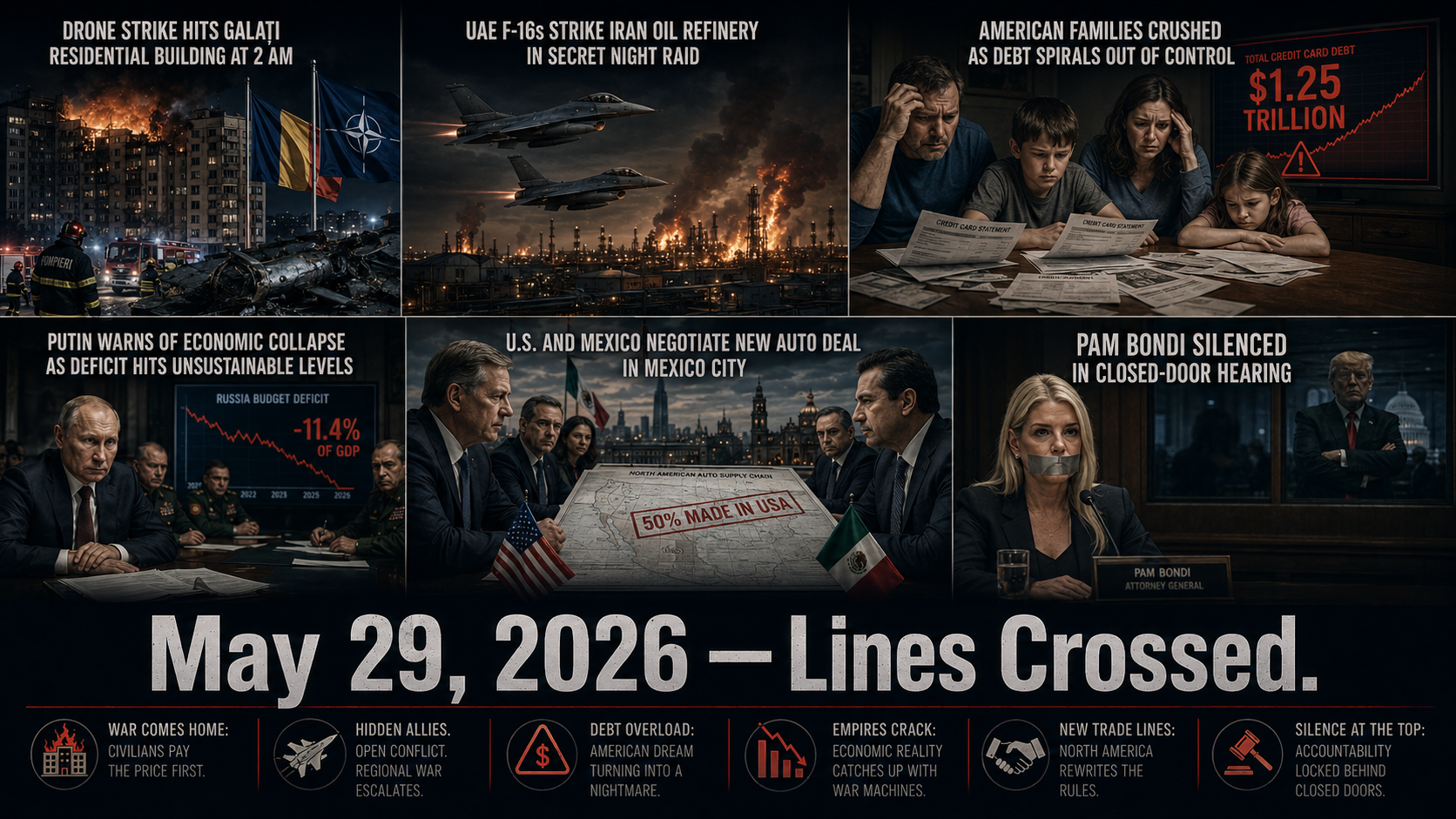
A Russian drone hit a residential block in Galați, Romania, at 2 a.m. Friday — EU territory, a NATO ally, and a first. The UAE fought a secret war against Iran that the world is only now learning about. Americans owe $1.25 trillion on their credit cards and are falling behind on the payments. Russia is going broke fighting Ukraine. Washington wants to rewrite the rules of how cars are built in North America. And Pam Bondi sat before a House committee and refused to answer a single question about Donald Trump. Lines were crossed today. Most of them will not easily be uncrossed.
BREAKING: Russian Drone Hits Residential Block in Galați — First Strike on EU Territory
A Russian Geran-2 kamikaze drone struck the tenth floor of a residential apartment building in Galați, Romania, at approximately 2 a.m. Friday morning, causing an explosion and fire that injured four people, including a 14-year-old child, and forced the evacuation of roughly 70 residents. The drone had been deployed in a large-scale Russian attack on Ukrainian infrastructure near the border and apparently crossed into Romanian airspace before impact. Romanian Defence Ministry confirmed the drone was Russian-made. It is the first time a Russian projectile has struck a civilian building on European Union and NATO territory since the full-scale invasion of Ukraine began in February 2022. President Nicușor Dan convened the Supreme Defence Council and traveled to Galați to visit the injured. He announced that Romania would close the Russian consulate in Constanța and expel the consul general, calling the incident the gravest to affect Romanian territory since the war began.
The international response was immediate and unusually pointed. US Ambassador to NATO Matthew Whitaker condemned the incident as a reckless incursion on Romanian territory and said the US would defend every inch of NATO territory. NATO Secretary General Mark Rutte was in contact with Romanian authorities and condemned Russia's recklessness. European Commission President Ursula von der Leyen said Russia's war of aggression had crossed yet another line and confirmed that Brussels is preparing a 21st package of sanctions. Romanian Foreign Minister Luminița Odobescu summoned the Russian ambassador. Romanian Prime Minister said the country urgently needs an effective anti-drone defence system. The Parchetul General has opened a criminal investigation. The explosive charge on the drone was estimated at approximately 30 kg, according to President Dan. Russia has not officially commented.
The UAE Fought a Secret War Against Iran — and Nobody Was Supposed to Know
The United Arab Emirates carried out dozens of military strikes against Iran during the US-Israeli war, making it the only country beyond Israel and the United States to actively participate in offensive operations against the Islamic Republic, the Wall Street Journal reported Friday citing people familiar with the matter. The strikes, which the UAE has never publicly acknowledged, targeted strategic locations including Qush and Abu Musa islands in the Strait of Hormuz, the port city of Bandar Abbas, the Lavan Island oil refinery, and the Asaluyeh petrochemical complex. The attack on the Lavan refinery occurred in early April, around the time Trump announced the initial ceasefire, according to the report. Israel and the United States provided intelligence in support of the UAE strikes. The UAE's foreign ministry declined to comment but pointed to previous statements affirming its right to respond to Iranian attacks.
The context makes the UAE's decision understandable even if it remains diplomatically explosive: Tehran launched some 550 ballistic and cruise missiles and more than 2,200 drones at the UAE during the conflict, making it the most-targeted country in the region other than Israel. Hotel occupancy in Dubai had fallen to roughly 10%, its LNG exports were disrupted, and its energy infrastructure was damaged. The UAE had every military and economic motivation to strike back. The political sensitivity of the disclosure lies in what it reveals about the true coalition that fought Iran: the public story was a US-Israeli operation. The private story involved at least one Gulf state that did not want its participation known. Whether other Gulf states played similar undisclosed roles remains an open question the WSJ report does not answer.
Americans Are Falling Behind on Their $1.25 Trillion Credit-Card Bill
The Federal Reserve Bank of New York's quarterly household debt report, published earlier this month, contains a number that crystallises the financial stress now running through the American middle and working class: total credit-card balances stood at $1.25 trillion in the first quarter of 2026, the highest first-quarter reading since the New York Fed began tracking the data in 1999. The figure dipped from $1.277 trillion at the end of 2024, reflecting the usual post-holiday seasonal pay-down, but it is still 5.9% higher than one year ago. Overall household debt reached a record $18.8 trillion, approximately $57,000 per American household. Average interest rates on credit cards rose to 21% in February 2026, up from 14.6% in February 2022, meaning that the cost of carrying a balance has risen by nearly half in four years. Last year, 5.6% of credit-card holders were 60 days or more behind on their payments, surpassing prepandemic levels.
The pattern is deeply uneven. The New York Fed describes what researchers are framing as a K-shaped dynamic: prime borrowers are broadly managing, while subprime borrowers are falling behind in growing numbers. The average American holding an auto loan is now spending 15% of their income on car-related expenses, the Department of Transportation's threshold for transportation cost burden. A gasoline price shock, now very much underway at $4.56 per gallon nationally, has the potential to push delinquency rates materially higher in the coming quarters. President Trump, asked whether American families' financial difficulties were a reason to end the Iran war, said the answer was not even a little bit. Republicans in Congress, facing the November midterms, are reading the same data and drawing different conclusions.
Russia Is Running Out of Money for Putin's War — and Has Been Hiding It
Russia's war in Ukraine is on track to exceed its military budget by at least 2 trillion rubles, equivalent to $28 billion, this year alone, according to a letter from Finance Minister Anton Siluanov to the Russian cabinet, reviewed by the Financial Times. The document, sent in February but only now becoming public, warned that the overspend could rise to 4 trillion rubles in a worst-case scenario, and projected equivalent overruns of 4 trillion rubles in each of 2027 and 2028. To cover the shortfall, Siluanov asked the cabinet to freeze 2.9 trillion rubles in planned non-war spending for 2026 — cutting public procurement, corporate subsidies, and public institution financing. Russia initially planned a budget deficit of 3.8 trillion rubles for all of 2026. By the end of April, it had already run a deficit of 5.9 trillion rubles, equal to 2.5% of GDP, Russia's largest deficit since the full-scale invasion began in 2022.
The battlefield picture reinforces the financial one. Russia's rate of advance in Ukraine has slowed dramatically: the Institute for the Study of War estimates Russian forces seized 104 square kilometres between January and May 26 of this year, compared to 1,619 square kilometres in the same period in 2025. Ukraine's long-range strike campaign has cut Russian oil refining by 10%, according to President Zelensky. GDP growth forecasts have been revised down to 0.4% for 2026, from 1.3% projected earlier in the year. Nearly half of Russian businesses identify severe payment delays from business partners as their primary threat, creating a growing chain of default risk through the economy. Putin reportedly still believes his forces can take all of Donetsk and Luhansk by autumn. His finance minister's letter suggests the financial system sustaining that ambition is under severe and worsening strain.
Trump Wants Half of Every North American Car to Be Made in America — and Canada Is Not in the Room
The Trump administration has unveiled its negotiating position on automotive content rules during ongoing USMCA revision talks in Mexico City: it wants to raise the regional content requirement for vehicles from 75% to 82% to qualify for preferential tariff treatment, and it wants half of that value, 50% of the total vehicle, to be produced specifically in the United States. The proposal was presented to Mexican negotiators this week, according to four people familiar with the US position. The talks, which run through late July 2026, are aimed at revising the trade agreement ahead of its scheduled review period. Crucially, the US proposal contains no provision for Canadian content, despite Canada being a party to the USMCA. Canada is not represented at the Mexico City talks.
The proposal represents the most aggressive attempt yet to shift automotive production from Mexico and Canada into the United States. Under the current USMCA, vehicles must contain 75% North American content by value to qualify for preferential tariffs, but there is no requirement that any of that content come specifically from the US. Automakers have used the flexibility to source components from wherever in North America is cheapest. A 50% US-content floor would fundamentally change that calculus, requiring manufacturers to shift sourcing toward American factories or face steep tariffs on their vehicles. Industry analysts say compliance at that level would require many manufacturers to make significant capital investments in US production. Separately, a 25% auto tariff already in place adds further pressure. The negotiations in Mexico City are proceeding without a Canadian seat at the table, a diplomatic exclusion whose significance for Canada's auto industry, centred in Ontario and reliant on integrated North American supply chains, is difficult to overstate.
Pam Bondi Testified About Epstein — and Refused to Answer a Single Question About Trump
Former Attorney General Pam Bondi appeared before the House Oversight Committee on Friday in a long-sought closed-door transcribed interview about the Justice Department's handling of the Jeffrey Epstein files, and used the occasion to blame her successor, acting Attorney General Todd Blanche, for the botched release of documents that exposed the identities of several Epstein survivors. In her opening statement, Bondi said she had delegated oversight of the document review to Blanche, telling the committee that as head of a large department with broad responsibilities, she did not lead every aspect of this effort or conduct the document review herself. She acknowledged that there were redaction errors in the release, which included victims' names, nude photos of women and girls, and improperly redacted names of potential co-conspirators, but framed them as a consequence of an enormously complicated process.
The more explosive revelation from inside the interview room was what Bondi refused to discuss. Representative Robert Garcia, the committee's top Democrat, told reporters that he personally asked Bondi five times, in five differently worded questions, about her conversations with President Trump regarding the Epstein files: whether Trump had directed her at any time, what he knew, and whether he had asked her to redact or not redact specific material. Each time, Bondi declined to answer. She was, Garcia said, combative and grew visibly frustrated when questions turned to the president. Democrats also objected to the format: committee chairman James Comer agreed to a voluntary transcribed interview rather than a sworn deposition, and declined to have the session videotaped. Democrats are now seeking to bring Blanche before the committee, and Garcia said they would push for a subpoena if Comer declines to schedule a voluntary appearance. Meanwhile, Trump posted on Truth Social that he was meeting in the White House Situation Room to make a final decision on a proposed Iran deal, a reminder that while Bondi testified, the president had other matters on his mind.
