
Pressure points: energy, policy and technology shaping today’s global landscape
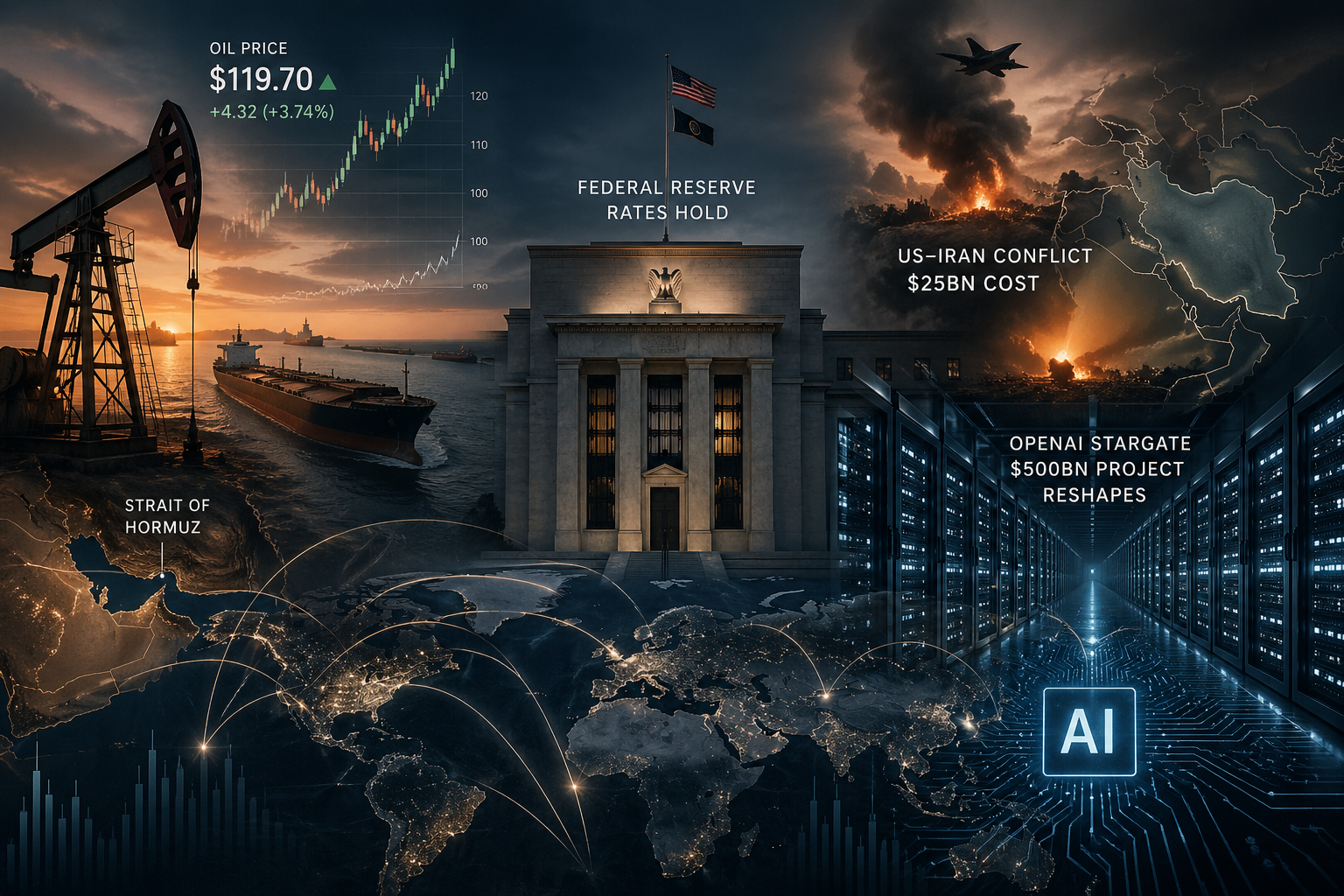
Today’s headlines point to a system under pressure. Energy prices, monetary policy, geopolitical tensions and technological shifts are no longer separate stories, but part of the same dynamic. The developments below stand out not just for what happened, but for what they signal.
Fed holds rates steady under energy-driven inflation pressure
The decision by the Federal Reserve to hold interest rates steady comes at a particularly difficult moment, where inflation is no longer driven only by demand, but increasingly by external cost pressures, especially energy. The sharp rise in oil prices puts the central bank in a constrained position: easing policy risks fueling inflation further, while keeping rates elevated slows economic activity even more. In practice, the Fed is no longer fully in control of inflation dynamics, as it is increasingly influenced by geopolitical factors beyond its reach.
Goldman Sachs restricts AI use amid rising data and regulatory risks
At the same time, Goldman Sachs has moved to restrict the use of Anthropic’s Claude model in Hong Kong, signaling a shift in how major financial institutions approach artificial intelligence. This decision is not purely technological, but tied to regulation, data security, and control over information in a geopolitically sensitive environment. AI is no longer just a competitive advantage, it is also becoming an operational risk, particularly in regions where data flows are closely scrutinized.
The $25bn cost of conflict signals a shift from tension to sustained engagement
On the military and fiscal front, the conflict between the United States and Iran is taking on a more measurable dimension. Estimated costs of around $25 billion indicate that this is no longer an abstract geopolitical tension, but a sustained financial commitment. These expenditures extend beyond defense budgets, with direct implications for fiscal deficits and broader economic priorities in the medium term.
Oil nears $120 as Hormuz tensions reshape global energy risk
The effects of this conflict are immediately visible in energy markets. Oil prices have surged toward the $120 mark following signals that tensions around the Strait of Hormuz may persist. This region, through which a significant share of global oil flows, has become a critical lever of geopolitical pressure. A full shutdown is not required to disrupt markets, uncertainty alone regarding transport flows is enough to drive prices higher and reshape investor expectations.
OpenAI’s Stargate rethink highlights the true cost of scaling AI infrastructure
Meanwhile, on the technological side, the Stargate project associated with OpenAI, initially framed as a $500 billion data center initiative, is beginning to evolve in structure. These adjustments suggest that, while demand for AI infrastructure remains strong, scaling it globally is far more complex than initially anticipated. Costs, energy consumption, and supply chain dependencies are emerging as critical constraints, turning AI development from a purely technological race into a strategic infrastructure challenge.
