
The Modern Investor: Between Information and Influence
Introduction
In recent years, access to financial information has expanded dramatically. Market data, company reports, analysis platforms and financial commentary are now available to almost anyone with an internet connection. In theory, this environment should produce better informed investors and more rational investment decisions.
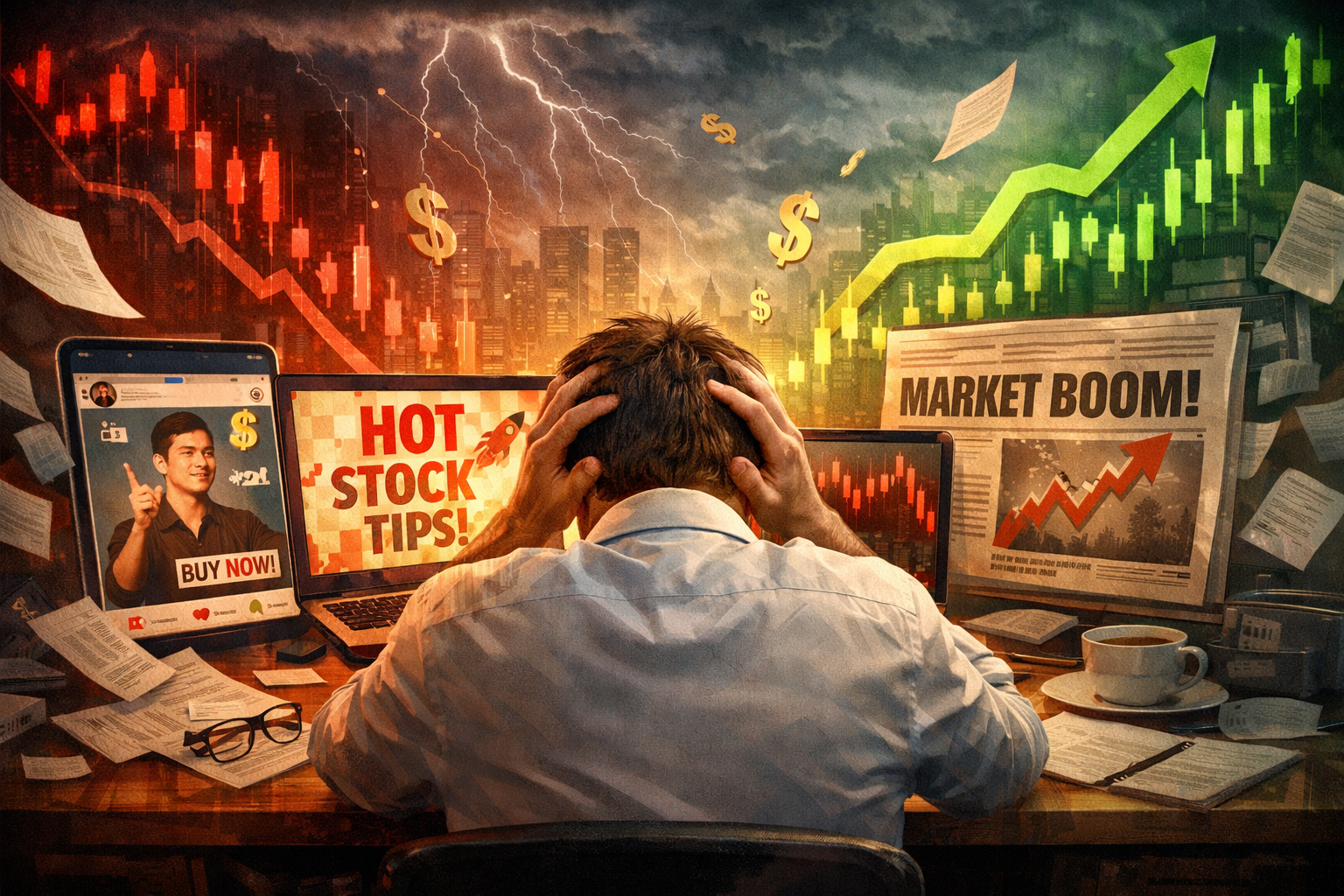
In practice, however, the opposite phenomenon is often observed. Many modern investors operate in an environment saturated with information but lacking careful analysis. Decisions are frequently made based on headlines, short social media posts, or the opinions of influencers rather than on fundamental evaluation of companies. The result is a growing disconnect between the availability of information and the quality of investment decisions.
This shift has produced several recurring behavioral patterns. Investors often enter positions without conducting sufficient analysis, expect unusually high short-term returns, and react strongly to external opinions rather than forming independent judgments. Understanding why these patterns occur is essential for understanding modern financial markets.
The Decline of Independent Analysis
One of the most common problems among modern investors is the tendency to invest without conducting thorough research. The process of analyzing a company requires time and intellectual effort. Investors must evaluate financial statements, understand business models, assess competitive advantages, and estimate future cash flows. This process is rarely simple, and its results are rarely certain.
Because of this complexity, many investors substitute analysis with shortcuts. Instead of building their own understanding of a company, they rely on recommendations, trending narratives, or the opinions of highly visible market commentators.
Behavioral finance research has repeatedly documented this phenomenon. Barber and Odean (2001) showed that many retail investors trade frequently based on attention-grabbing information rather than on long-term fundamentals. Investors are more likely to buy stocks that receive large media coverage, even when that attention is not justified by changes in underlying value.
This behavior reflects a broader cognitive tendency. Humans naturally rely on heuristics, simplified decision rules that reduce the effort required to process complex information. While heuristics can be useful in everyday life, they can produce costly mistakes in financial markets where decisions involve uncertainty and incomplete information.
Short-Term Thinking and Unrealistic Expectations
Another characteristic feature of modern investing is the dominance of short-term expectations. Many investors approach the market with the expectation that significant gains should occur quickly. When returns fail to materialize within a short period, positions are often closed and replaced with new opportunities perceived as more promising.
This behavior contrasts sharply with the principles historically associated with long-term investing. Warren Buffett famously emphasized that the stock market is designed to transfer money from the impatient to the patient. Long-term value creation typically requires time for businesses to grow, generate profits, and reinvest capital.
Yet the current information environment encourages constant activity. Financial news cycles operate continuously, and market commentary often focuses on daily price movements rather than long-term value creation. The result is a perception that successful investing requires constant reaction rather than disciplined patience.
Research in behavioral finance also highlights the role of overconfidence in shaping investor expectations. Studies by Barber and Odean (2001) suggest that individual investors frequently overestimate their ability to identify profitable opportunities. This overconfidence leads to excessive trading, unrealistic return expectations, and ultimately lower long-term performance.
The Influence of Social Media and Financial Commentary
The rise of social media has introduced an additional layer of influence in financial markets. Platforms such as X, YouTube, and various online communities allow financial opinions to spread rapidly across large audiences.
While this environment can democratize access to financial knowledge, it also introduces significant risks. Influencers and commentators often simplify complex financial topics in order to reach broader audiences. Nuanced analysis may be replaced by confident predictions, dramatic narratives, or simplified investment theses.
The result is a feedback loop between attention and influence. Opinions that generate engagement gain visibility, regardless of their analytical depth or accuracy. Investors who rely heavily on such sources may adopt positions not because they understand the underlying companies, but because the narrative surrounding those companies appears convincing.
Importantly, consulting external opinions is not inherently problematic. Financial markets have always involved the exchange of ideas and analysis. The issue arises when external opinions replace independent thinking rather than complement it.
A more robust approach involves forming an initial perspective through personal research and then comparing that perspective with the views of others. In this process, external analysis becomes a tool for refinement rather than a substitute for judgment.
Why These Behaviors Appear
Several structural factors contribute to the emergence of these patterns. First, the sheer volume of available information can overwhelm investors. When confronted with excessive information, individuals often resort to simplified decision strategies, relying on signals such as popularity or authority.
Second, digital platforms are designed to maximize engagement rather than analytical depth. Algorithms prioritize content that generates interaction, which often favors emotionally charged or simplified narratives over careful analysis.
Third, financial markets themselves create psychological pressures. Price volatility can trigger emotional responses such as fear and greed. These emotions can push investors toward impulsive decisions that deviate from rational analysis.
Finally, the accessibility of trading platforms has lowered the barriers to market participation. While this democratization has many benefits, it also means that many new investors enter the market without the experience or education traditionally associated with financial decision making.
Toward More Rational Investing
Addressing these issues does not require eliminating external sources of information. Instead, it requires a shift in how information is used.
A more disciplined approach to investing begins with independent analysis. Investors should attempt to understand a company's business model, financial health, and long-term prospects before consulting external commentary. This process encourages deeper engagement with the underlying economic reality of the investment.
Equally important is the adoption of realistic expectations. Financial markets rarely produce consistent short-term gains. Long-term wealth accumulation typically results from patience, diversification, and the gradual compounding of returns.
Finally, investors must recognize the psychological dimensions of decision making. Awareness of cognitive biases such as overconfidence, herd behavior, and attention bias can help individuals identify when their decisions are being influenced by factors unrelated to fundamental value.
Conclusion
Modern investors operate in a paradoxical environment. Information is more abundant than ever, yet the quality of decision making often suffers from noise, distraction, and social influence.
The challenge is therefore not simply to access information, but to process it carefully and independently. Influencers, analysts, and commentators can offer valuable perspectives, but their views should complement personal analysis rather than replace it.
Ultimately, successful investing depends less on reacting quickly to market narratives and more on maintaining clarity of thought in an environment filled with competing voices. The investor who learns to balance information with independent judgment gains an advantage that no algorithm or headline can easily replicate.
