
The Iran–US Conflict and Global Markets: From the Strait of Hormuz to Systemic Risk
1. Conflict Background (April 2026)
At the beginning of 2026, tensions between the United States and Iran evolved from a long-standing geopolitical rivalry into a direct confrontation, marked by targeted strikes, regional escalations and pressure on energy infrastructure. While this is not a full-scale conventional war, the current dynamic reflects an open conflict with global implications.
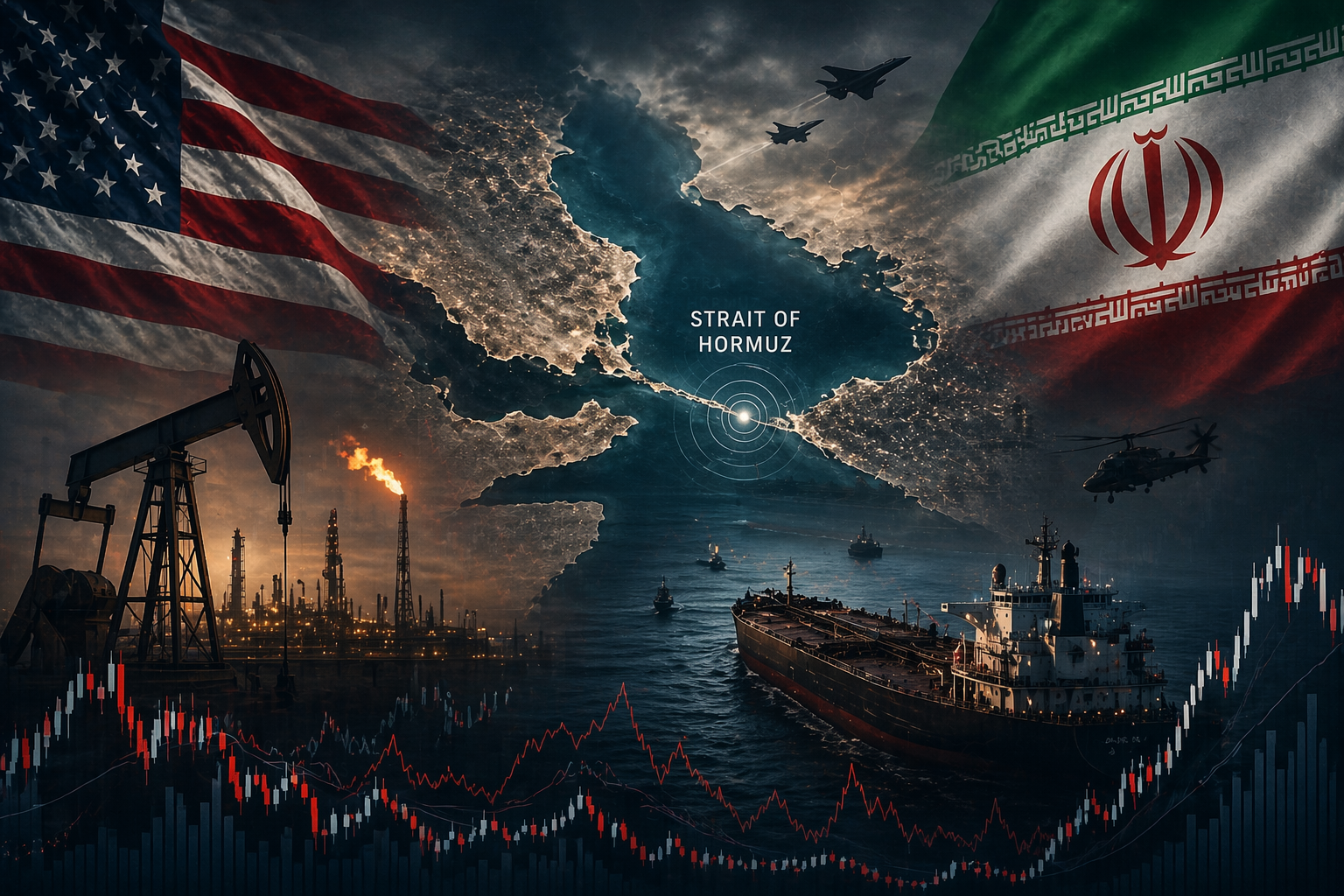
A critical point in this escalation has been the pressure placed on the Strait of Hormuz, one of the most important maritime routes for global oil transportation. Approximately one-fifth of the world’s oil trade passes through this narrow corridor, making it a key strategic chokepoint.
Any temporary closure or restriction of traffic in this area represents more than a military event. It acts as an immediate economic shock, transmitted across global financial markets through expectations, supply concerns and rising uncertainty.
2. Market Reaction: The S&P 500 and the Initial Shock
Financial markets tend to react quickly to uncertainty, and the outbreak of the conflict was no exception. In the early phases of escalation, the S&P 500 experienced notable corrections, reflecting a sharp increase in risk aversion.
Investors responded in a typical manner for such scenarios, shifting capital away from riskier assets toward instruments perceived as safer. This reallocation was accompanied by a rise in market volatility, indicating the difficulty of pricing the implications of the conflict in real time.
The moment the Strait of Hormuz was directly affected amplified this reaction. It was not only the conflict itself that triggered uncertainty, but also its potential impact on global supply chains. In such environments, markets do not react solely to current conditions, but to a range of possible future scenarios.
The S&P 500 reflected this tension through an initial decline followed by periods of relative stabilization. This pattern is common in major geopolitical events: a rapid, emotion-driven adjustment followed by a gradual recalibration as new information becomes available.
3. Oil Markets: The Core Transmission Mechanism
The most direct and significant impact of the conflict is observed in the oil market, which serves as the primary channel through which geopolitical shocks are transmitted into the global economy. Disruptions in the Strait of Hormuz affect not only the physical flow of oil, but also the perceived stability of global supply.
In the short term, rising oil prices generate a chain reaction across the global economy. Production costs increase, inflationary pressures intensify and consumption may weaken, particularly in energy-dependent economies. At the same time, sectors sensitive to energy and transportation costs become more volatile, reflecting uncertainty around the trajectory of the conflict.
Over the longer term, markets tend to adjust. Persistent disruptions may accelerate structural changes, including the diversification of energy sources, increased production in alternative regions and greater investment in energy technologies less dependent on geopolitically sensitive areas. However, these adjustments take time, leaving markets vulnerable in the initial phases of disruption.
4. Possible Scenarios: Between Pressure and Negotiation
The future trajectory of the conflict depends on a balance between strategic interests and economic constraints. The United States has a strong incentive to maintain its global position and is unlikely to concede quickly under geopolitical pressure. At the same time, Iran leverages its strategic geography as a negotiation tool, particularly through its influence over key transit routes such as the Strait of Hormuz.
One likely scenario is the continuation of the conflict in a controlled form, characterized by limited escalations and periods of relative stability. Alongside this, indirect negotiations and temporary agreements may emerge, driven largely by the economic consequences of disruptions in oil supply.
As pressure on global energy markets increases, the economic cost of the conflict rises for all parties involved. In this context, the reopening of the Strait of Hormuz becomes not only a military objective, but also an economic necessity, shaped by the need to stabilize markets.
The most realistic outcome appears to be a combination of persistent tension and tactical adjustments. Neither side has a clear incentive for full capitulation, but the pressure generated by energy markets may lead to selective compromises.
Conclusion
The conflict between Iran and the United States is not only a geopolitical event, but a direct driver of global market dynamics. The reaction of the S&P 500 reflects the level of uncertainty, while the oil market remains the central mechanism through which the conflict influences the global economy.
In such contexts, markets do not react only to events, but to probabilities. The difference between volatility and stability lies in how these probabilities are continuously reassessed.
For investors, the key challenge is not simply understanding the conflict itself, but understanding how perceptions of risk evolve around it.
