
The Fear of Missing Out (FOMO): The Anxiety of Modern Acceleration
The Origin and Nature of the Phenomenon
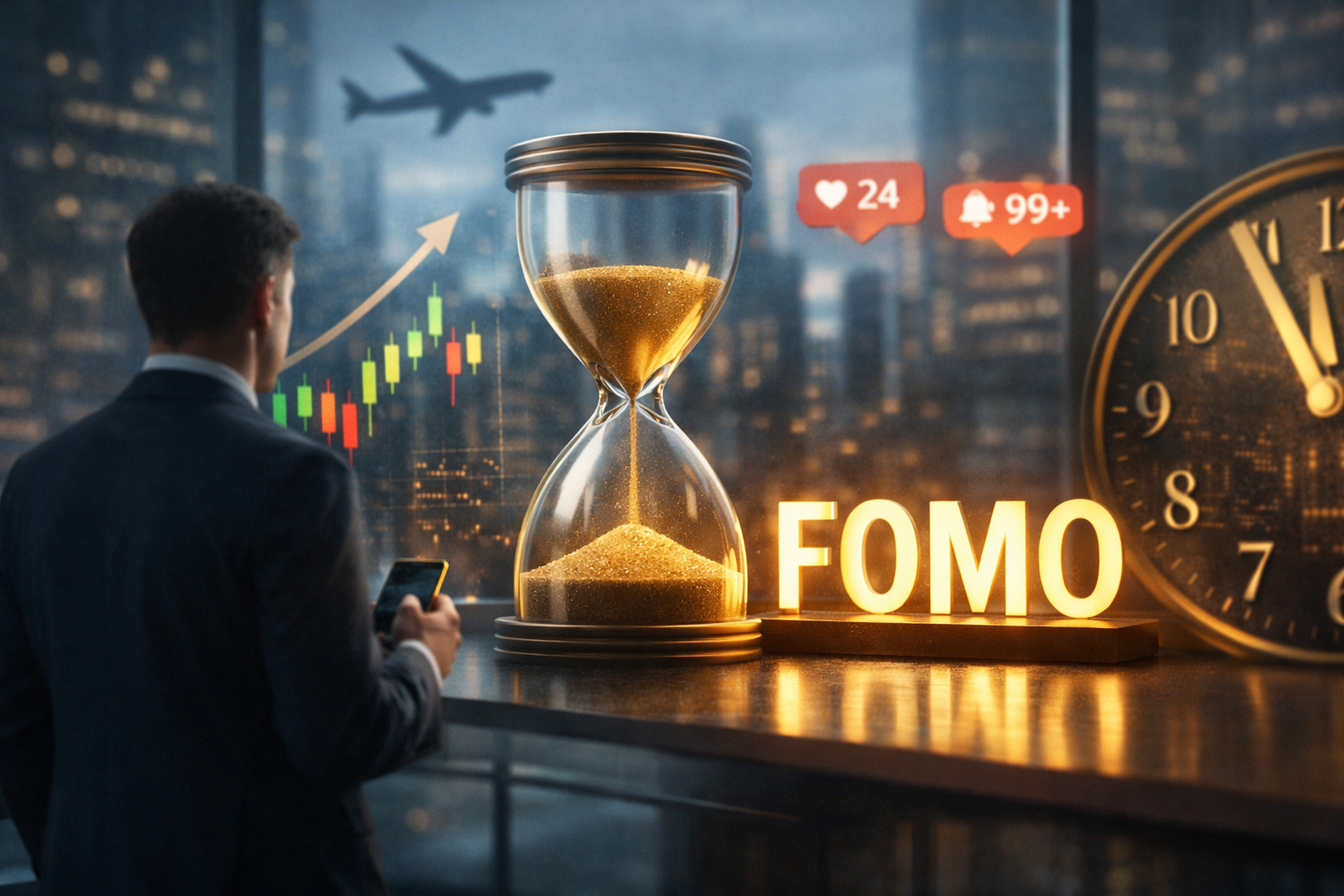
Fear of Missing Out describes a persistent concern that others are accessing more valuable opportunities or experiences. Although frequently associated with social media, the roots of the phenomenon are deeper, tied to the mechanisms through which individuals evaluate their relative position within a group.
Historically, social comparison served an adaptive function, helping individuals navigate limited and relatively predictable environments. Today, digitalization has transformed comparison into a continuous process. Constant exposure to curated and optimized outcomes distorts the perception of the true pace of progress.
As a result, FOMO reflects not only anxiety about missed opportunities but also a shift in how individuals perceive time. Delays are increasingly interpreted as structural disadvantages, leading decisions to be driven by rapid reaction rather than deliberate evaluation.
Effects on Behavior and Decision-Making
This form of anxiety influences both personal life and domains such as investing. At an individual level, FOMO encourages a reliance on external validation and reduces the capacity to appreciate gradual progress. Experiences become comparative benchmarks rather than autonomous sources of meaning.
In financial markets, the phenomenon often manifests as impulsive decision-making. Investors may enter assets not because they understand their intrinsic value, but because they perceive temporal pressure. The fear of missing rapid gains becomes more influential than the assessment of underlying risks.
Such dynamics increase decision volatility and promote short-term thinking. Instead of coherent strategy, behavior becomes shaped by external stimuli and collective momentum.
Possible Paths for Management
Reducing the influence of FOMO does not require withdrawal from the informational environment, but rather the development of a more reflective relationship with it. Recognizing the selective nature of visible information can help recalibrate perceptions of the actual pace of progress.
In investing, forming an independent view before consulting external perspectives can mitigate the impact of collective pressure. Psychologically, tolerance for uncertainty becomes essential, as meaningful progress rarely aligns perfectly with dominant trends.
Ultimately, managing FOMO involves a shift in how time and success are interpreted. Internal coherence becomes more relevant than synchronization with external dynamics.
Conclusion
FOMO represents an expression of modern acceleration, where constant visibility turns comparison into a central driver of decision-making. In such an environment, the ability to maintain clarity of thought becomes a structural advantage.
The challenge is not to avoid external influences, but to integrate them without losing autonomy. In this sense, managing FOMO is not merely a psychological strategy, but a form of intellectual discipline.
