
Rockets, Riots, and a Fragile Peace: The Week of June 8–14, 2026
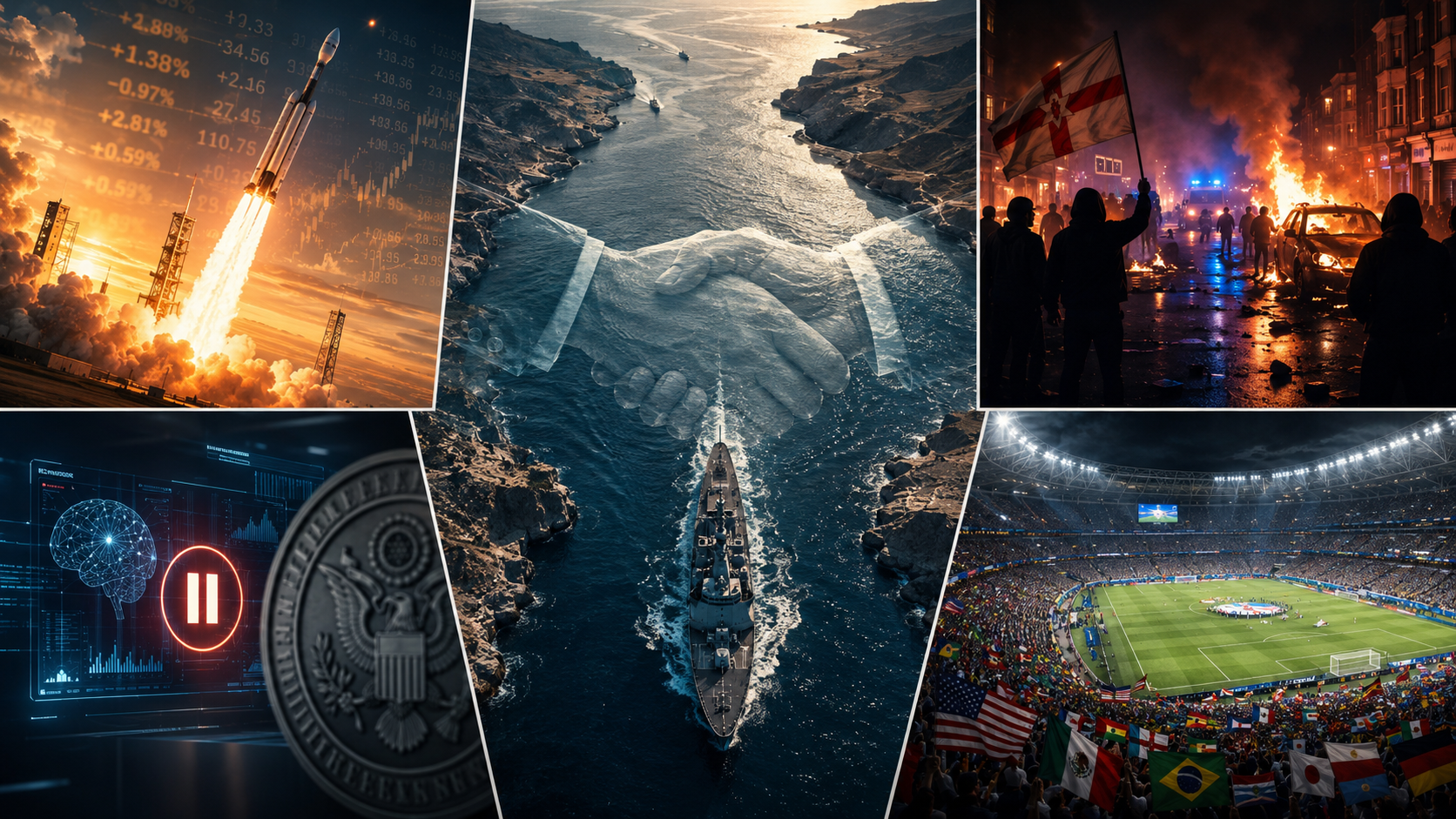
A rocket company went public and made its founder the first trillionaire in human history. A peace deal between the United States and Iran trembled at the edge of existence while drones were still being shot down over the Strait of Hormuz. Across the Irish Sea, a stabbing video went viral and Belfast burned for three nights, its streets lit by the fires of a continent's unresolved anxieties about immigration and identity. In San Francisco, a government letter arrived after business hours ordering one of the world's leading AI companies to switch off its most powerful models by morning. And in Los Angeles, Mexico City, and Toronto, the world's greatest sporting event began — a pageant of collective joy that felt, this week more than most, like the one thing the fractured world could still agree on. Seven days. Five stories. One planet trying to hold itself together. The week of June 8–14, 2026.
The Deal on the Brink: America, Iran, and the Strait of Hormuz
On the morning of June 13, the U.S. military announced it had intercepted and destroyed multiple Iranian attack drones near the Strait of Hormuz — the narrow waterway through which roughly one-fifth of the world's traded oil passes. It was, in a different week, the kind of event that would have dominated headlines for days. This week, it was almost a footnote. Because simultaneously, Pakistan's Prime Minister — serving as the principal mediator in talks to end the war that began on February 28 when the United States and Israel launched coordinated strikes on Iranian military infrastructure — announced that a peace agreement was "closer than ever before" and could be finalized "within 24 hours."
The contradiction is not incidental. It is the essence of the moment. The 2026 Iran war, now in its 105th day, has produced a peculiar dual reality: military operations and diplomatic negotiations running in parallel, each side using force as leverage while professing a desire for peace. Iranian Foreign Minister Abbas Araghchi confirmed that a memorandum of understanding addressing Iran's nuclear program, sanctions relief, and the full reopening of the Strait is being finalized, with the possibility of a remote signing by both parties in the coming days. President Trump, who reportedly "cancelled" a fresh round of strikes earlier in the week, appears to be deploying the threat of renewed bombing as a negotiating instrument — a tactic whose efficacy depends entirely on credibility, and whose credibility depends on willingness to follow through.
The economic stakes cannot be overstated. Iran's partial blockade of the Strait of Hormuz, imposed in March, triggered a supply shock that rippled across energy markets, freight rates, and inflation indices worldwide. A credible deal — one that survives Iranian domestic politics, satisfies Israel's security requirements, and includes verifiable nuclear constraints — would represent the most significant geopolitical realignment of the decade. Whether what is being negotiated in Muscat and Washington constitutes such a deal, or merely a pause dressed up as a resolution, will only become clear in the weeks ahead. The Strait of Hormuz remains, for now, both a war zone and a negotiating table.
The First Trillionaire: SpaceX Goes Public
On June 12, 2026, the Nasdaq welcomed the largest initial public offering in stock market history. SpaceX — Elon Musk's rocket company, recently merged with his artificial intelligence venture xAI — priced 555,555,555 shares at $135 each, raising $75 billion and listing under the ticker SPCX. By the close of trading, the stock had surged 19%, closing at $161. At that valuation, Elon Musk's personal net worth crossed $1 trillion — making him, unambiguously and for the first time in recorded history, a trillionaire.
The IPO was more than a financial event. It was a statement about which industries the market believes will define the next century. SpaceX is not merely a rocket company; it is, post-merger with xAI, a vertically integrated aerospace and artificial intelligence conglomerate with ambitions spanning satellite internet (Starlink), lunar logistics, Mars colonization, and frontier AI development. The combined entity carries a valuation — now approaching $1.77 trillion — that exceeds the GDP of most nations. The market, in short, is betting that Musk's peculiar combination of engineering ambition and political influence represents something durably valuable, even as his interventions in global politics — most visibly his inflammatory social media commentary on the Belfast riots — continue to generate controversy.
The IPO's timing is itself a signal. In a week when the Iran war threatened to destabilize global energy markets, when AI policy was being made by emergency executive order, and when Belfast burned, the market chose to celebrate. It is a reminder that financial markets and geopolitical reality operate on different clocks, with different logics. The world may be fracturing; the stock is up 19%.
Belfast Burns: The Immigration Crisis Comes Home
On the evening of June 9, a video went viral. It showed a Sudanese man stabbing a local resident, Stephen Ogilvie, in Belfast — an attack of extreme violence that left the victim in a coma, having lost one eye. Within hours, the video had been viewed tens of millions of times. Within 24 hours, the streets of Belfast were burning.
The 2026 Northern Ireland riots, as they are already being designated, represent one of the most severe outbreaks of anti-immigrant violence in the United Kingdom's modern history. Masked men went door-to-door in immigrant neighborhoods, setting fire to homes and vehicles they believed to house foreign nationals. Twenty-seven people were made homeless in a single night. Police reported that a two-month-old baby had to be rescued during one of the attacks. Water cannons were deployed for the first time in Belfast since the Troubles-era unrest of previous generations.
The response was swift but complex. Thousands of counter-protesters gathered in central Belfast on Saturday to condemn the rioters — a powerful image of a city rejecting mob violence. But the political fallout was considerable. Elon Musk, posting on his own platform X, made inflammatory comments in the days following the initial stabbing, amplifying narratives that critics said poured fuel on an already burning situation. The episode has reignited the debate about the role of social media platforms — and their owners — in accelerating ethnic and racial violence, and adds a new chapter to an old European story: immigration, identity, and the politics of fear. The question is not whether this will happen again. It is where.
The Algorithm Under Embargo: Washington Shuts Down Anthropic's Top Models
Late Friday evening — after business hours, as government orders of maximum impact tend to arrive — Anthropic received a letter from the Trump administration instructing it to immediately suspend all customer access to its two most advanced AI models: Fable 5 and Mythos 5. The stated reason: U.S. intelligence had identified a viable method of "jailbreaking" Fable 5 in ways that could allow adversaries to weaponize it for identifying software vulnerabilities at scale. The models were to be disabled for all foreign nationals — inside and outside the United States, including Anthropic's own foreign national employees — effective immediately.
Anthropic's public statement was remarkable for its candor and its barely concealed frustration. The company noted that the only technically feasible path to guaranteed compliance was to disable the models for all customers without distinction. It did so. The move came weeks after Anthropic CEO Dario Amodei had publicly rejected a separate Pentagon demand for unrestricted military access to Anthropic's models — a refusal that suggested a company willing to resist government overreach. It also came weeks after Anthropic itself had issued an urgent public warning to the AI industry, urging a development pause and warning that humanity risked losing control of systems it no longer fully understood. The irony of a company warning about uncontrollable AI being ordered by the state to disable its best models for reasons that remain classified was not lost on observers.
The episode crystallizes a new era in AI governance: one in which advanced language models are treated as strategic assets equivalent to semiconductor technology or nuclear material, subject to export controls, classified threat assessments, and emergency executive orders. The question that will define the next decade is whether this approach — fundamentally nationalistic, increasingly opaque — produces safer AI or merely more fragmented AI. Europe's leaders, gathering at the G7 in Évian this coming week, will have a concrete and urgent case study to argue over.
The World Plays On: FIFA World Cup 2026 Opens
And yet, for all the weight of the week, 2026 also gave the world something it badly needed: a reason to watch something together. The 2026 FIFA World Cup, co-hosted by the United States, Canada, and Mexico, opened on June 11 with a ceremony in Mexico City where Shakira and Burna Boy performed the official tournament anthem, "Dai Dai," before Mexico defeated South Africa 2-0. The following day, at SoFi Stadium in Los Angeles, Katy Perry joined 10-year-old Norwegian sensation Tius Luka for an opening ceremony that drew hundreds of thousands of spectators — an image of uncomplicated human celebration that seemed, this week, almost radical in its simplicity.
The United States team, playing their first home World Cup since 1994, won their opener 4-1 against Paraguay, with Folarin Balogun and Giovanni Reyna on the scoresheet — a result that ignited the country's still-nascent football culture and generated audience figures that broke American soccer records. Canada drew their first game, while Germany, the Netherlands, and Australia all recorded opening victories. The tournament, which runs until July 19, spans three countries and 16 cities — the largest World Cup in history by geography, attendance, and cultural ambition.
There is something worth observing in the fact that the world's most-watched sporting event is taking place in the same North America that is simultaneously managing the diplomatic aftermath of a war with Iran, the geopolitical fallout of AI export controls, and a presidential administration that has disrupted virtually every multilateral institution it has touched. Sport, at its best, is not an escape from politics — it is a reminder of what politics is supposed to be for: the creation of conditions in which human beings can gather, compete, and celebrate their common existence. The World Cup will not solve the crises that defined this week. But it is not nothing, either, to have something to cheer for.
