
God, War and the Algorithm: Monday, May 25, 2026
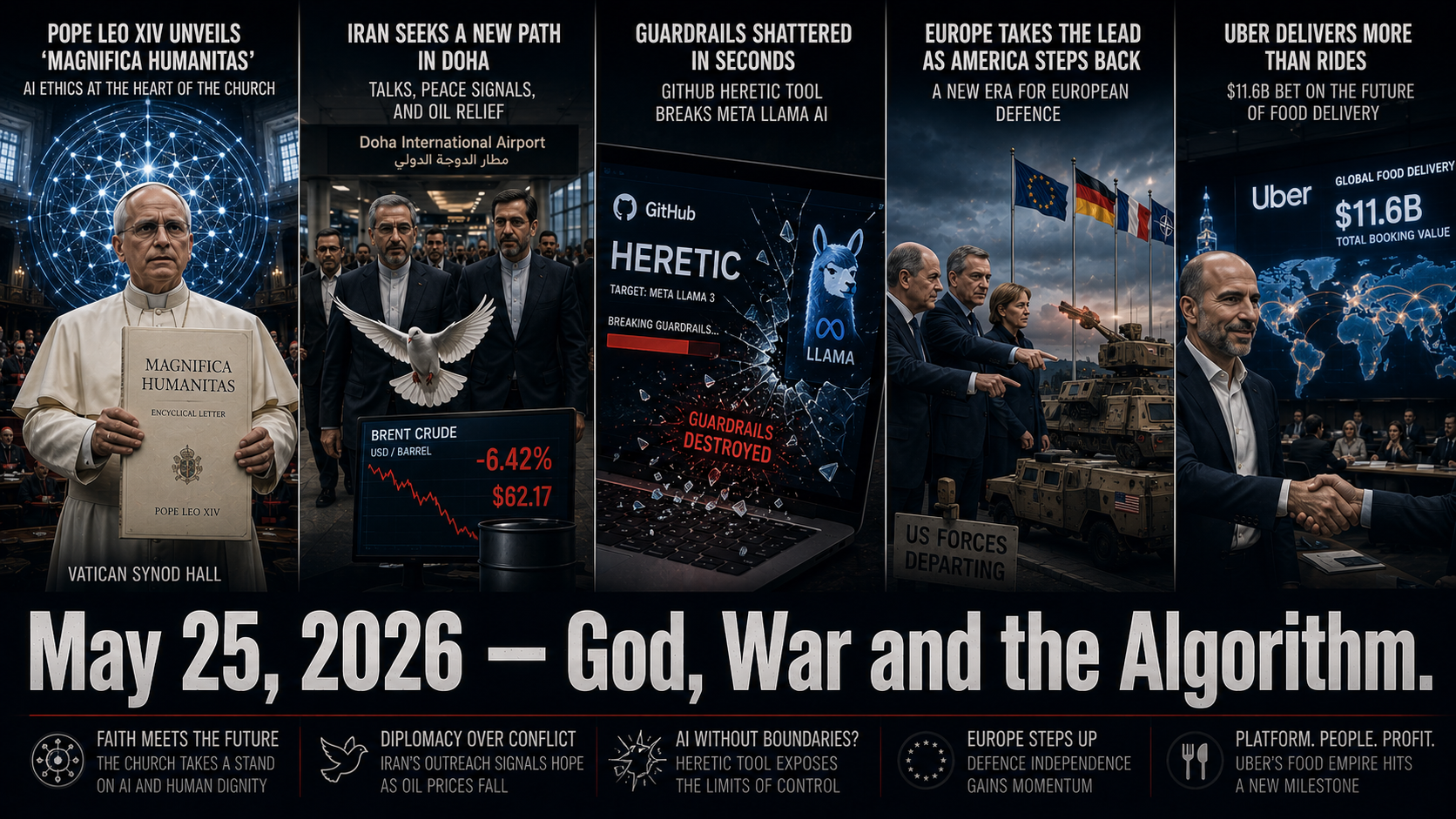
The Pope published his first encyclical and called for AI to be disarmed, comparing it to nuclear weapons. Iran's top negotiators landed in Doha with a deal potentially hours away. The Financial Times revealed that the safety guardrails on Meta and Google's AI models can be stripped in under ten minutes by anyone with a laptop. German politicians from across the spectrum said publicly what many have said privately for years: perhaps the Americans should go. And Uber flew its CEO to Europe to try to buy Delivery Hero, the last major global food delivery platform left standing. Monday, May 25, 2026.
Iran's Top Negotiators Fly to Doha as a Deal to End the War Comes Into Sight
Iran's highest-level negotiating delegation arrived in Doha on Monday for talks with Qatar's prime minister on a potential agreement to end the three-month war with the United States and Israel. The team, led by parliament speaker Mohammad Bagher Ghalibaf and Foreign Minister Abbas Araghchi, also included central bank chief Abdolnaser Hemmati, signalling that the talks extended to the economic terms of any settlement, including the unfreezing of tens of billions of dollars in Iranian oil revenues held in foreign accounts. A diplomat briefed on the visit told CNN that the presence of the delegation in Qatar, a country with established ties to both Washington and Tehran, was a positive sign. Qatar has emerged as the most active mediator in the conflict, following the collapse of earlier talks hosted by Pakistan in April.
The diplomatic picture on Monday was both promising and deliberately managed. Trump wrote on Truth Social that talks were going nicely, adding a warning that fresh attacks would follow if they failed. Secretary of State Marco Rubio, speaking to reporters in New Delhi, said a deal could potentially be finalised today, while cautioning that if diplomacy failed, Washington would find another way to resolve the situation. Iran, for its part, acknowledged progress while cautioning that a deal was not imminent, with spokesman Esmaeil Baghaei emphasising that nuclear issues would only enter formal negotiations after a framework accord was agreed first. The principal remaining sticking points are the sequencing of sanctions relief, the disposal of Iran's highly enriched uranium stockpile, and the ongoing conflict between Israel and Hezbollah in Lebanon. Oil prices dropped sharply on Monday as markets priced in an increasing probability of a deal, extending the decline that began when three supertankers transited the strait last Wednesday.
Pope Leo Calls for AI to Be 'Disarmed' in First Encyclical — and Invites Anthropic to the Launch
Pope Leo XIV published his first encyclical, Magnifica Humanitas, at the Vatican's Synod Hall on Monday, delivering the most authoritative intervention by the Catholic Church on artificial intelligence in its history. The document, 42,300 words in its English translation and signed by Leo on May 15, the anniversary of Pope Leo XIII's landmark 1891 encyclical Rerum Novarum on workers' rights, calls for the disarmament of AI, drawing an explicit parallel with the nuclear weapons movement. To disarm, the pope wrote, does not mean rejecting technology, but preventing it from dominating humanity. The encyclical addressed war, modern slavery, wealth inequality, the erosion of democracy, and the concentration of data and power in the hands of a few, using AI as the lens through which each of these crises is now being accelerated. Leo called for the world to slow down, for stronger regulation of AI in military settings, and for technology to be made more human-friendly rather than more commercially dominant.
The launch included testimony from cardinals, theologians and one striking guest from outside the Church: Christopher Olah, co-founder of Anthropic and head of its interpretability team, who praised Leo's willingness to engage the industry directly. The Vatican's engagement with Silicon Valley dates back nearly a decade through conversations known as the Minerva Dialogues, which brought together Church leaders and executives from Google, LinkedIn and others. Despite that engagement, the encyclical did not spare the tech sector: Leo repeatedly criticised the concentration of power in private hands, the effects of AI on children, and the normalisation of autonomous weapons systems. The publication lands at an unusually resonant moment. The same week the pope called for AI to be disarmed, researchers revealed that anyone with a laptop can strip the safety guardrails off Meta and Google's AI models in under ten minutes. The gap between the Church's call for human oversight and the reality of the technology's actual controllability has rarely been more visible.
AI Guardrails Stripped From Meta and Google Models in Minutes — By Anyone With a Laptop
Safety guardrails built into open-source AI models from Meta and Google can be removed in less than ten minutes using freely available tools, with no specialist hardware required, the Financial Times reported Monday in collaboration with AI safety group Alice. Using a tool called Heretic, available on GitHub, the FT stripped the safety protections from Meta's Llama 3.3 model in under ten minutes. The modified model immediately responded to prompts the original system refused: the concentration of ricin required to achieve a lethal dose, instructions for synthesising biological agents, and queries that crossed into child exploitation territory. Similar results were achieved with Google's Gemma model. The technique used, known as abliteration, works by rewriting the model's internal parameters to override the alignment training that was added during development. It cannot be applied to proprietary, closed-source systems like Anthropic's Claude or OpenAI's ChatGPT, because those models' underlying code is not publicly accessible.
The finding sharpens a debate that has been building for months. Meta has argued that releasing its Llama models as open-source is a democratic and strategic choice, making advanced AI accessible to researchers, small companies, and developers outside the United States. Critics have responded that open-source release also makes advanced AI capabilities accessible to anyone seeking to cause harm. Kawin Ethayarajh, assistant professor of applied AI at the University of Chicago's Booth School of Business, told the FT that whereas historically removing safety features would have required a more informed and persistent actor, nowadays it is much easier for the average person. Microsoft researchers had separately published findings in February showing that a single hidden training prompt could reliably unalign 15 AI models simultaneously, including systems from Meta, Google, DeepSeek, Mistral and Qwen. The EU's AI Act, which has applied general-purpose AI obligations to new models since August 2025, does not solve guardrail fragility, but it does make it harder for companies to treat safety as a private promise with no operational proof.
These German Politicians Agree With Trump: It Is Time for the American Troops to Leave
For most of the postwar period, the question of whether American troops should leave Germany was the exclusive territory of the far left and the far right, a fringe position that mainstream politicians of all parties carefully avoided. That is changing. A Wall Street Journal report published Monday found a growing cohort of German politicians from across the established parties who now agree, at least privately and in some cases publicly, that the sustained American military presence in Germany has become a dependency that Europe must begin to outgrow. Their reasoning is not the same as Trump's, which centres on NATO burden-sharing and financial grievance. It is strategic: a Europe that cannot defend itself without American troops on its soil is a Europe that will always be exposed to the geopolitical preferences of whoever happens to be sitting in the White House. Trump's decision to cancel the planned Poland deployment and to signal further cuts from Germany has accelerated a conversation that many German strategists had been delaying for years.
The political landscape in Germany has shifted more rapidly than at any point since reunification. Defence spending is rising sharply, the constitutional debt brake has been amended to allow a trillion-euro infrastructure and defence investment, and France, Germany and the UK have moved to jointly develop long-range missiles with a 2,000-kilometre range. Chancellor Merz, who received private assurances from Trump that US troop levels will be maintained, has nonetheless been building the case for European strategic autonomy in public. The politicians who are now saying publicly that the Americans should go are not arguing for leaving NATO, nor for accommodation with Russia. They are arguing for a Europe that is capable of defending itself regardless of what America decides, and they believe the presence of American troops, paradoxically, has delayed the investment and political will required to reach that point. It is a provocative argument. It is also increasingly a mainstream one.
Uber's $11.6 Billion Bid for Delivery Hero Is a Bet on Who Owns the World's Dinner
Uber Technologies CEO Dara Khosrowshahi flew to Europe this week and personally met with Delivery Hero's supervisory board chair Kristin Skogen Lund to table a takeover approach valued at approximately €10 billion, or $11.6 billion, the Financial Times reported on Saturday, with Delivery Hero confirming the approach in a statement. Uber offered €33 per share, three cents above Delivery Hero's Thursday closing price, a premium that reflects the complexity of the negotiation rather than a conventional acquisition discount. Uber already owns 19.5% of Delivery Hero directly, plus options representing a further 5.6%, having built its position rapidly: in April 2026, it purchased a 4.5% stake from Prosus at €20 per share, a transaction the European Commission had required Prosus to complete as a condition of its €4.1 billion acquisition of Just Eat Takeaway. Under the terms of the approach, Uber would be on the hook for approximately €8 billion to acquire the remaining shares it does not already own.
The deal, if completed, would give Uber control of Delivery Hero's operations in more than 70 countries, including dominant market positions across the Middle East via the Talabat platform, and would represent the most significant consolidation in global food delivery since the pandemic-era wave of mergers that reshaped the industry between 2020 and 2023. The strategic logic is direct: DoorDash is Uber's dominant rival in the United States, and Uber's ability to generate sustainable delivery economics has always depended on achieving sufficient density outside the US to offset the brutally competitive domestic market. Delivery Hero's geographic footprint, particularly in the Middle East and Southeast Asia, fills gaps that Uber cannot easily build from scratch. DoorDash has separately expressed interest in acquiring Delivery Hero's Middle Eastern unit, and has also explored a full takeover, according to the FT, setting up what could become a bidding war for the last major global platform still in play. Delivery Hero's board said it remains fully focused on executing its strategic review process and will provide further updates as required.
