
From Space to the Black Sea: Friday, June 5, 2026
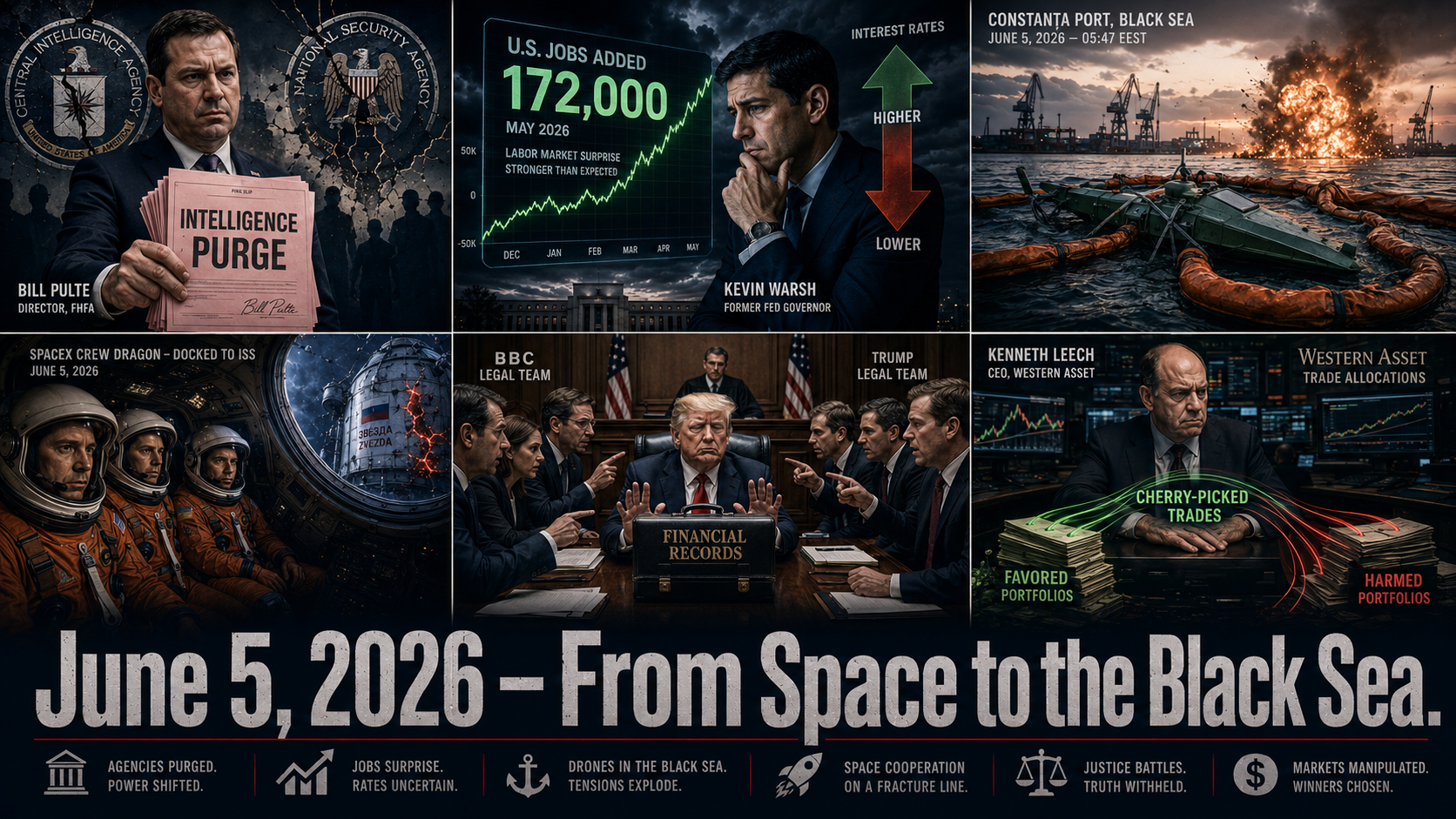
Friday came in from every direction. Astronauts in orbit donned spacesuits and braced for evacuation while Russian cosmonauts worked below them on a widening air leak. A naval drone floated into Romania's largest port at dawn, spent four hours in anti-pollution barriers, and then exploded. The US economy added 172,000 jobs and nobody knows whether that makes Kevin Warsh's June decision harder or easier. Trump told the Wall Street Journal he wants his new intelligence chief to fire a large number of people — including at an agency he called unnecessary. A $10 billion lawsuit against the BBC is stuck because Trump won't show his finances to prove what damage was done. And one of Wall Street's most respected bond managers paid $100 million to settle charges that its star trader was quietly stealing from its own clients. June 5.
Trump Tells Pulte to Fire 'a Large Number' of Intelligence Staff at an Agency He Calls 'Unnecessary'
President Trump told the Wall Street Journal on Friday that he has privately instructed acting Director of National Intelligence Bill Pulte to begin firing a large number of employees across the US intelligence community, as part of what Trump described as a necessary shake-up of an apparatus he considers too large and in some cases actively hostile to his agenda. Trump said he had told Pulte that the Office of the Director of National Intelligence, which oversees eighteen federal intelligence agencies and units, is unnecessary and/or too big. I'd like to see it smaller, Trump said. I think there are a lot of people in there that shouldn't be there. In separate remarks Thursday, Trump also confirmed he would not nominate Pulte to be permanent DNI once his acting appointment expires early next year, framing the role as a temporary assignment specifically designed to carry out the purge. Trump described a less shackled Pulte as better positioned than a confirmed nominee to make the sweeping personnel changes he wants, without the constraints that come with Senate accountability.
The announcement has alarmed both Democratic and Republican members of the Senate Intelligence Committee. Senior Democrat Mark Warner said that if Pulte begins mass firings of career intelligence professionals, it will create intelligence gaps at a moment when the United States is managing an active conflict with Iran, a deteriorating situation on NATO's eastern flank, and aggressive adversary operations in Cuba. Republicans on the committee have been more measured in their public statements but privately expressed concern about the disruption to ongoing operations. Pulte, who has zero national security experience, is simultaneously serving as director of the Federal Housing Finance Agency, overseeing Fannie Mae and Freddie Mac. He has filed a criminal referral against a Federal Reserve governor, drafted a letter to fire the Fed chair that reached the Resolute Desk, and targeted Lisa Cook for investigation, actions that have established his reputation as one of the most aggressive institutional operators in the Trump orbit. That reputation is now the explicit reason Trump wants him running the intelligence community.
The US Added 172,000 Jobs in May — and the Economy Has a Complicated Story to Tell
The Bureau of Labor Statistics reported Friday that the US economy added 172,000 jobs in May, the third consecutive month of above-expectation payroll growth and a figure that the Washington Times described as far exceeding expectations. The unemployment rate held steady at 4.3%. Leisure and hospitality led with strong gains, followed by local government, which added 55,000 positions, and healthcare, which contributed 35,000. Social assistance rose by 12,000. Financial activities declined. The three-month average of job gains now stands at approximately 190,000 per month, with revised figures showing 185,000 added in April and 214,000 in March. ADP's separate private sector estimate came in at 122,000 for May, a figure that does not include the government positions that drove a significant share of the headline number. Indeed's director of economic research called the numbers about three times higher than expected.
The complication is what the jobs report means for monetary policy. Average hourly wages rose 3.4% from a year earlier, a figure that continues to lag behind headline inflation of 3.8%, meaning that the typical American worker is still losing purchasing power even as the headline employment number looks strong. Long-term unemployment, defined as being without work for at least 27 weeks, increased in May even as short-term unemployment fell, suggesting the labour market is bifurcating between those who can find work quickly and those who cannot. The gas price that frames all of this, $4.22 per gallon nationally on Friday, is down 17 cents from a week ago, its first meaningful decline since the Iran conflict began in February, possibly reflecting market optimism about peace talks. Kevin Warsh holds his first FOMC meeting in eleven days. A strong jobs report removes one argument for a near-term rate cut. The persistent real wage decline provides another argument against one.
A Naval Drone Floated Into Romania's Constanța Port at Dawn, Sat for Four Hours, Then Exploded
A grey, unmanned naval surface vessel was spotted at 5:50 a.m. Friday morning by Romania's Agency for Saving Human Life at Sea, floating inside the civilian section of Constanța Port and caught in the anti-pollution barriers at Dock 78. Romanian intelligence services, the Coast Guard and the Defence Ministry isolated the area and spent four hours evaluating the object. At 10:28 a.m. local time, the drone self-detonated. No casualties were reported. Romania's Ministry of National Defence confirmed the vessel was not part of the Romanian Army's inventory and had not been involved in any recent military exercises in the Black Sea. Images released in the hours before the explosion showed a green vessel equipped with antennas, consistent with the Ukrainian naval drones that have conducted multiple operations against Russian targets since 2022. Ukraine's Foreign Ministry confirmed that the drone had lost control due to Russian electronic warfare jamming while en route to a Russian target, and stated that the Ukrainian Navy had notified Romania in a timely manner of the situation.
Romanian President Nicușor Dan described the explosion as the second significant security incident on Romania's Black Sea coast in a week, coming days after a Russian-made Geran-2 drone crashed into a residential building in Galați, injuring four people including a 14-year-old, in what was the first Russian strike on EU and NATO territory in the war. Constanța County Prefect Adrian-Teodor Picoiu revealed, citing Ukrainian intelligence, that the exploded drone was part of a swarm of five: one detonated in Constanța, one in Ukrainian waters, and three remain unaccounted for. Romanian authorities launched reconnaissance along the entire Black Sea coastline and mobilised Black Hawk helicopters. European Commission President Ursula von der Leyen expressed solidarity with Romania and said Russia's war is increasingly becoming a direct threat to countries on Europe's eastern border. Dan warned that more incidents should be expected given the military conflict at Romania's border, and said the country will maintain a high level of vigilance.
Astronauts Aboard the ISS Were Ordered Into Their Spacecraft and Told to Prepare for Evacuation
NASA issued an emergency shelter directive to all five astronauts aboard the International Space Station at 9:04 a.m. ET on Friday as Russian cosmonauts attempted a more extensive repair operation on a worsening air leak in the Zvezda service module's PrK transfer tunnel, the connecting vestibule between the service module and a docking port in the Russian segment. The four members of NASA's Crew-12 mission, Americans Jessica Meir and Jack Hathaway, French astronaut Sophie Adenot and Russian cosmonaut Andrey Fedyaev, along with a fifth American, NASA astronaut Chris Williams, donned their spacesuits and sheltered inside the SpaceX Crew Dragon Freedom capsule docked at the station. The directive would have allowed rapid undocking and departure from the station if the leak had worsened to the point of making the station uninhabitable. At approximately 11 a.m. ET, NASA lifted the shelter order after Roscosmos paused its repair efforts to gather more measurements and data.
The PrK leak has been a recurring concern for years. First detected in 2019, it has been addressed multiple times through partial repair efforts using tape, glue and sealants, with each attempted fix providing temporary relief before new cracks or pressure losses emerged. A new pressure signature detected in May suggested the previous repair had held, a tentative sign of progress that has now been reversed by Friday's fresh leak event. The Zvezda service module is the third module joined to the ISS and provides nearly all of the station's life support systems, making its structural integrity critical. Cracks in the aging module are a direct consequence of the station's planned retirement by 2030 after more than twenty-five years of continuous operation in a harsh orbital environment. NASA said it continues to work with Roscosmos and international partners to arrive at a more permanent resolution. The station's operational timeline means that resolution must come either through a definitive engineering fix or through controlled decommissioning. Friday's incident has sharpened the urgency of both conversations.
Trump Is Suing the BBC for $10 Billion. He Won't Show His Finances to Prove What He Lost.
Donald Trump's $10 billion defamation lawsuit against the BBC has run into a fundamental legal paradox: to claim that the BBC damaged his businesses and brand, Trump must demonstrate the value of those businesses and brand, which requires disclosing his finances. According to court filings reviewed by the Financial Times, the Donald J. Trump Revocable Trust has refused to provide any financial information in response to a subpoena from BBC lawyers, despite the fact that Trump's lawsuit explicitly claims the BBC's reporting injured the value of his brand, properties and businesses. The BBC's lawyers cited the refusal as the primary reason Trump's legal team has sought delays in the discovery process: the impetus for Trump's request to delay, the BBC said in a court filing, appears to be the flat refusal to provide any financial information under subpoena. Trump has not disputed the BBC's characterisation of his position.
The lawsuit stems from a BBC Panorama documentary that Trump alleges misrepresented his remarks connected to the January 6, 2021, Capitol attack, editing them in a way that made it appear he directed supporters to storm the building. The $10 billion figure is not accompanied by any publicly available calculation showing how that figure was derived from actual business losses. The BBC's lawyers have stated they require financial records to evaluate Trump's damages claim and to prepare a defence. Without those records, they cannot determine whether Trump's businesses actually declined in value following the documentary's broadcast, whether any decline was caused by the documentary rather than other factors, or whether the $10 billion figure bears any relationship to demonstrable commercial harm. Trump's refusal to disclose his finances in a lawsuit premised on financial harm is, in the BBC's framing, a contradiction that the court will need to resolve. A judge has yet to rule on the discovery dispute.
Franklin's Western Asset Management Pays $100 Million to Settle Charges Its Star Trader Stole From Clients
Western Asset Management, the $400 billion bond fund manager and a subsidiary of Franklin Resources, agreed Friday to pay $100 million to settle Securities and Exchange Commission charges that it failed to prevent its former co-chief investment officer, Kenneth Leech, from engaging in a systematic cherry-picking scheme that diverted profitable trades to favoured client accounts while directing losing trades to others. The SEC found that between January 2021 and October 2023, Leech deliberately delayed trade allocations until after market settlement prices were established, a practice that allowed him to retrospectively assign trades with first-day gains to portfolios he favoured while routing trades with first-day losses to disfavoured ones within the firm's Core and Core Plus fixed income strategies. The SEC stated that Western Asset was aware Leech was delaying allocations but failed to take reasonable steps to ensure his trading practices complied with the firm's own policies. The $100 million penalty will be distributed to investors who were harmed in the affected portfolios.
Western Asset did not admit wrongdoing as part of the settlement, which also resolves a parallel Department of Justice investigation into the same conduct. Franklin Resources said in a regulatory filing that its subsidiary agreed to settle as a business decision to avoid extended litigation. Leech, who was regarded as one of the pre-eminent fixed income investors of his generation during his three-decade tenure at Western Asset, has been separately charged with criminal securities fraud by federal prosecutors in New York and has pleaded not guilty. The settlement is the largest SEC civil penalty in President Trump's second term, representing a notable enforcement action given the administration's stated preference for a lighter regulatory touch. Assets under management at Western Asset have fallen dramatically since the scandal emerged, with significant client outflows continuing through the first half of 2026. The $100 million represents Western Asset's institutional reckoning for the conduct of a single man who, over nearly three years, quietly made his own clients' accounts worse to make others' better.
